MCQ
Isoclinic lines are the lines joining places with:
- AEqual dip
- BEqual declination
- Cjequal dip and declination
- DNone of these
Generate a complete, print-ready paper with questions like this in minutes — across 16+ boards, with answer keys.
5 amperes of current is passed through a metallic conductor. The charge flowing in one minute in coulombs will be
|
(a) 5 |
(b) 12 |
(c) 1/12 |
(d) 300 |
Two very thin metallic wires placed along X and Y-axis carry equal currents as shown here. AB and CD are lines at 45° with the axes with origin of axes at O. The magnetic field will be zero on the line

|
(a) AB |
(b) CD |
|
(c) Segment OB only of line AB |
(d) Segment OC only of line CD |
A circular loop carrying a current is replaced by an equivalent magnetic dipole. A point on the axis of the loop is
|
(a) An end-on position |
(b) A broad side-on position |
|
(c) Both (a) and (b) |
(d) Neither (a) nor (b) |
A conducting square loop of side L and resistance R moves in its plane with a uniform velocity v perpendicular to one of its sides. A magnetic induction B constant in time and space, pointing perpendicular and into the plane of the loop exists everywhere. The current induced in the loop is
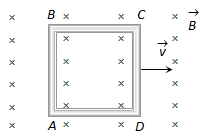
|
(a) |
(b) |
(c) |
(d) Zero |
When the temperature of silicon sample is increased from 27℃ to 100℃, the conductivity of silicon will be
|
(a) Increased |
(b) Decreased |
(c) Remain same |
(d) Zero |
Two concentric coils each of radius equal to 2π cm are placed at right angles to each other. 3 ampere and 4 ampere are the currents flowing in each coil respectively. The magnetic induction in  at the centre of the coils will be (
|
(a) 5 |
(b) 7 |
(c) 12 |
(d) |
In case of NPN-transistors the collector current is always less than the emitter current because
|
(a) Collector side is reverse biased and emitter side is forward biased |
|
(b) After electrons are lost in the base and only remaining ones reach the collector |
|
(c) Collector side is forward biased and emitter side is reverse biased |
|
(d) Collector being reverse biased attracts less electrons |
X-rays were discovered by
| (a) Becquerel | (b) Roentgen | (c) Marie Curie | (d) Von Laue |


