Question
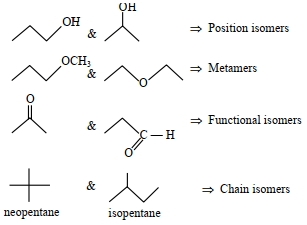
Isomerism shown by
$C{H_3} - {(C{H_2})_3} - O - C{H_3}$
$C{H_3} - C{H_2} - O - C{H_2} - C{H_2} - C{H_3}$
$C{H_3} - \mathop {CH}\limits_{\mathop {|\,\,\,\,}\limits_{C{H_3}} } - O - C{H_2} - C{H_3}$ is
$C{H_3} - {(C{H_2})_3} - O - C{H_3}$
$C{H_3} - C{H_2} - O - C{H_2} - C{H_2} - C{H_3}$
$C{H_3} - \mathop {CH}\limits_{\mathop {|\,\,\,\,}\limits_{C{H_3}} } - O - C{H_2} - C{H_3}$ is
Generate a complete, print-ready paper with questions like this in minutes — across 16+ boards, with answer keys.
[Atomic numbers of $Cr =24$ and $Mn =25$ ]
$(A)$ $Cr ^{2+}$ is a reducing agent
$(B)$ $Mn ^{3+}$ is an oxidizing agent
$(C)$ Both $Cr ^{2+}$ and $Mn ^{3+}$ exhibit $d^4$ electronic configuration
$(D)$ When $Cr ^{2+}$ is used as a reducing agent, the chromium ion attains $d^5$ electronic configuration

