Question
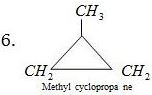
Isomers have essentially identical

Answer

d
(d) Five isomers of ${C_4}{H_8}$

1. $\mathop {C{H_3} - \mathop {\mathop {C{\mkern 1mu} {\mkern 1mu}  = {\mkern 1mu} {\mkern 1mu} {\mkern 1mu} }\limits^{|{\kern 1pt} {\kern 1pt} {\kern 1pt} \,\,\,\,\,{\kern 1pt} {\kern 1pt} {\kern 1pt} } }\limits^{C{H_{3\,\,}}\,\,\,} C{H_2}}\limits_{{\text{Isobutene}}} $

2. $\mathop {C{H_3}C{H_2} - CH = C{H_2}}\limits_{{\text{1 - butene}}} $

3. $\mathop {\begin{array}{*{20}{c}}
  {{H_2}C{\mkern 1mu}  - C{H_2}} \\ 
  {|{\mkern 1mu} {\mkern 1mu} {\mkern 1mu} {\mkern 1mu} \,\,\,\,\,\,{\mkern 1mu} {\mkern 1mu} {\mkern 1mu} {\mkern 1mu} {\mkern 1mu} |} \\ 
  {{H_2}C - C{H_2}} 
\end{array}}\limits_{Cyclobu\tan e} {\mkern 1mu} $

4. $\underset{Trans-2-butene}{\mathop{\begin{matrix}
   ^{C{{H}_{3}}}  \\
   _{H}  \\
\end{matrix}\begin{matrix}
   \text{ }\!\!\backslash\!\!\text{ }  \\
   /  \\
\end{matrix}C=C\begin{matrix}
   /  \\
   \text{ }\!\!\backslash\!\!\text{ }  \\
\end{matrix}_{C{{H}_{3}}}^{H}}}\,$

5. $\underset{cis-2-butene}{\mathop{\begin{matrix}
   ^{C{{H}_{3}}}  \\
   _{H}  \\
\end{matrix}\begin{matrix}
   \text{ }\!\!\backslash\!\!\text{ }  \\
   /  \\
\end{matrix}C=C\begin{matrix}
   /  \\
   \text{ }\!\!\backslash\!\!\text{ }  \\
\end{matrix}_{C{{H}_{3}}}^{C{{H}_{3}}}}}\,$
Need a full question paper?

Generate a complete, print-ready paper with questions like this in minutes — across 16+ boards, with answer keys.

Start Generating Free

Similar questions

Which of the following represents the most oxidized form of hydrocarbon
The $H - H$ bond energy is $ 430\, kJ $ $mol$ and $Cl - Cl$ bond energy is $240\,kJ\,mo{l^{ - 1}}.\,\,\Delta H$ for $HCl$ is $ - 90\,kJ$. The $H - Cl$ bond energy is about.....$kJ\,mo{l^{ - 1}}$
The decreasing order of nucleophilicity among the nucleophiles is

$(I)$ $\begin{array}{*{20}{c}}
  {C{H_3} - C - {O^ - }} \\ 
  {\,\,\,\,\,\,||\,\,} \\ 
  {\,\,\,\,\,\,O\,\,} 
\end{array}$

$(II)$ $CH_3O^-$

$(III)$ ${C_6}{H_5}{O^\Theta }$

$(IV)$ (image)
${H_2}S$ react with ${O_2}$ to form
An organometallic compound amongst the following is
For reaction $A \to B$, the rate constant $k_1 = A_1    e^{-Ea_{1} /(RT)}$ and for the reaction $X \to Y$ the rate constant $k_2 = A_2 e^{-Ea_2 /(RT)}$ . If $A_1 = 10^{8}, \,\,A_2 = 10^{10}$ and $E_{a_1} = 600\ cal/mol$, $E_{a_2} = 1800\, cal/mol$, then the temperature at which $k_1 = k_2$ is (Given : $R = 2 \,cal/K-mol$)
Which of the following amine (s) show (s) positive carbylamines test?Image
Choose the correct answer from the options given below :
Who synthesised the first organic compound urea in the laboratory
Consider the reaction $M_{(aq)}^{n + } + n{e^ - } \to {M_{(s)}}$. The standard reduction potential values of the elements ${M_1},\,{M_2}$ and ${M_3}$ are $ - 0.34V,\, - \,3.05\,V$ and $ - 1.66\,V$ respectively. The order of their reducing power will be
Calculate the hydrolysis constant of the salt containing $N{O_2}$. Given the ${K_a}$ for $HN{O_2}$ $ = 4.5 \times {10^{ - 10}}$