MCQ
Isopropyl alcohol heated at ${300\,^o}C$ with copper catalyst to form
  • Acetone
  • B
    Dimethyl ether
  • C
    Acetaldehyde
  • D
    Ethane

Answer

Correct option: A.
Acetone
a
(a)Secondary alcohol on dehydrogenation gives acetone

$C{{H}_{3}}-\underset{\underset{OH\,\,}{\mathop{|\,\,\,\,\,\,}}\,}{\mathop{CH}}\,-C{{H}_{3}}\underset{{{300}\,^{o}}C}{\mathop{\xrightarrow{Cu}}}\,\,C{{H}_{3}}-\underset{\underset{O}{\mathop{||}}\,}{\mathop{C}}\,-C{{H}_{3}}+{{H}_{2}}$

Need a full question paper?

Generate a complete, print-ready paper with questions like this in minutes — across 16+ boards, with answer keys.
Start Generating Free

Similar questions

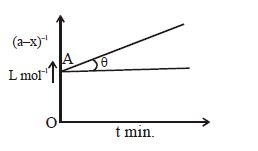
Following is the graph between $(a-x)^{-1}$ and time $t$ for second order reaction if $\theta  = {\tan ^{ - 1}}\left( {\frac{1}{2}} \right)$ ; $OA = 2\,L\,mol^{-1}$ then rate at the start of reation will be $ [$ in $L\, mol^{-1}\,min^{-1}]$
$C{H_3}COOH\mathop {\xrightarrow{\Delta }}\limits_{{P_2}{O_5}} X$ . Identify $X$
What is the angle between any two bonds in methane molecule?
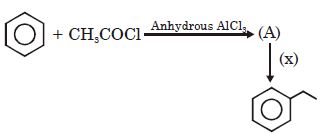
Reagent  $(x)$  can be
Identify $Z$ in $CH_3CH_2CH_2Br$ $\xrightarrow{{Aq.NaOH}}X\xrightarrow{{A{l_2}{O_3}}}Y\xrightarrow{{C{l_2}/{H_2}O}}Z$
The initial rate for a first order reaction is $0.6932 \times10^{-2}\,mol\, L^{-1}\, \min^{-1}$ and the initial conc. of the reactant is $0.1\, M$. Then $t_{1/2}$ is equal to ...... $\min $
Which of the following reaction, does not give chloro benzene as a product ?
A certain quantity of electricity is passed through an aqueous solution of $AgN{O_3}$ and cupric salt solution connected in series. The amount of $Ag$ deposited is $1.08\,gm$, the amount of copper deposited is ............. $\mathrm{g}$ (atomic weight of $Cu = 63.5$ ; $Ag = 108$)
For each of the following pairs of $E_2$ reaction, select the one that occurs with  the greater rate constant.

$(1)$ $C{H_3}C{H_2}C{H_2}Cl + $ $\begin{array}{*{20}{c}}
  {\,\begin{array}{*{20}{c}}
  {\,\,\,\,\,\,\,\,\,\,C{H_3}} \\ 
  {\,\,\,|} 
\end{array}} \\ 
  {C{H_3} - C - {O^ - }} \\ 
  {\,\,\,|} \\ 
  {\,\,\,\,\,\,\,\,\,\,C{H_3}} 
\end{array}$                      $(2)$  $C{H_3}C{H_2}C{H_2}I + $$\begin{array}{*{20}{c}}
  {\,\begin{array}{*{20}{c}}
  {\,\,\,\,\,\,\,\,\,\,C{H_3}} \\ 
  {\,\,\,|} 
\end{array}} \\ 
  {C{H_3} - C - {O^ - }} \\ 
  {\,\,\,|} \\ 
  {\,\,\,\,\,\,\,\,\,\,C{H_3}} 
\end{array}$

$(3)$  $\begin{array}{*{20}{c}}
  {{H_3}C - CH - C{H_3}} \\ 
  {|\,\,\,\,} \\ 
  {Br\,\,\,} 
\end{array}$  $+CH_3O^-$                      $(4)$  $\begin{array}{*{20}{c}}
  {{H_3}C - CH - C{H_3}} \\ 
  {|\,\,\,\,} \\ 
  {Br\,\,\,} 
\end{array}$ $+CH_3S^-$

For an endothermic reaction, energy of activation is $E_a$ and enthalpy of reaction is $\Delta H$ (both of these in $kJ/mol$). Minimum value of $E_a$ will be