Question
It is a common observation that rain clouds can be at about a kilometre altitude above the ground.
Rate of change of momentum is force. Estimate how much force such a drop would exert on you.
Answer

Key concept: This problem can be solved by kinematic equations of motion and Newton’s second law that $\text{F}_\text{ext}=\frac{\text{dp}}{\text{dt}}$ will be used, where dp is change in momentum over time dt. Force exerted by a rain drop is$\text{F}=\frac{\text{Change in momentum}}{\text{Time}}=\frac{\text{p}-0}{\text{t}}$
$=\frac{4.7\times10^{-3}}{2.8\times10^{-5}}=168\text{N}$

Need a full question paper?

Generate a complete, print-ready paper with questions like this in minutes — across 16+ boards, with answer keys.

Start Generating Free

Similar questions

Give the formula to find the no. of moles of gas.
What is the value of restitution coefficient in a perfectly elastic collision?
If the sum of all the forces acting on a body is zero, is it necessarily in equilibrium? If the sum of all the forces on a particle is zero, is it necessarily in equilibrium?
Relative to which axis the moment of inertia of the body is minimum?
Find the increase in pressure required to decrease the volume of a water sample by 0.01%. Bulk modulus of water = $2.1 \times 10^9N/m^2$.
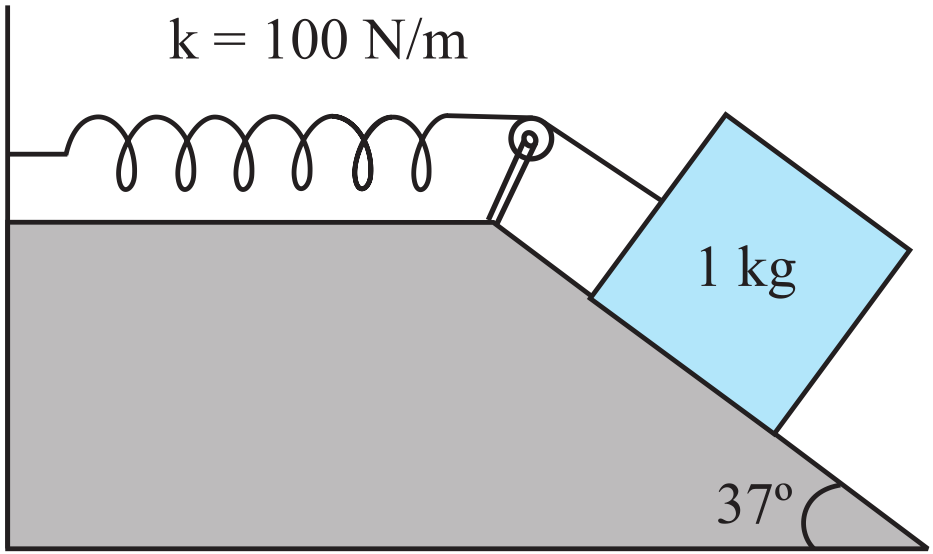
A $1kg$ block situated on a rough incline is connected to a spring of spring constant $100Nm^{-1}$ as shown in. The block is released from rest with the spring in the unstretched position. The block moves 10cm down the incline before coming to rest. Find the coefficient of friction between the block and the incline. Assume that the spring has a negligible mass and the pulley is frictionless.
When a body accelerates by at, what is the velocity after time ‘t', when it starts from rest?
One of your friends argues that he has read in the previous chapters that there can be no electric field inside a conductor. And hence there can be no current through it. What is the fallacy of this argument?
If $f=x^2$, relative error in $f$, then how many times the relative error would be in $x$ ?
An object is moving on a frictionless horizontal plane. Is there any force acting on it in the following conditions when the body (1) is moving with same velocity (ii) is moving with the same speed?