Question
It is found experimentally that $13.6 eV$ energy is required to separate a hydrogen atom into a proton and an electron. Compute the orbital radius and the velocity of the electron in a hydrogen atom.

Answer

Total energy of the electron in hydrogen atom is $-13.6 eV =$ $-13.6 \times 1.6 \times 10^{-19} J =-2.2 \times 10^{-18} J$. Thus from Eq. (12.4), we have
$
E=-\frac{e^2}{8 \pi \varepsilon_0 r}=-2.2 \times 10^{-18} J
$
This gives the orbital radius
$
\begin{aligned}
r & =-\frac{e^2}{8 \pi \varepsilon_0 E}=-\frac{\left(9 \times 10^9 N m ^2 / C ^2\right)\left(1.6 \times 10^{-19} C \right)^2}{(2)\left(-2.2 \times 10^{-18} J \right)} \\
& =5.3 \times 10^{-11} m .
\end{aligned}
$
The velocity of the revolving electron can be computed from Eq. (12.3) with $m=9.1 \times 10^{-31} kg$,
$
v=\frac{e}{\sqrt{4 \pi \varepsilon_0 m r}}=2.2 \times 10^6 m / s
$

Need a full question paper?

Generate a complete, print-ready paper with questions like this in minutes — across 16+ boards, with answer keys.
Start Generating Free

Similar questions

A resistance is connected to an AC source. If a capacitor is included in the series circuit, will the average power absorbed by the resistance increase or decrease? If an inductor of small inductance is also included in the series circuit, will the average power absorbed increase or decrease further?
Write Snell's law and derive its general equation.
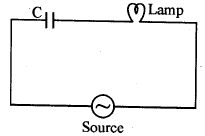
An electric lamp having coil of negligible inductance connected in series with a capacitor and an AC source is glowing with certain brightness. How does the brightness of the lamp change on reducing the (i) capacitance, and (ii) the frequency? Justify your answer.

A neutron having kinetic energy 12.5eV collides with a hydrogen atom at rest. Nelgect the difference in mass between the neutron and the hydrogen atom and assume that the neutron does not leave its line of motion. Find the possible kinetic energies of the neutron after the event.
Obtain expression of self inductance of a solenoid having length $l$ and cross-section of area A .
Write down the Coulomb's law and explain its scalar form.
In an electrolyte, the positive ions move from left to right and the negative ions from right to left. Is there a net current? If yes, in what direction?
A current of 10A is established in a long wire along the positive z-axis. Find the magnetic field $\overrightarrow{\text{B}}$ at the point (1m, 0, 0).
In the Rutherford's nuclear model of the atom, the nucleus (radius about $10^{-15} m$ ) is analogous to the sun about which the electron move in orbit (radius $\approx 10^{-10} m$ ) like the earth orbits around the sun. If the dimensions of the solar system had the same proportions as those of the atom, would the earth be closer to or farther away from the sun than actually it is? The radius of earth's orbit is about $1.5 \times 10^{11} m$. The radius of sun is taken as $7 \times 10^8 m$.
A circular coil of N turns and radius R carries a current I. It is unwound and rewound to make another coil of radius R/2, current I remaining the same. Calculate the ratio of the magnetic moments of the new coil and the original coil.