Question
It is found that yellow light does not eject photoelectrons from a metal. Is it advisable to try with orange light? With green light?

Answer

Photoelectrons are emitted from a metal's surface if the frequency of incident radiation is more than the threshold frequency of the given metal surface. As yellow light does not eject photoelectrons from a metal it means that the threshold frequency of the metal is more than the frequency of yellow light. Since the frequency of orange light is less than the frequency of yellow light, therefore it will not be able to eject photoelectrons from the metal's surface. The frequency of green light is more than the frequency of yellow light. Hence, when it is incident on the metal surface, it will eject electrons from the metal.
Need a full question paper?

Generate a complete, print-ready paper with questions like this in minutes — across 16+ boards, with answer keys.

Start Generating Free

Similar questions

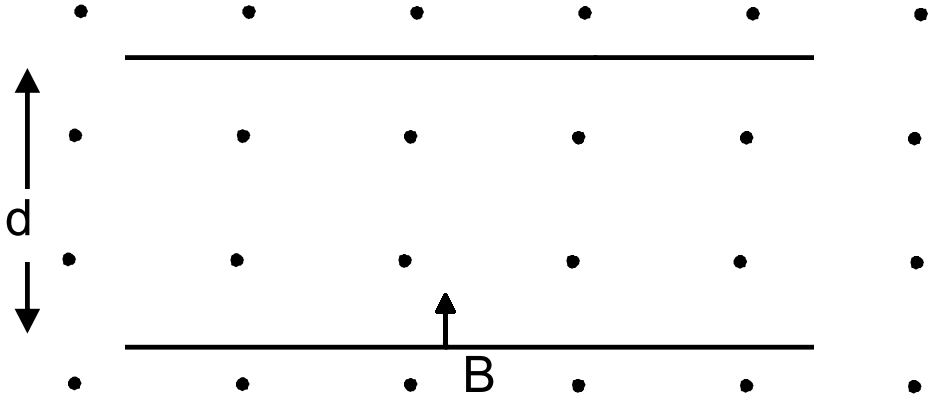
An electron is emitted with negligible speed from the negative plate of a parallel$-$plate capacitor charged to a potential difference $V.$ The separation between the plates is $d$ and $a$ magnetic field Bexists in the space, as shown in the figure. Show that the electron will fail to strike the upper plates if $\text{d}>\Big(\frac{2\text{m}_\text{e}\text{v}}{\text{eB}^2}\Big)^{\frac{1}{2}}.$

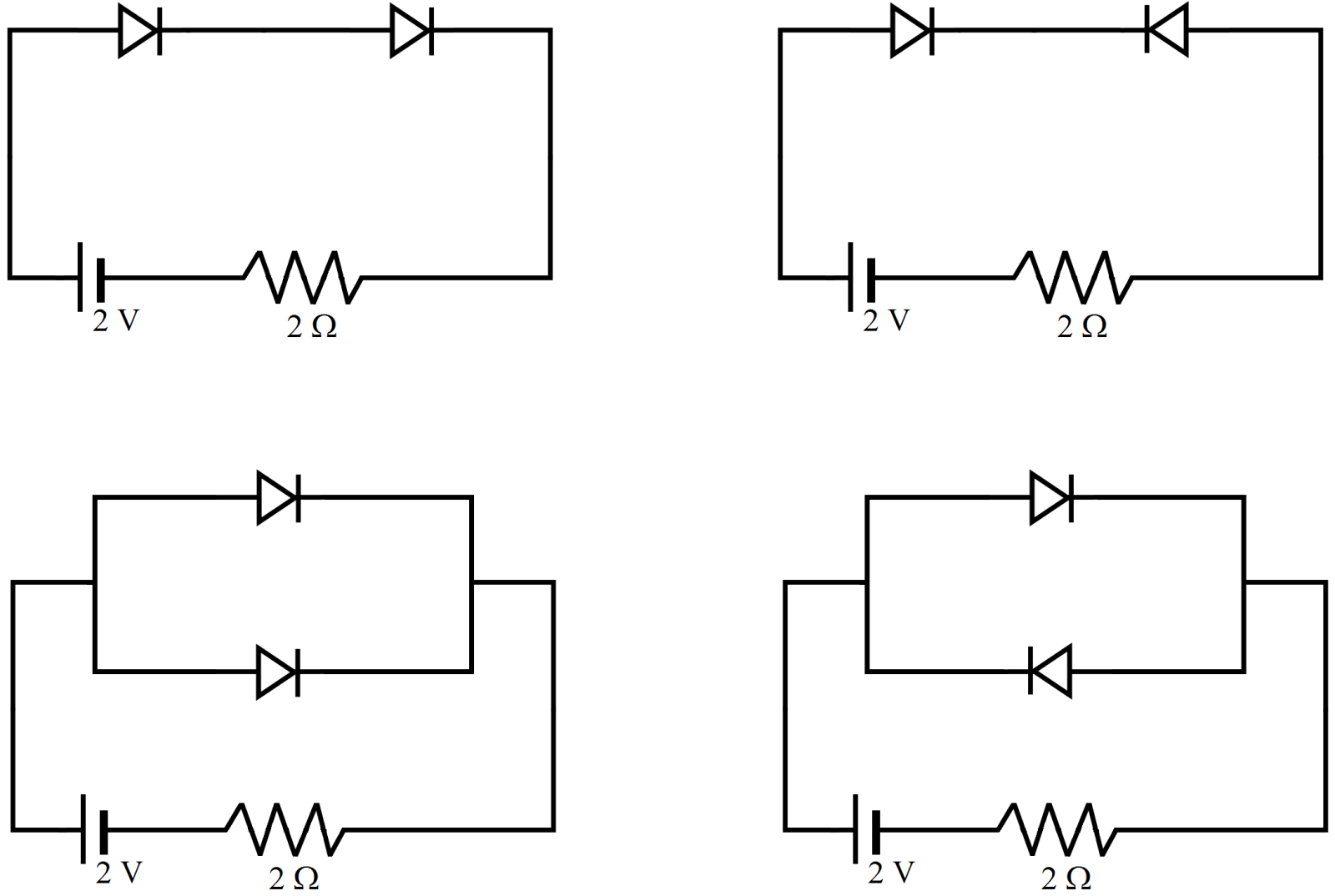
Find the currents through the resistances in the circuits shown in figure.
A table with smooth horizontal surface is fixed in a cabin that rotates with a uniform angular velocity $\omega$ in a circular path of radius R (In figure). A smooth groove AB of length L(<$\theta$ with the radius OA of the circle in which the cabin rotates. A small particle is kept at the point A in the groove and is released to move along AB. Find the time taken by the particle to reach the point B.
  1. Two insulated charged copper spheres $A$ and $B$ have their centres separated by a distance of $50 \ cm$. What is the mutual force of electrostatic repulsion if the charge on each is $6.5 \times 10^{-7} C?$ The radii of A and B are negligible compared to the distance of separation.
  2. What is the force of repulsion if each sphere is charged double the above amount, and the distance between them is halved?
How many is energy states are present in one mole of sodium vapour? Are they all filled in normal conditions? "How many $3s$ energy states are present in one mole of sodium vapour? Are they all filled in normal conditions?
Explain with a neat diagram construction and working of a compound microscope. Obtain an expression for its magnifying power.
  1. Using Biot-Savart’s law, derive the expression for the magnetic field in the vector form at a point on the axis of a circular current loop.
  2. What does a toroid consist of ? Find out the expression for the magnetic field inside a toroid for N turns of the coil having the average radius r and carrying a current I. Show that the magnetic field in the open space inside and exterior to the toroid is zero.
Find the maximum magnifying power of a compound Microscope having a $25$ diopter lens as the objective, a $5$ diopter lens as the eyepiece and the separation $30\ cm$ between the two lenses. The least distance for clear vision is $25\ cm$.
  1. Draw a labelled ray diagram to obtain the real image formed by an astronomical telescope in normal adjustment position. Defineits magnifying power.
  2. You are given three lenses of power 0.5 D, 4 D and 10 D to design a telescope.
  1. Which lenses should he used as objective and eyepiece? Justify your answer.
  2. Why is the aperture of the objective preferred to be large?
Two large conducting plates are placed parallel to each other with a separation of $2.00\ cm$ between them. An electron starting from rest near one of the plates reaches the other plate in $2.00$ microseconds. Find the surface charge density on the inner surfaces.