Question
It is found that yellow light does not eject photoelectrons from a metal. Is it advisable to try with orange light? With green light?

Answer

Photoelectrons are emitted from a metal's surface if the frequency of incident radiation is more than the threshold frequency of the given metal surface. As yellow light does not eject photoelectrons from a metal it means that the threshold frequency of the metal is more than the frequency of yellow light. Since the frequency of orange light is less than the frequency of yellow light, therefore it will not be able to eject photoelectrons from the metal's surface. The frequency of green light is more than the frequency of yellow light. Hence, when it is incident on the metal surface, it will eject electrons from the metal.

Need a full question paper?

Generate a complete, print-ready paper with questions like this in minutes — across 16+ boards, with answer keys.
Start Generating Free

Similar questions

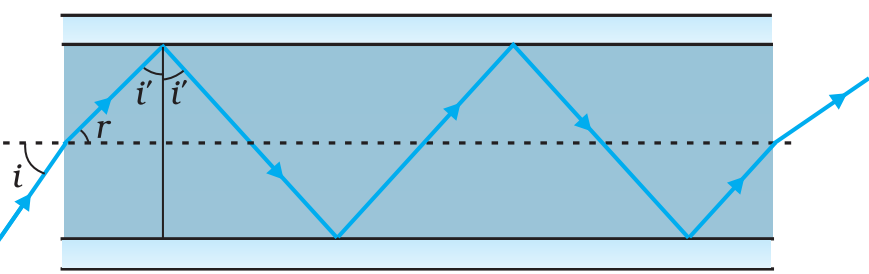
  1. a cross - section of a ‘light pipe’ made of a glass fibre of refractive. The outer covering of the pipe is made of a material of refractive. What is the range of the angles of the incident rays with the axis of the pipe for which total reflections inside the pipe take place, as shown in the figure.
  2. What is the answer if there is no outer covering of the pipe?

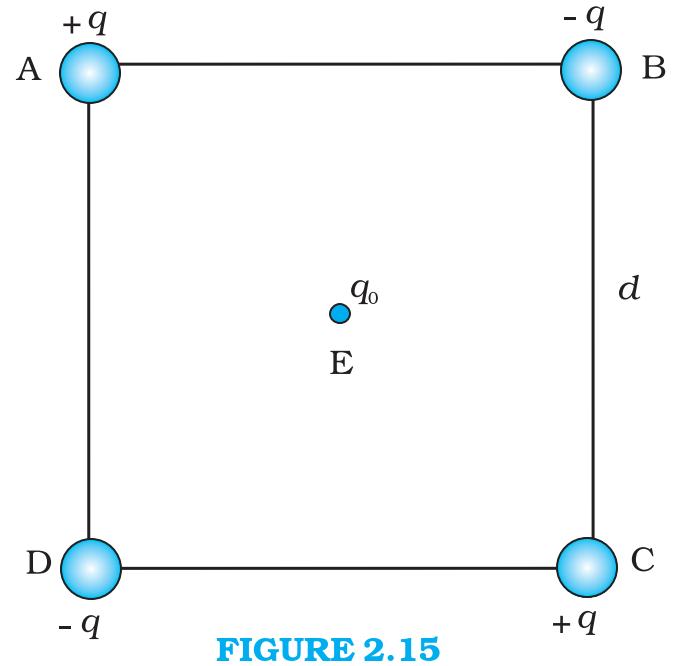
Four charges are arranged at the corners of a square $ABCD$ of side $d$, as shown in Fig. 2.15.(a) Find the work required to put together this arrangement. (b) A charge $q_0$ is brought to the centre $E$ of the square, the four charges being held fixed at its corners. How much extra work is needed to do this?
Image
A rod, when suspended in a magnetic field, stays in the east-west direction. Can we be sure that the field is in the east-west direction? Can it be in the north-south direction?
A paperweight in the form of a hemisphere of radius 3.0cm is used to hold down a printed page. An observer looks at the page vertically through the paperweight. At what height above the page will the printed letters near the centre appear to the observer?
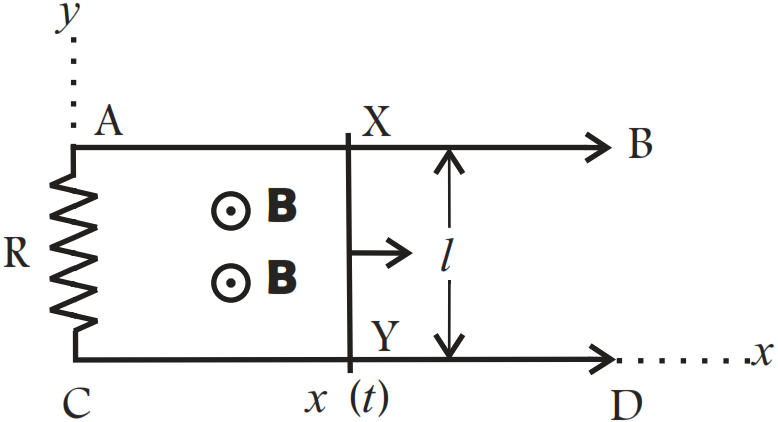
A conducting wire XY of mass m and neglibile resistance slides smoothly on two parallel conducting wires as shown in Fig. The closed circuit has a resistance R due to AC. AB and CD are perfect conductors. There is a magnetic field $\text{B}=\text{B}(\text{t})\hat{\text{k}}$.

  1. Write down equation for the acceleration of the wire XY.
  2. If B is independent of time, obtain v(t), assuming v(0) = u0.
  3. For (b), show that the decrease in kinetic energy of XY equals the heat lost in R.
A long, straight wire carrying a current of 30A is placed in an external, uniform magnetic field of 4.0 × 10⁻⁴T parallel to the current. Find the magnitude of the resultant magnetic field at a point 2.0cm away from the wire.
A particle stays at rest as seen in a frame. We can conclude that:
  1. The frame is inertial.
  2. Resultant force on the particle is zero.
  3. The frame may be inertial but the resultant force on the particle is zero.
  4. The frame may be non-inertial but there is a non-zero resultant force.
The magnetic field B and the magnetic intensity H in material are found to be 1.6T and 1000A/m reepectively. Calculate the relative permeability $\mu_\text{r}$ and the susceptibility x of the material.
4 × 10²³ tritium atoms are contained in a vessel. The half-life of decay tritium nuclei is 12.3y. Find:
  1. The activity of the sample.
  2. The number of decay in the next 10 hours.
  3. The number of decays in the next 6.15y.
Answer the following Questions.

  1. Find expressions for the force and torque on an electric dipole kept in a uniform electric field.

OR

An electric dipole is held in a uniform electric field. (i) Using suitable diagram show that it does not undergo any translatory motion, and (ii) derive an expression for torque acting on it and specify its direction.

  1. Derive an expression for the work done in rotating a dipole from the angle $\theta_0$ to $\theta_1$ in a uniform electric field E.

​​​​​​​OR

  1. Define torque acting on a dipole of dipole moment $\vec{\text{p}}$ placed in a uniform electric field $\vec{\text{E}}.$ Express it in the vector form and point out the direction along which it acts.
  2. What happens if the field is non-uniform?
  3. What would happen if the external field $\vec{\text{E}}$ is increasing (i) parallel to $\vec{\text{p}}$ and (ii) anti-parallel to $\vec{\text{p}}?$