Question
It is known that, if the interest is compounded continuously, the principal changes at the rate equal to the product of the rate of bank interest per annum and the principal. Let $P$ denotes the principal at any time $t$ and rate of interest be $r\%$ per annum.

Based on the above information, answer the following question.
  1. Find the value of $\frac{\text{dP}}{\text{dt}}.$
  1. $\frac{\text{Pr}}{1000}$
  2. $\frac{\text{Pr}}{100}$
  3. $\frac{\text{Pr}}{10}$
  4. $\text{Pr}$
  1. If $P_0$ be the initial principal, then find the solution of differential equation formed in given situation.
  1. $\log\Big(\frac{\text{P}}{\text{P}_0}\Big)=\frac{\text{rt}}{100}$
  2. $\log\Big(\frac{\text{P}}{\text{P}_0}\Big)=\frac{\text{rt}}{10}$
  3. $\log\Big(\frac{\text{P}}{\text{P}_0}\Big)=\text{rt}$
  4. $\log\Big(\frac{\text{P}}{\text{P}_0}\Big)=100\text{rt}$
  1. If the interest is compounded continuously at $5\%$ per annum, in how many years will $₹ 100$ double it self $?$
  1. $12.728$ years
  2. $14.789$ years
  3. $13.862$ years
  4. $15.872$ years
  1. At what interest rate will $₹ 100$ double itself in $10$ years$?\ (\log_\text{e}2 = 0.6931 ).$
  1. $9.66\%$
  2. $8.239\%$
  3. $7.341\%$
  4. $6.931\%$
  1. How much will $₹ 1000$ be worth at $5\%$ interest after $10$ years$?\ (e^{0.5} = 1.648).$
  1. $₹ 1648$
  2. $₹ 1500$
  3. $₹ 1664$
  4. $₹ 1572$

Answer

  1. $(b)\ \frac{\text{Pr}}{100}$
Solution:
Here, $P$ denotes the principal at any time $t$ and the rate of interest be $r\%$ per annum compounded continuously, then according to the law given in the problem, we get
$\frac{\text{dP}}{\text{dt}}=\frac{\text{Pr}}{100}$
  1. $(a)\ \log\Big(\frac{\text{P}}{\text{P}_0}\Big)=\frac{\text{rt}}{100}$
Solution:
We have, $\frac{\text{dP}}{\text{dt}}=\frac{\text{Pr}}{100}$
$\Rightarrow\frac{\text{dP}}{\text{P}}=\frac{\text{r}}{100}\text{dt}$
$\Rightarrow\int\frac{\text{1}}{\text{P}}\text{dP}=\frac{\text{r}}{100}\int\text{dt}$
$\Rightarrow\log\text{P}=\frac{\text{rt}}{100}+\text{C}...\text{(i)}$
$\text{At t}=0,\ \ \text{P}=\text{P}_0.$
$\therefore\ \ \text{C}=\log\text{P}_0$
So, $\log\text{P}=\frac{\text{rt}}{100}+\log\text{p}_0$
$\Rightarrow\log\Big(\frac{\text{P}}{\text{P}_0}\Big)=\frac{\text{rt}}{100}...\text{(ii)}$
  1. $(c)\ 13.862$ years
Solution:
We have, $r = 5, P_{0 }= ₹ 100$ and $P = ₹ 200 = 2P_0 $
Substituting these values in $(2),$ we get
$\log2=\frac{5}{100}\text{t}$
$\Rightarrow\text{t}=20\log_\text{e}$
$2 = 20 \times 0.6931\ \text{years} = 13.862\ \text{years}$
  1. $(d)\ 6.931\%$
Solution:
We have,
$P_0 = ₹ 100, P = ₹ 200 = 2P_0$​​​​​​​ and $t = 10$ years Substituting these values in $(2),$ we get
$\log2\frac{10\text{r}}{100}\Rightarrow\text{r}=10\log2=10\times0.6931=6.931$
  1. $(a)\ ₹ 1648$
Solution:
We have $P_0 = ₹ 1000, r = 5$ and $t = 10$ Substituting these values in $(2),$ we get
$\log\Big(\frac{\text{P}}{1000}\Big)=\frac{5\times10}{100}=\frac{1}{2}=0.5$
$\Rightarrow\frac{\text{P}}{1000}=\text{e}^{0.5}$
$\Rightarrow\text{ P} = 1000 × 1.648 = ₹ \ 1648$

Need a full question paper?

Generate a complete, print-ready paper with questions like this in minutes — across 16+ boards, with answer keys.

Start Generating Free

Similar questions

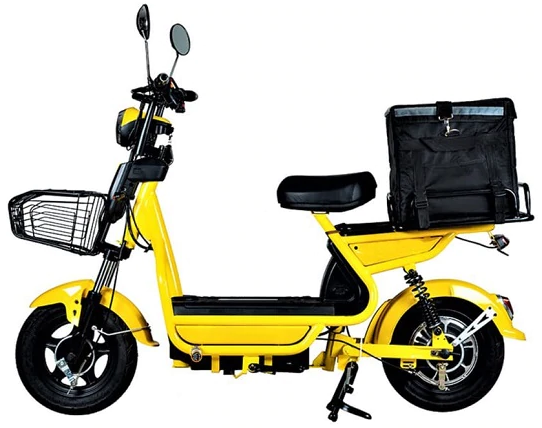
An owner of an electric bike rental company have determined that if they charge customers $₹ x$ per day to rent a bike, where $50 < x < 200,$ then number of bikes $(n),$ they rent per day can be shown by linear function $n(x) = 2000 - 10x$. If they charge $₹ 50$ per day or less, they will rent all their bikes. If they charge $₹ 200$ or more per day, they will not rent any bike.

Based on the above information, answer the following questions.
  1. Total revenue $R$ as a function of $x $ can be represented as.
  1. $2000x - 10x^2$
  2. $2000x + 10x^2$
  3. $2000 - 10x$
  4. $2000 - 5x^2$
  1. If $R(x)$ denote the revenue, then maximum value of $R(x)$ occur when x equals.
  1. $10$
  2. $100$
  3. $1000$
  4. $50$
  1. At $x = 260,$ the revenue collected by the company is.
  1. $₹ 10$
  2. $₹ 500$
  3. $₹ 0$
  4. $₹ 1000$
  1. The number of bikes rented per day, if $x = 105$ is.
  1. $₹ 40,000$
  2. $₹ 50,000$
  3. $₹ 75,000$
  4. $₹ 1,00,000$
Maximum revenue collected by company is.
  1. $850$
  2. $900$
  3. $950$
  4. $1000$
Order: The order of a differential equation is the order of the highest order derivative appearing in the differential equation.
Degree: The degree of differential equation is the power of the highest order derivative, when differential coefficients are made free from radicals and fractions. Also, differential equation must be a polynomial equation in derivatives for the degree to be defined.
Based on the above information, answer the following questions.
  1. Find the degree of the differential equation $2\frac{\text{d}^2\text{y}}{\text{dx}^2}+3\sqrt{1-\Big(\frac{\text{dy}}{\text{dx}}\Big)^2-\text{y}=0}.$
  1. $3$
  2. $4$
  3. $3$
  4. $1$
  1. Order and degree of the differential equation $\text{y}\frac{\text{dy}}{\text{dx}}=\frac{\text{x}}{\frac{\text{dy}}{\text{dx}}+\Big(\frac{\text{dy}}{\text{dx}}\Big)^3}$ are respectively.
  1. $1, 1$
  2. $1, 2$
  3. $1, 3$
  4. $1, 4$
  1. Find order and degree of the equation $y + y^2 + e^{y} = 0.$
  1. Order $= 3,$ degree $=$ undefined.
  2. Order $= 1,$ degree $= 3.$
  3. Order $= 2,$ degree $=$ undefined.
  4. Order $= 1,$ degree $= 2.$
  1. Determine degree of the differential equation $(\sqrt{\text{a+x}})\times\Big(\frac{\text{dy}}{\text{dx}}\Big)+\text{x}=0.$
  1. $3$
  2. Not defined
  3. $1$
  4. $2$
  1. Order and degree of the differential equation $\Bigg(1+\Big(\frac{\text{dy}}{\text{dx}}\Big)^3\Bigg)^\frac{7}{3}=7\frac{\text{d}^2\text{y}}{\text{dx}^2}$ are respectively.
  1. $2, 1$
  2. $2, 3$
  3. $1, 3$
  4. $1,\ \frac{7}{3}$
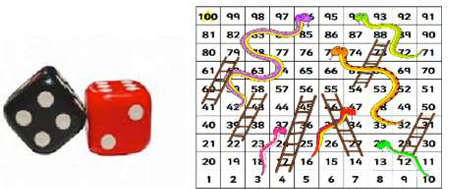
Akshat and his friend Aditya were playing the snake and ladder game. They had their own dice to play the game. Akshat was having red dice whereas Aditya had black dice. In the beginning, they were using their own dice to play the game. But then they decided to make it faster and started playing with two dice together.

Image

Aditya rolled down both black and red die together.

First die is black and second is red.

(i) Find the conditional probability of obtaining a sum greater than 9, given that the black die resulted in a 5 .

(ii) Find the conditional probability of obtaining the sum 8, given that the red die resulted in a number less than 4 .

Three friends Ravi, Raju and Rohit were doing buying and selling of stationery items in a market. The price of per dozen of pen, notebooks and toys are Rupees $\mathrm{x}, \mathrm{y}$ and $\mathrm{z}$ respectively.Ravi purchases $4$ dozen of notebooks and sells $2$ dozen of pens and $5$ dozen of toys. Raju purchases $2$ dozen of toy and sells $3$ dozen of pens and $1$ dozen of notebooks. Rohit purchases one dozen of pens and sells $3$ dozen of notebooks and one dozen of toys.
In the process, Ravi, Raju and Rohit earn $₹\ 1500, ₹\ 10$0 and $₹ \ 400$ respectively.
Image
$(i)$ Write the above information in terms of matrix Algebra.
$(ii)$ What is the total price of one dozen of pens and one dozen of notebooks?
$(iii)$ What is the sale amount of Ravi?
$OR$
What is the amount of purchases and sales made by all three friends?
If a real valued function $f(x)$ is finitely derivable at any point of its domain, it is necessarily continuous at that point. But its converse need not be true.
For example, every polynomial, constant function are both continuous as well as differentiable and inverse trigonometric functions are continuous and differentiable in its domains etc.
Based on the above information, answer the following questions.

  1. If $\text{f}(\text{x})=\begin{cases}\text{x},\text{for x}\leq0\\0,\text{for x}>0\end{cases},$ then at $x = 0$
  1. $f(x)$ is differentiable and continuous.
  2. $f(x)$ is neither continuous nor differentiable.
  3. $f(x)$ is continuous but not differentiable.
  4. None of these.
  1. If $\text{f}(\text{x})=|\text{x}-1|,\text{x }\epsilon\text{ R},$ then at $x = 1$
  1. $f(x)$ is not continuous.
  2. $f(x)$ is continuous but not differentiable.
  3. $f(x)$ is continuous and differentiable.
  4. None of these.
  1. $f(x) = x^3$ is:
  1. Continuous but not differentiable at $x = 3$
  2. Continuous but not differentiable at $x = 3$
  3. Neither continuous nor differentiable at $x = 3$
  4. None of these.
  1. If $\text{f}(\text{x})=[\sin\text{x}],$ then which of the following is true?
  1. $f(x)$ is continuous and differentiable at $x = 0.$
  2. $f(x)$ is discontinuous at $x = 0.$
  3. $f(x)$ is continuous at $x = 0$ but not differentiable.
  4. $f(x)$ is differentiable but not continuous at $\text{x}=\frac{\pi}{2}.$
  1. If $\text{f}(\text{x})=\sin^{-1}\text{x},-1\leq\text{x}\leq1,$ then:
  1. $f(x)$ is both continuous and differentiable.
  2. $f(x)$ is neither continuous nor differentiable.
  3. $f(x)$ is continuous but not differentiable.
  4. None of these.
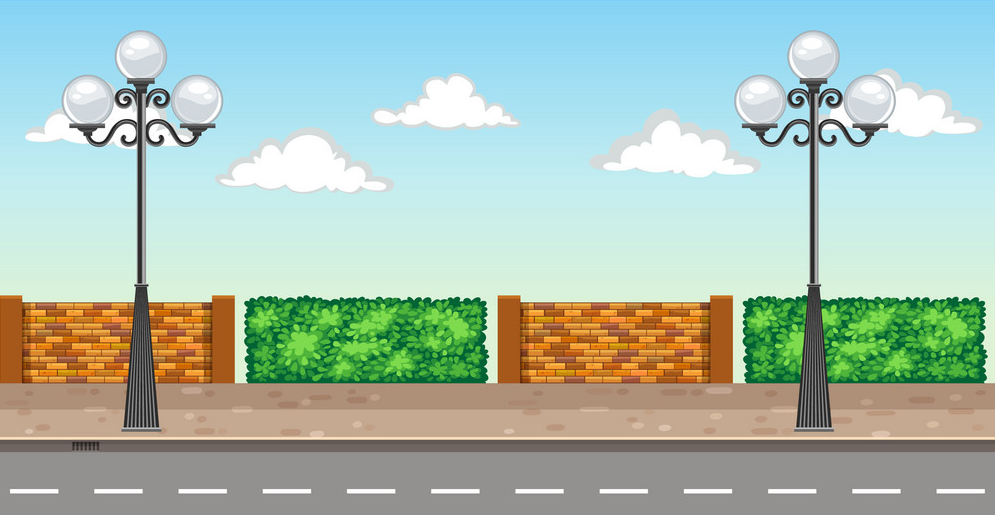
In a street, two lamp posts are 600 feet apart. The light intensity at a distanced from the first (stronger) lamp post is $\frac{1000}{\text{d}^2}$ the light intensity at distance d from the second (weaker) lamp post is $\frac{125}{\text{d}^2}$ (in both cases the light intensity is inversely proportional to the square of the distance to the light source). The combined light intensity is the sum of the two light intensities coming from both lamp posts.

Based on the above information, answer the following questions.
  1. If you are in between the lamp posts, at distance x feet from the stronger tight, then the formula for the combined light intensity coming from both lamp posts as function of x, is
  1. $\frac{1000}{\text{x}^2}+\frac{125}{\text{x}^2}$
  2. $\frac{1000}{\big(600-\text{x}^2\big)}+\frac{125}{\text{x}^2}$
  3. $\frac{1000}{\text{x}^2}+\frac{125}{\big(600-\text{x}^2\big)}$
  4. $\text{None of these}$
  1. The maximum value of x can not be.
  1. 100
  2. 200
  3. 600
  4. None of these
  1. The minimum value of x can not be.
  1. 0
  2. 100
  3. 200
  4. None of these
  1. If l(x) denote the combined tight intensity, then l(x) will be minimum when x =
  1. 200
  2. 400
  3. 600
  4. 800
  1. The darkest spot between the two lights is.
  1. At a distance of 200 feet from the weaker lamp post.
  2. At distance of 200 feet from the stronger lamp post.
  3. At a distance of 400 feet from the weaker lamp post.
  4. None of these
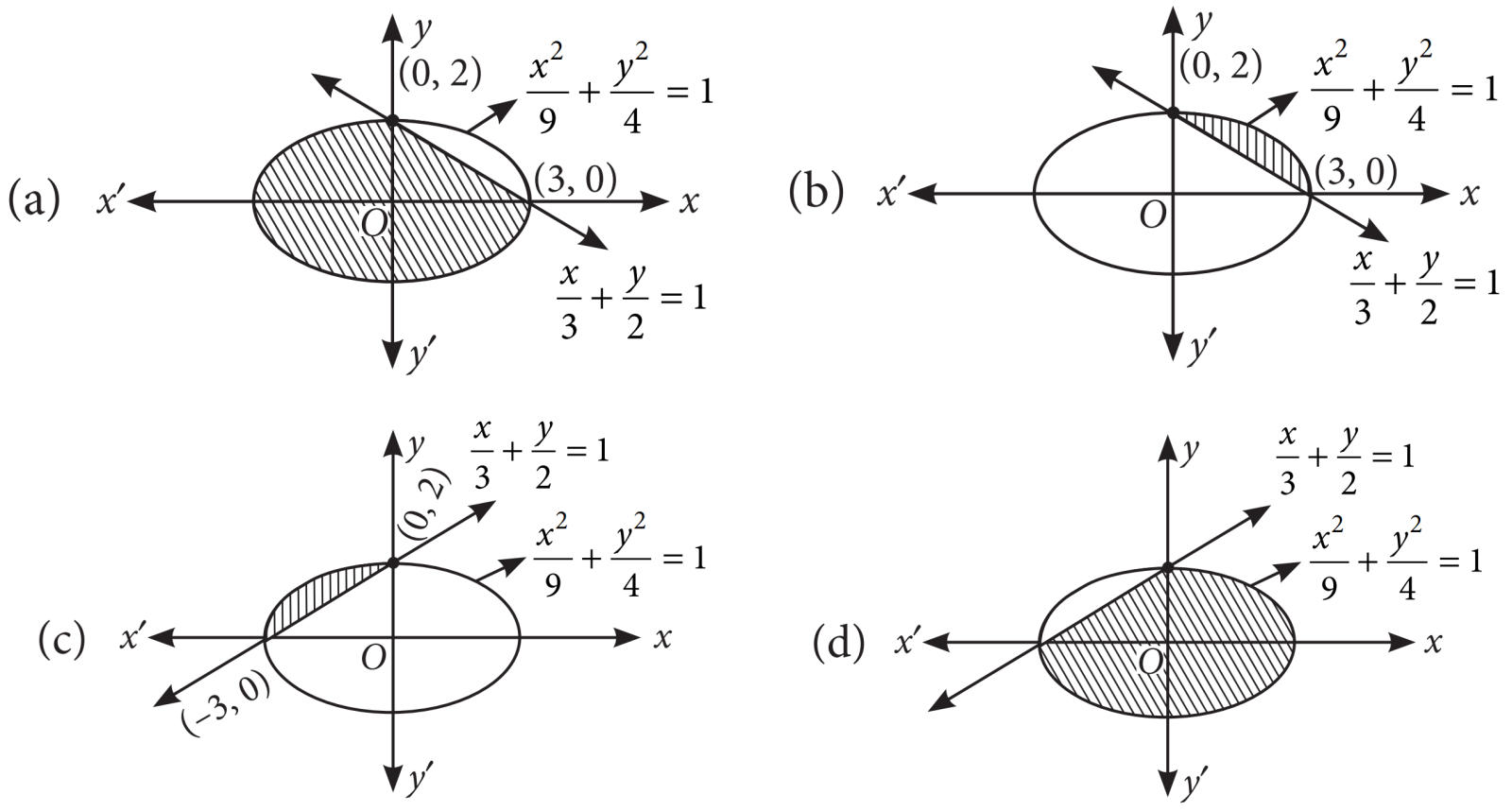
A mirror in the shape of an ellipse represented by $\frac{\text{x}^2}{9}+-\frac{\text{y}^2}{4}=1$ was hanging on the wall. Arun and his sister were playing with ball inside the house, even their mother refused to do so. All of sudden, ball hit the mirror and got a scratch in the shape of line represented by $\frac{\text{x}}{3}+\frac{\text{y}}{2}=1$ Based on the above information, answer the following questions.
  1. Point(s) of intersection of ellipse and scratch (straight line) is (are).
  1. (0, 2), (3, 0)
  2. (2, 0), (3, 0)
  3. (2, 3), (0, 0)
  4. (0, 3), (3, 0)
  1. Area of smaller region bounded by the ellipse and line is represented by.
  1. The value of $\frac{2}{3}\int\limits_{0}^{3}\sqrt{9-\text{x}^2}\text{dx}$ is.
    1. $\frac{\pi}{2}$
    2. $\pi$
    3. $\frac{3\pi}{2}$
    4. $\frac{\pi}{4}$
  1. The value of  $2\int\limits_{0}^{3}\bigg(1-\frac{\text{x}}{3}\bigg)\text{dx}$ is.
    1. 0
    2. 1
    3. 2
    4. 3
  1. Area of the smaller region bounded by the mirror and scratch is.
  1. $3\Big(\frac{\pi}{2}+1\Big)\text{ sq.units}$
  2. $\Big(\frac{\pi}{2}+1\Big)\text{ sq.units}$
  3. $\Big(\frac{\pi}{2}-1\Big)\text{ sq.units}$
  4. $3\Big(\frac{\pi}{2}-1\Big)\text{ sq.units}$
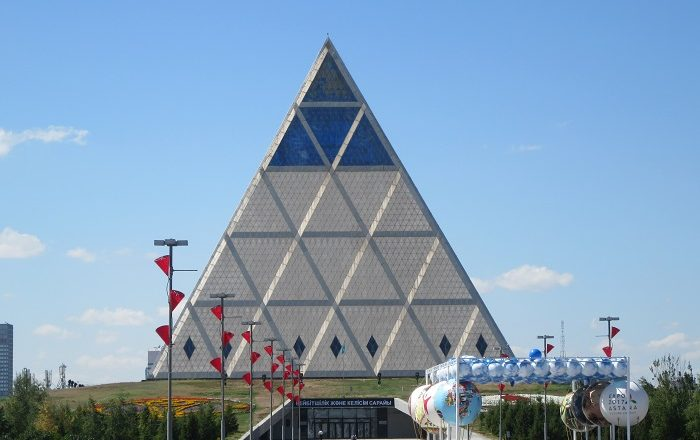
Each triangular face of the Pyramid of Peace in Kazakhstan is made up of $25$ smaller equilateral triangles as shown in the figure.

Using the above information and concept of determinants, answer the following questions.
  1. If the vertices ofoneof the smaller equilateral triangle are $(0, 0), (3,\sqrt{3})$ and $(3,-\sqrt{3}),$ then the area of such triangle is:
  1. $\sqrt{3}\text{ sq}.\text{units}$
  2. $2\sqrt{3}\text{ sq}.\text{units}$
  3. $3\sqrt{3}\text{ sq}.\text{units}$
  4. None of these.
  1. The area of a face of the Pyramid is:
  1. $25\sqrt{3}\text{ sq}.\text{units}$
  2. $50\sqrt{3}\text{ sq}.\text{units}$
  3. $75\sqrt{3}\text{ sq}.\text{units}$
  4. $35\sqrt{3}\text{ sq}.\text{units}$
  1. The length of a altitude of a smaller equilateral triangle is:
  1. $2\ \text{units}$
  2. $3\ \text{units}$
  3. $\sqrt{3}\text{ units}$
  4. $4\ \text{units}$
  1. If $(2, 4), (2, 6)$ are two vertices of a smaller equilateral triangle, then the third vertex will lie on the line represented by:
  1. $\text{x}+\text{y}=5$
  2. $\text{x}=1+\sqrt3$
  3. $\text{x}=2+\sqrt3$
  4. $2\text{x}+\text{y}=5$
  1. Let $A(a, 0), B(0, b)$ and $C(1, 1)$ be three points. If $\frac{1}{\text{a}}+\frac{1}{\text{b}}=1,$ then the three points are:
  1. Vertices of an equilateral triangle.
  2. Vertices of a right angled triangle.
  3. Collinear.
  4. Vertices of an isosceles triangle.
On a holiday, a father gave a puzzle from a newspaper to his son Ravi and his daughter Priya. The probability of solving this specific puzzle independently by Ravi and Priya are $\frac{1}{4}$ and $\frac{1}{5}$ respectively.

Based on the above information, answer the following questions.
  1. The chance that both Ravi and Priya solved the puzzle, is:
  1. $10\%$
  2. $5\%$
  3. $20\%$
  4. $25\%$
  1. Probability that puzzle is solved by Ravi but not by Priya, is:
  1. $\frac{1}{2}$
  2. $\frac{1}{5}$
  3. $\frac{3}{5}$
  4. $\frac{1}{3}$
  1. Find the probability that puzzle is solved.
  1. $\frac{1}{2}$
  2. $\frac{1}{5}$
  3. $\frac{2}{5}$
  4. $\frac{5}{6}$
  1. Probability that exactly one of them solved the puzzle, is:
  1. $\frac{1}{30}$
  2. $\frac{1}{20}$
  3. $\frac{7}{20}$
  4. $\frac{3}{20}$
  1. Probability that none of them solved the puzzle, is:
  1. $\frac{1}{5}$
  2. $\frac{3}{5}$
  3. $\frac{2}{5}$
  4. None of these
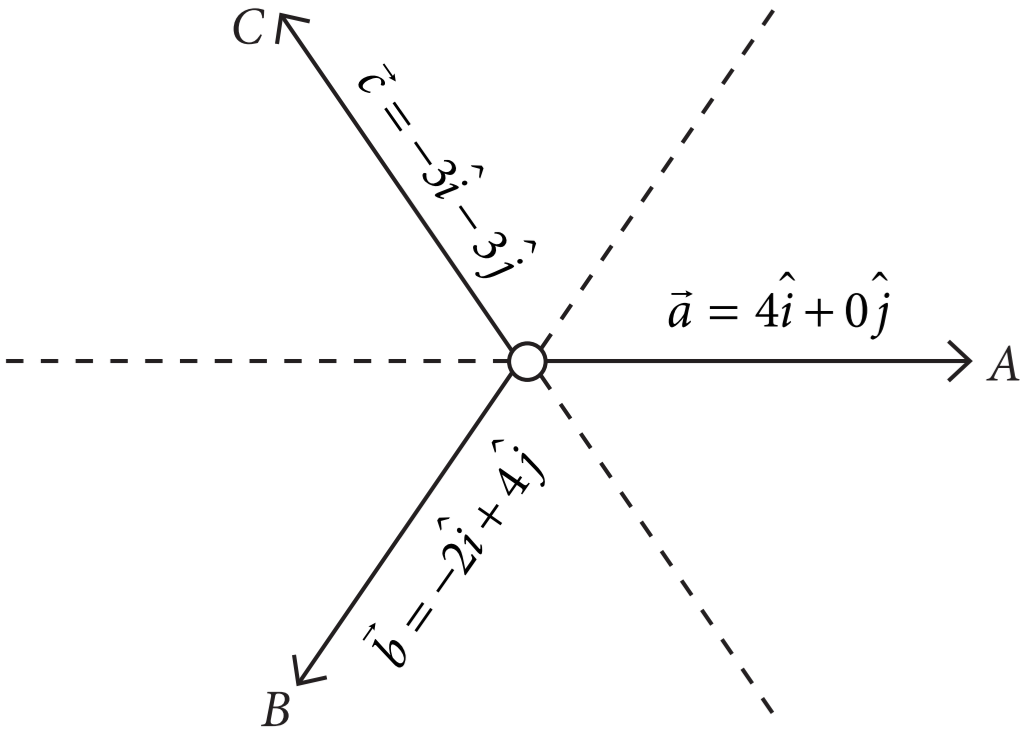
Teams A, B, Cwent for playing a tug of war game. Teams A, B, C have attached a rope to a metal ring and is trying to pull the ring into their own area ( team areas shown below).
Team A pulls with force $\text{F}_1=4\hat{\text{i}}+0\hat{\text{j}}\text{KN}$
Team $\text{B}\rightarrow\text{F}_2=-2\hat{\text{i}}+4\hat{\text{j}}\text{KN}$
Team $\text{C}\rightarrow\text{F}_3=-3\hat{\text{i}}+3\hat{\text{j}}\text{KN}$

Based on the above information, answer the following questions.
  1. Which team will win the game?
  1. Team B
  2. Team A
  3. Team C
  4. No one
  1. What is the magnitude of the teams combined force?
  1. 7KN
  2. 1.4KN
  3. 1.5KN
  4. 2KN
  1. In what direction is the ring getting pulled?
  1. 2.0 radian
  2. 2.5 radian
  3. 2.4 radian
  4. 3 radian
  1. What is the magnitude of the force of Team B?
  1. $2\sqrt{5}\text{KN}$
  2. 6 KN
  3. 2 KN
  4. $\sqrt{6}\text{KN}$
  1. How many KN force is applied by Team A?
  1. 5KN
  2. 4KN
  3. 2KN
  4. 16KN