MCQ
It is possible to distinguish between the transverse and longitudinal waves by studying the property of
  • A
    Interference
  • B
    Diffraction
  • C
    Reflection
  • Polarisation

Answer

Correct option: D.
Polarisation
d
(d) Interference, diffraction and reflection occurs in both transverse and longitudinal waves.

Polarisation occurs only in transverse waves.

Need a full question paper?

Generate a complete, print-ready paper with questions like this in minutes — across 16+ boards, with answer keys.
Start Generating Free

Similar questions

Inertia is that property of a body by virtue of which the body is
An ideal gas undergoes an adiabatic process obeying the relation $PV^{4/3} =$ constant. If its initial temperature is $300\,\, K$ and then its pressure is increased upto four times its initial value, then the final temperature is (in Kelvin):
A particle starts from rest, accelerates at $2 \,ms^{-2}$ for $10\,s$ and then goes for constant speed for $30\,s$ and then decelerates at $ 4\, ms^{-2}$ till it stops. What is the distance travelled by it.........$m$
An aeroplane is moving with horizontal velocity $u$ at height $h$. The velocity of a packet dropped from it on the earth's surface will be ($g$ is acceleration due to gravity)
An object falling through a fluid is observed to have acceleration given by $a = g -bv$ where $g =$ gravitational acceleration and $b$ is constant. After a long time of release, it is observed to fall with constant speed. The value of constant speed is
A particle moves such that its position vector $\overrightarrow{\mathrm{r}}(\mathrm{t})=\cos \omega \mathrm{t} \hat{\mathrm{i}}+\sin \omega \mathrm{t} \hat{\mathrm{j}}$ where $\omega$ is a constant and $t$ is time. Then which of the following statements is true for the velocity $\overrightarrow{\mathrm{v}}(\mathrm{t})$ and acceleration $\overrightarrow{\mathrm{a}}(\mathrm{t})$ of the particle
An ideal gas follows a process $PT =$ constant. The correct graph between pressure $\&$ volume is
A body of mass $5 \times 10^{3} \,kg$ moving with speed $2\, m / s$ collides with a body of mass $15 \times 10^{3} \,kg$ in elastically and sticks to it. Then loss in $K. E.$ of the system will be (in $KJ$)
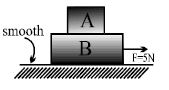
In the shown arrangement mass of $A = 1\,\,kg$  mass of  $B = 2\,\,kg.$  Coefficient of friction between $A $ and $B = 0.2.$  There is no friction between $B$  and ground. The frictional force exerted by $A$ on $B$ equals to
The bulk modulus of rubber is $9.1 \times 10^8\,N/m^2$. To what depth a rubber ball be taken in a lake so that its volume is decreased by $0.1\%$ ? ....... $m$