Question
It is proposed to move a particle in simple harmonic motion on a rough horizontal surface by applying an external force along the line of motion. Sketch the graph of the applied force against the position of the particle. Note that the applied force has two values for a given position depending on whether the particle is moving in positive or negative direction.
Answer

Get the step-by-step solution for this question inside the Vidyadip app.

Get the answer in the app

Need a full question paper?

Generate a complete, print-ready paper with questions like this in minutes — across 16+ boards, with answer keys.

Start Generating Free

Similar questions

An iron ring of relative permeability $\mu_{\text{r}}$ has windings of insulated copper wire of n turns per metre. When the current in the windings is I, find the expression for the magnetic field in the ring.
A beam of protons with a velocity $4 \times 10^5 m / s$ enters a uniform magnetic field of 0.3 T at an angle $60^{\circ}$ to the magnetic field. Find the radius of the helical path taken by the proton beam. Also find the pitch of the helix mp $=1.67 \times 10^{-27} k$
Electrons are continuously mobile in any conductor but then too, no electric current flows in the conductor till an electric source is joined across its ends. Explain.
A person drops a coin. Describe the path of the coin as seen by the person if he is in:
  1. A car moving at constant velocity.
  2. In a freely falling elevator.
Draw the series L-C-R AC circuit and obtain the relationship between voltage and current for this circuit. (Derive the necessary equations.)
How magnetic field lines are drawn? Write their four characteristics.
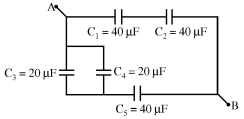
If five capacitors $C_1, C_2, C_3, C_4, C_5$ are connected in an electric circuit as shown in the figure, then calculate the equivalent capacitance of this network between point $A$ and point $B$.
Image
Mention important results regarding electrostatics of conductors.
The electric field and electric potential at any point due to a point charge kept in air is $20 NC^{-1}$ and $10 NC^{-1}$ respectively. Compute the magnitude of this charge.
Draw 3 equipotential surfaces corresponding to a field that uniformly increases in magnitude but remains constant along Z-direction. How are these surfaces different from that of a constant electric field along Z-direction?