Question
It is required to construct a $10\mu\text{F}$ capacitor which can be connected across a 200V battery. Capacitors of capacitance $10\mu\text{F}$ are available but they can withstand only 50V. Design a combination which can yield the desired result.
Answer

Let there are ‘x’ no of capacitors in series ie in a row
So, x × 50 = 200
⇒ x = 4 capacitors.
Effective capacitance in a row $=\frac{10}{4}$
Now, let there are ‘y’ such rows
So, $\frac{10}{4}\times\text{y}=10$
⇒ y = 4 capacitor.
So, the combinations of four rows each of 4 capacitors.

Need a full question paper?

Generate a complete, print-ready paper with questions like this in minutes — across 16+ boards, with answer keys.

Start Generating Free

Similar questions

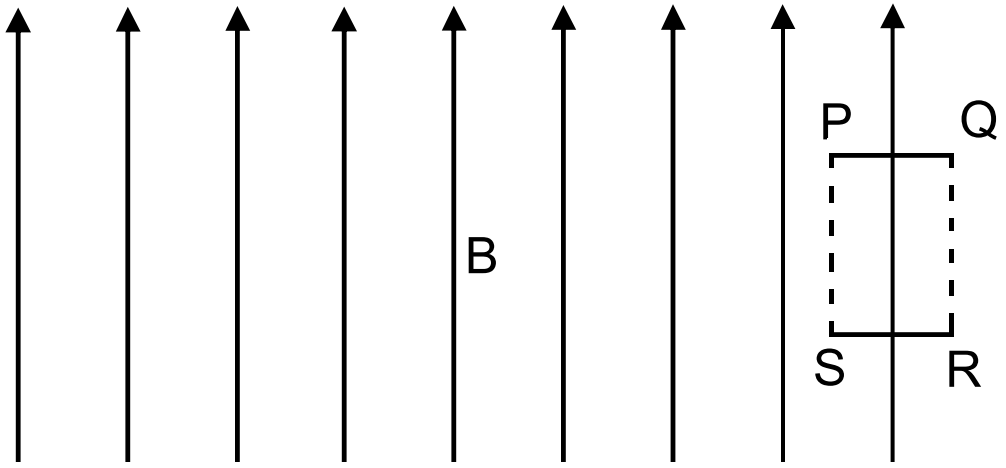
Sometimes we show an idealised magnetic field which is uniform in a given region and falls to zero abruptly. One such field is represented in figure. Using Ampere's law over the path PQRS, show that such a field is not possible.
A screen is placed 90 cm from an object. The image of the object on the screen is formed by a convex lens at two different locations separated by 20 cm. Determine the focal length of the lens.
Find the circuit in the three resistors shown in the figure.
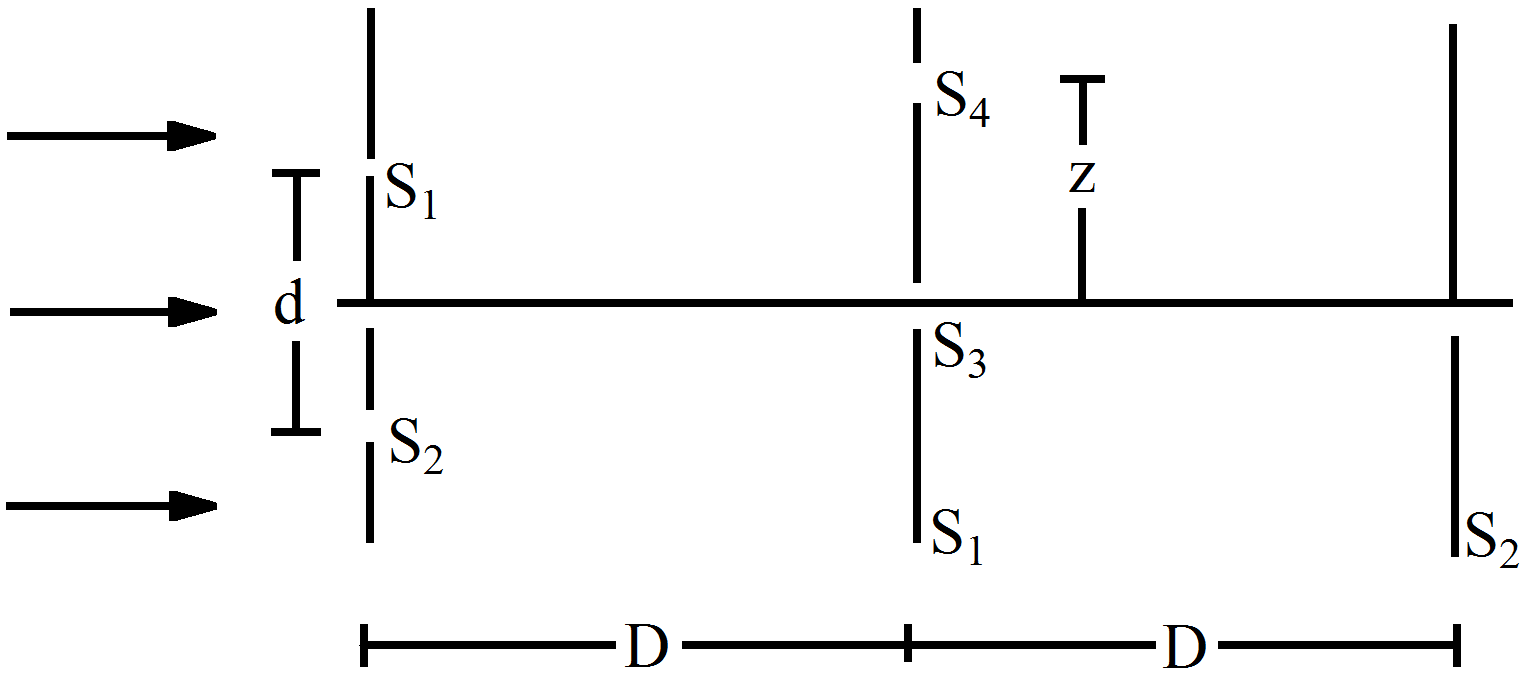
Consider the situation shown in figure $(17-E6)$. The two slits $S_1$ and $S_2\ p$ laced symmetrically around the central line are illuminated by a monochromatic light of wavelength $\lambda.$ The separation between the slits is $d$. The light transmitted by the slits falls on a screen $E_1$ placed at a distance $D$ from the slits. The slit $S_3$ is at the central line and the slit $S_4$ is at a distance $z$ from $S_3$. Another
screen $\sum_2$ is placed a further distance $D$ away from $\sum_1$. Find the ratio of the maximum to minimum intensity observed on $\sum_2$, if z is equal to,
  1. $\text{z}=\frac{\lambda\text{D}}{2\text{d}}$
  2. $\frac{\lambda\text{D}}{\text{d}}$
  3. $\frac{\lambda\text{D}}{4\text{d}}$
Consider the situation of the previous problem. Suppose the block of mass $m_1$ is pulled by a constant force $F_1$ and the other block is pulled by a constant force $F_2.$ Find the maximum elongation that the spring will suffer.
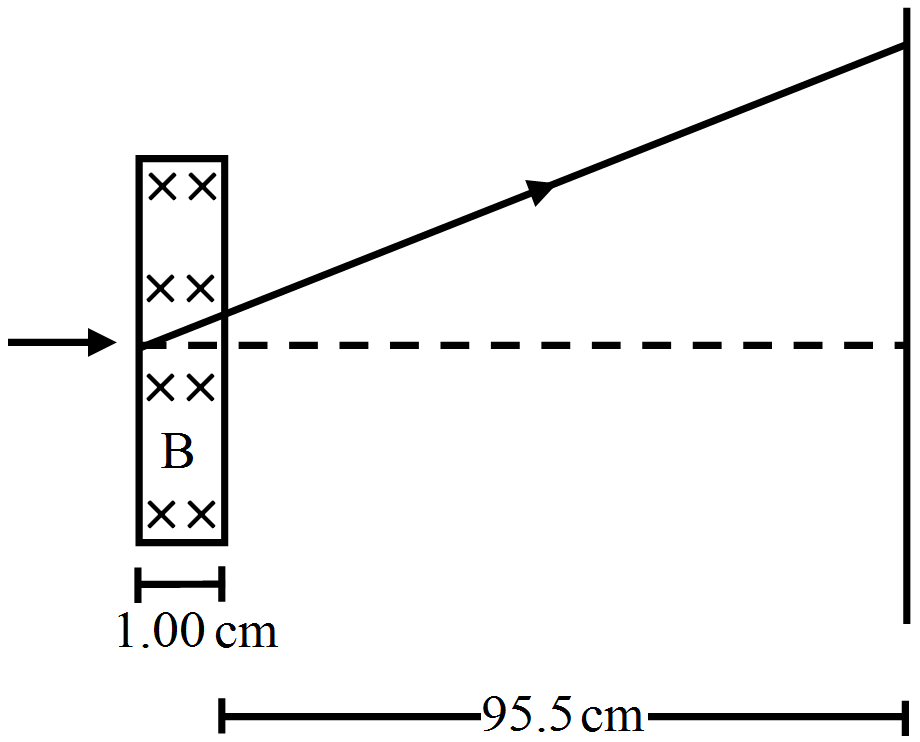
A narrow beam of singly charged potassium ions of kinetic energy $32keV$ is injected into a region of width $1.00\ cm$ with a magnetic field of strength $0.500T,$ as shown in the figure. The ions are collected at a screen $95.5\ cm$ away from the field region. If the beam contains isotopes of atomic weights $39$ and $41,$ find the separation between the points where these isotopes strike the screen. Take the mass of a potassium ion $= A (1.6 \times 10^{-27})kg,$ where $A$ is the mass number.
Two identical balls, each having a charge of $2.00 \times 10^{-7}C$ and a mass of $100\ g,$ are suspended from a common point by two insulating strings each $50\ cm$ long. The balls are held at a separation $5.0\ cm$ apart and then released. Find,
  1. The electric force on one of the charged balls.
  2. The components of the resultant force on it along and perpendicular to the string.
  3. The tension in the string.
  4. The acceleration of one of the balls. Answers are to be obtained only for the instant just after the release.
Two charges $2.0 \times 10^{-6}C$ and $1.0 \times 10^{-6}C$ are placed at a separation of $10\ cm$. Where should a third charge be placed such that it experiences no net force due to these charges?
When an electron goes from the valence band to the conduction band in silicon, its energy is increased by 1.1eV. The average energy exchanged in a thermal collision is of the order of kT which is only 0.026eV at room temperature. How is a thermal collision able to take some of the electrons from the valence band to the conduction band?
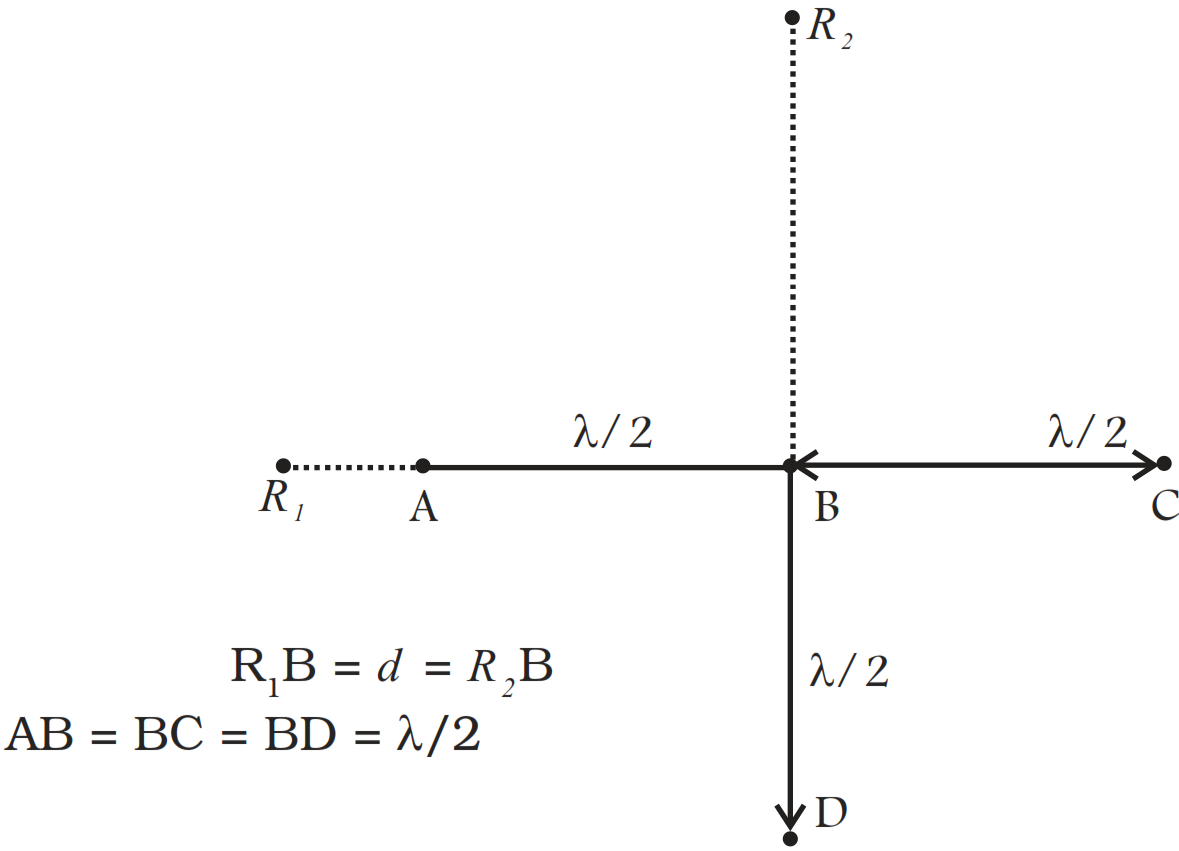
Four identical monochromatic sources $A,B,C,D$ as shown in the $($Fig.$)$ produce waves of the same wavelength $\lambda$ and are coherent. Two receiver $R_1$ and $R_2$ are at great but equal distaces from $B.$​​​​​​​
  1. Which of the two receivers picks up the larger signal?
  2. Which of the two receivers picks up the larger signal when $B$ is turned off?
  3. Which of the two receivers picks up the larger signal when $D$ is turned off?
  4. Which of the two receivers can distinguish which of the sources $B$ or $D$ has been turned off?