MCQ
It is true for adiabatic change:
  • A
    $PV ^{\gamma-1}=$ Constant
  • $TV ^{\gamma^{-1}}=$ Constant
  • C
    $T ^{\gamma^{-1} V}=$ Constant
  • D
    TV ${ }^\gamma=$ Constant

Answer

Correct option: B.
$TV ^{\gamma^{-1}}=$ Constant
B

Need a full question paper?

Generate a complete, print-ready paper with questions like this in minutes — across 16+ boards, with answer keys.
Start Generating Free

Similar questions

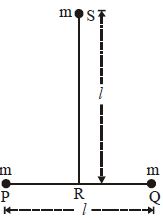
Two particles each of mass $m$ are placed at points $P$ and $Q$ as shown in the figure. $R$ is the mid-point of $PQ = l$. The gravitational force on the third particle of mass $m$ placed at point $S$ on the perpendicular bisector of $PQ$ is
Consider a uniform square plate of side '$a$' and mass '$m$ ' The moment of inertia of this plate about an axis perpendicular to its plane and passing through one of its corners is
The density of the atmosphere at sea level is $1.29 \;kg / m ^{3} .$ Assume that it does not change with altitude. Then how high (in $km$) would the atmosphere extend?
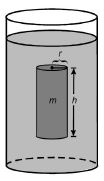
A right circular cylinder has a mass $m$, radius $r$, and a height $h$. The cylinder is completely submerged in a fluid of density $\rho$, as shown in the diagram. What is the magnitude of the net force on the cylinder?
If the interatomic spacing in a steel wire is $3.0Å$ and ${Y_{steel}}$= $20 \times {10^{10}}N/{m^2}$ then force constant is
Consider an ideal gas confined in an isolated closed chamber. As the gas undergoes an adiabatic expansion, the average time of collision between molecules increases as $V ^q$, where $V$ is the volume of the gas. The value of $q$ is $\left( {\gamma = \frac{{{C_P}}}{{{C_V}}}} \right)$
The displacement at a point due to two waves are $y_1=4 \sin (500 \pi t)$ and $y_2=2 \sin (506 \pi t)$. The result due to their superposition will be
Which of the following statements is correct for any thermodynamic system
The kinetic energy and the potential energy of a particle executing $S.H.M.$ are equal. The ratio of its displacement and amplitude will be 
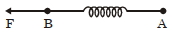
Two masses $A$ and $B ,$ each of mass $M$ are fixed together by a massless spring. $A$ force acts on the mass $B$ as shown in figure. If the mass $A$ starts moving away from mass $B$ with acceleration $'a',$ then the acceleration of mass $B$ wil be :-