MCQ
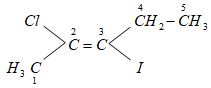
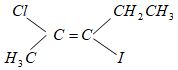
$IUPAC$ name for the compound
  • A
    trans $3$ iodo, $4$-chloro, $3$-pentene
  • B
    cis $3$ chloro, $3$-iodo, $2$-pentene
  • trans $2$ chloro, $3$-iodo, $2$-pentene
  • D
    cis $3$ iodo, $4$-chloro, $3$-pentene

Answer

Correct option: C.
trans $2$ chloro, $3$-iodo, $2$-pentene
c
(c) Trans $2$-chloro, $3$-iodo, $2$-pentene

Need a full question paper?

Generate a complete, print-ready paper with questions like this in minutes — across 16+ boards, with answer keys.

Start Generating Free

Similar questions

$\begin{array}{*{20}{c}}
  {\,C{H_3}\,\,\,\,\,\,\,\,\,\,\,\,\,} \\ 
  {|\,\,\,\,\,\,\,\,\,\,\,\,\,\,\,\,\,\,} \\ 
  {C{H_3} - C - C{H_2} - \mathop C\limits^ \oplus  {H_2}} \\ 
  {|\,\,\,\,\,\,\,\,\,\,\,\,\,\,\,\,\,\,\,} \\ 
  {C{H_3}\,\,\,\,\,\,\,\,\,\,\,\,\,\,} 
\end{array} \to \begin{array}{*{20}{c}}
  {\,\,\,\,\,\,\,\,\,\,\,C{H_3}} \\ 
  {\,\,\,\,\,\,|} \\ 
  {C{H_3} - \mathop C\limits^ \oplus   - CH - C{H_3}} \\ 
  {\,\,\,\,\,\,|} \\ 
  {\,\,\,\,\,\,\,\,\,\,\,\,\,C{H_3}} 
\end{array}$   

How many ${H^ \ominus }$ shifts are involved in above rearrangement :

Unknown $(A)$ in the reaction 
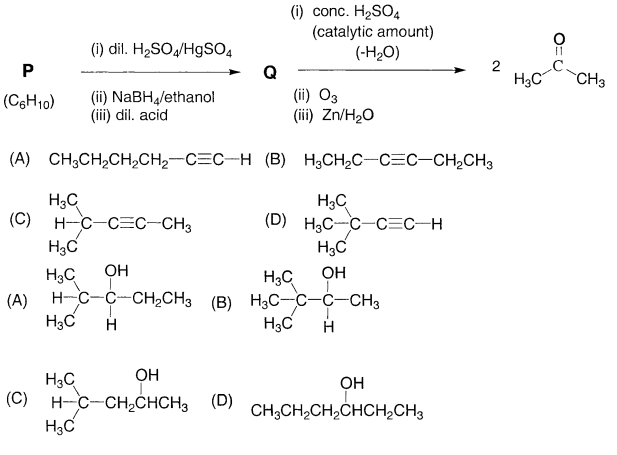
An acyclic hydrocarbon ${P}$, having molecular formula $\mathrm{C}_6 \mathrm{H}_{10}$, gave acetone as the only organic product through the following sequence of reactions, in which ${Q}$ is an intermediate organic compound. $Image$

$1.$ The structure of compound ${P}$ is

mcq $Image$

$2.$ The structure of the compound ${Q}$ is

mcq $Image$

Give the answer question $1,2$ and $3.$
Which is not a electrophile
Molecule having non-polar as well as polar bonds but the molecule as a whole is polar
A salt producing hydrocarbon among these compounds is
The free energy change for a reversible reaction at equilibrium is
Only two isomers of monochloro product is possible of
Which of the following molecules/ions are all the bonds not equal
A pair of stereoisomers might be classified in various ways. Which of the  following statement are true with respect to pairs of stereoisomers?

$(a)$ They might be configurational isomers  $(b)$ They might be diastereomers
$(c)$ They might be constitutional isomers    $(d)$ They might be tautomers
$(e)$ They might be conformational isomers   $(f)$ They might be enantiomers
$(g)$ They might be positional isomers