MCQ
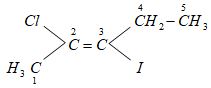
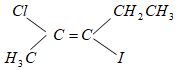
$IUPAC$ name for the compound
  • A
    trans $3$ iodo, $4$-chloro, $3$-pentene
  • B
    cis $3$ chloro, $3$-iodo, $2$-pentene
  • trans $2$ chloro, $3$-iodo, $2$-pentene
  • D
    cis $3$ iodo, $4$-chloro, $3$-pentene

Answer

Correct option: C.
trans $2$ chloro, $3$-iodo, $2$-pentene
c
(c) Trans $2$-chloro, $3$-iodo, $2$-pentene

Need a full question paper?

Generate a complete, print-ready paper with questions like this in minutes — across 16+ boards, with answer keys.

Start Generating Free

Similar questions

Glucose and fructose are
Amongst $SF _{4}, XeF _{4}, CF _{4}$ and $H _{2} O$, the number of species with two lone pairs of electrons ..... .
Answer the following by appropriately matching the lists based on the information given in the paragraph Consider the Bohr's model of a one-electron atom where the electron moves around the nucleus. In the following $List-I$ contains some quantities for the $n^{t /}$ orbit of the atom and $List-II$ contains options showing how they depend on $n$.

Which of the following options has the correct combination considering $List-I$ and $List-II$?

$List-I$ $List-II$
$(I)$ Radius of the $n^{\text {th }}$ orbit $(P)$ $\propto n ^{-2}$
$(II)$ Angular momentum of the electron in the $n^{\text {th }}$ orbit $(Q)$ $\propto n ^{-1}$
$(III)$ Kinetic energy of the electron in the $n^{\text {th }}$ orbit $(R)$ $\propto n ^0$
$(IV)$ Potential energy of the electron in the $n^{\text {th }}$ orbit $(S)$ $\propto n ^1$
  $(T)$ $\propto n ^2$
  $(U)$ $\propto n ^{1 / 2}$

($1$) Which of the following options has the correct combination considering $List-I$ and $List-II$?

$(1) (II), (R)$ $(2) (I), (P)$ $(3) (I), (T)$ $(4) (II), (Q)$

($2$) Which of the following options has the correct combination considering $List-I$ and $List-II$?

$(1) (III), (S)$ $(2) (IV), (Q)$ $(3) (IV),(U)$ $(4) (III), (P)$

Give the answer or quetion ($1$) and ($2$)

The $pH$ of two equimolar weak acids are $3.0$ and $5.0$ respectively. Their relative strength is
Most unstable carbocation of given is
Heat of reaction for $C_6H_{12}O_{6(s)} + 6O_{2(g)} \to 6CO_{2(g)} + 6H_2O_{(v)}$ at constant pressure is $-651\, K\, cal$ at $17\,^oC$. Calculate heat of reaction at constant volume at $17\,^oC$......$ K\, cal$
Which of the following is chiral?
Compounds after ozonolysis followed by hydrolysis are :
Which of following is most reactive toward electrophilic aromatic substitution reaction
An organic compound contains $C = 74.0\% ,$ $H = 8.65\% $ and $N = 17.3\% $. Its Empirical formula is