MCQ
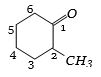
$IUPAC$ name for the compounds
  • A
    $\alpha$-Methyl cyclohexanone
  • $2-$Methyl cyclohexanone
  • C
    Heptanone$-2$
  • D
    Methyl cyclo-hexanone

Answer

Correct option: B.
$2-$Methyl cyclohexanone
b
(b) $2 -$methyl cyclohexanone

Need a full question paper?

Generate a complete, print-ready paper with questions like this in minutes — across 16+ boards, with answer keys.

Start Generating Free

Similar questions

The positive value of $\Delta S$ indicates that
$2.5 \mathrm{~mL}$ of $\frac{2}{5} \mathrm{M}$ weak monoacidic base $\left(\mathrm{K}_{\mathrm{b}}=1 \times 10^{-12}\right.$ at $\left.25^{\circ} \mathrm{C}\right)$ is titrated with $\frac{2}{15} \mathrm{M} \mathrm{HCl}$ in water at $25^{\circ} \mathrm{C}$. The concentration of $\mathrm{H}^{+}$at equivalence point is $\left(\mathrm{K}_W=1 \times 10^{-14}\right.$ at $\left.25^0 \mathrm{C}\right)$
Which of the following is the correct plot for the probability density $\psi^{2}( r )$ as a function of distance ' $r$ ' of the electron form the nucleus for $2 s$ orbital?
Degree of dissociation of an electrolyte does not depends on
A student was carrying out a Grignard reaction between $PhMgBr$ and ethyl  benzoate. She ran out of anhydrous ether just after the Grignard reagent was made. Which of the following solvents can still be used to dissolve the ethyl  benzoate for its reaction with already formed $PhMgBr$ ?
The factors affecting corrosion are
$1-$ Alkyne and $2-$ alkyne can be distinguished by
A solution containing $30\,gms$ of non-volatile solute in exactly $90\,gm$ water has a vapour pressure of $21.85 \,\,mm\,Hg$ at ${25\,^o}C$. Further $18 \,gms$ of water is then added to the solution. The resulting solution has a vapour pressure of $ 22.15\,\,mm\,Hg$ at ${25\,^o}C$. Calculate the molecular weight of the solute
The $EAN$ of metal atoms in $Fe(NO)_2(CO)_2$ and $CO_2(CO)_8$ respectively are
If the solubility products of $AgCl$ and $AgBr$ are $1.0 \times {10^{ - 8}}\,M$ and $3.5 \times {10^{ - 13}}$ respectively, then the relation between the solubilities (denoted by the symbol$'S'$) of these salts can correctly be represented as