MCQ
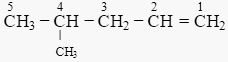
$IUPAC$ name of $C{H_3} - \mathop {\mathop {CH - C{H_2}}\limits_{|\,\,\,\,\,\,\,\,\,\,\,\,\,\,\,\,\,\,} }\limits_{C{H_3}\,\,\,\,\,\,\,\,\,\,\,} - CH = C{H_2}$ is
  • A
    $2-$ methyl pentene
  • $4-$ methyl pentene $-1$
  • C
    $1-$ hexene
  • D
    $2-$  methyl pentene $-1$

Answer

Correct option: B.
$4-$ methyl pentene $-1$
b
since it contains double bond hence it is alkene and it also has methyl group attached to the fourth carbon atom, Thus its IUPAC name of the compound will be:

$4$- methyl -$1$- pentene

Need a full question paper?

Generate a complete, print-ready paper with questions like this in minutes — across 16+ boards, with answer keys.

Start Generating Free

Similar questions

For the reaction at equilibrium 

${N_2}\left( g \right) + 3{H_2}\left( g \right) \rightleftharpoons \,2N{H_3}\left( g \right)$ 

On addition of an inert gas at constant pressure & constant temperature which of the following change is $NOT$ observed

Which of the following conditions will always lead to a non-spontaneous change
Which of the following have maximum number of atoms?
Empirical formula of a hydrocarbon containing $80\%$ carbon and $20\%$ hydrogen is
$\begin{array}{*{20}{c}}
  {C{H_3} - C{H_2} - CH - C{H_3}\xrightarrow[{KOH}]{{Alc.}}\mathop X\limits_{\left( {{\text{major}}} \right)} \,;} \\ 
  {\,\,\,\,\,\,\,\,\,\,\,\,|\,\,\,\,\,\,\,\,\,\,\,\,\,\,\,\,\,\,\,\,\,\,\,\,\,\,\,\,\,\,\,} \\ 
  {\,\,\,\,\,\,\,\,\,\,\,\,\,Br\,\,\,\,\,\,\,\,\,\,\,\,\,\,\,\,\,\,\,\,\,\,\,\,\,\,\,\,\,} 
\end{array}\,$

$\begin{array}{*{20}{c}}
  {C{H_3} - C{H_2} - CH - C{H_3}\xrightarrow[\Delta ]{{EtoNa}}\mathop {{\text{ }}Y}\limits_{\left( {{\text{major}}} \right)} } \\ 
  {{\mkern 1mu} {\mkern 1mu} {\mkern 1mu} {\mkern 1mu} {\mkern 1mu} {\mkern 1mu} {\mkern 1mu} {\mkern 1mu} {\mkern 1mu} {\mkern 1mu} {\mkern 1mu} {\mkern 1mu} |{\mkern 1mu} {\mkern 1mu} {\mkern 1mu} {\mkern 1mu} {\mkern 1mu} {\mkern 1mu} \,\,\,\,\,{\mkern 1mu} \,\,\,\,{\mkern 1mu} {\mkern 1mu} {\mkern 1mu} {\mkern 1mu} {\mkern 1mu} {\mkern 1mu} {\mkern 1mu} {\mkern 1mu} {\mkern 1mu} {\mkern 1mu} {\mkern 1mu} {\mkern 1mu} {\mkern 1mu} {\mkern 1mu} {\mkern 1mu} {\mkern 1mu} {\mkern 1mu} {\mkern 1mu} {\mkern 1mu} {\mkern 1mu} {\mkern 1mu} {\mkern 1mu} {\mkern 1mu} {\mkern 1mu} } \\ 
  {{\mkern 1mu} {\mkern 1mu} {\mkern 1mu} \mathop {{\mkern 1mu} {\mkern 1mu} {\mkern 1mu} {\mkern 1mu} \,\,\,\,\,\,\,NM{e_3}\,\,\,\,\,\,\,{\mkern 1mu} }\limits_{\,\,\,\,\,\,\,\,\,\, \oplus \,\,\,\,\,\,\,\,\,\,\,\,\,\,\,\,\,\,\,\,} {\mkern 1mu} {\mkern 1mu} {\mkern 1mu} {\mkern 1mu} {\mkern 1mu} {\mkern 1mu} {\mkern 1mu} {\mkern 1mu} {\mkern 1mu} {\mkern 1mu} {\mkern 1mu} {\mkern 1mu} {\mkern 1mu} {\mkern 1mu} } 
\end{array}{\mkern 1mu} $

Product $(X)$ and $(Y)$ respectively is
What is the name of tube in which a known mass of an organic compound is heated for the quantitative analysis of sulphur?
How much water should be added to $200 \,c.c$ of semi normal solution of $NaOH$ to make it exactly deci normal ............ $\mathrm{cc}$
In Ostwald's process for the manufacture of nitric acid, the first step involves the oxidation of ammonia gas by oxygen gas to give nitric oxide gas and steam. What is the maximum weight of nitric oxide that can be obtained starting only with 10.00 g of ammonia and 20.00 g of oxygen?
Addition of $HI$ on the double bond of propene yields isopropyl iodide and not $ n-$ propyl iodide as the major product. This is because the addition proceeds through
In $2^{nd}$ period which element has highest value of sum of $1^{st}$ & $2^{nd}\ I.E.$