MCQ
$IUPAC$ name of following compound is :-

- A$1$-Ethyl-$2, 2$-dimethyl-$6$-cyclohexene
- B$2$-Ethyl-$1, 1$-dimethyl-$2$-cyclohexene
- ✓$1$-Ethyl-$6, 6$-dimethyl- $1$-cyclohexene
- D$2$-Ethyl-$3, 3$-dimethyl- $1$-cyclohexene
Generate a complete, print-ready paper with questions like this in minutes — across 16+ boards, with answer keys.
$\left[\mathrm{PtCl}_{4}\right]^{2-}+\mathrm{H}_{2} \mathrm{O} \rightleftharpoons\left[\mathrm{Pt}\left(\mathrm{H}_{2} \mathrm{O}\right) \mathrm{Cl}_{3}\right]^{-}+\mathrm{Cl}^{-}$
was measured as a function of concentrations of different species. It was observed that
$\frac{-\mathrm{d}\left[\left[\mathrm{PtCl}_{4}\right]^{2-}\right]}{\mathrm{dt}}=4.8 \times 10^{-5}\left[\left[\mathrm{PtCl}_{4}\right]^{2-}\right]-2.4 \times10^{-3}\left[\left[\mathrm{Pt}\left(\mathrm{H}_{2} \mathrm{O}\right) \mathrm{Cl}_{3}\right]^{-}\right]\left[\mathrm{Cl}^{-}\right]$
where square brackets are used to denote molar concentrations. The equilibrium constant $\mathrm{K}_{\mathrm{c}}=....$. (Nearest integer)
Anions $-$ Separated by reagent
(image)
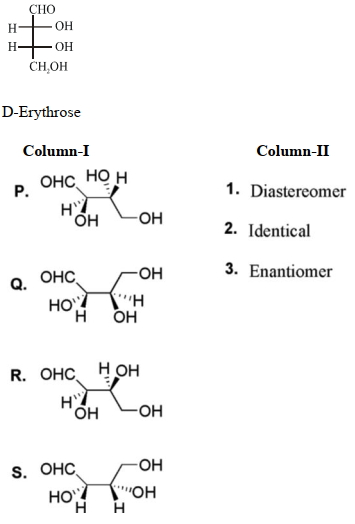
$D$-Erythrose and its isomers are listed as $P , Q , R$, and $S$ in Column-$I$. Choose the correct relationship of $P , Q , R$, and $S$ with D-erythrose from Column $II$.
(image)