MCQ
$IUPAC$ name of given compound is
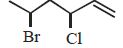
- ✓$5-$ Bromo $-3-$ chloro hex $1-$ ene
- B$2-$ Bromo $-4-$ chloro hex $-5-$ ene
- C$3-$ Chloro $-5-$ bromo hexene
- D$4-$ Chloro $-2-$ bromo hex $-6-$ ene
Generate a complete, print-ready paper with questions like this in minutes — across 16+ boards, with answer keys.
$\begin{array}{*{20}{c}}
{O\,\,\,\,\,\,\,\,\,\,\,\,\,\,\,\,\,\,\,\,\,\,\,\,\,\,C{H_3}} \\
{||\,\,\,\,\,\,\,\,\,\,\,\,\,\,\,\,\,\,\,\,\,\,\,\,\,\,\,\,\,\,\,\,|\,\,\,\,} \\
{C{H_3} - C - CH - CH - CH - C{H_3}} \\
{|\,\,\,\,\,\,\,\,\,\,\,\,\,|\,\,\,\,\,\,\,\,\,} \\
{C{H_3}\,\,\,\,\,CHO\,\,}
\end{array}$
is :
Statement $I :$ In 'Lassaigne's Test, when both nitrogen and sulphur are present in an organic compound, sodium thiocyanate is formed.
Statement $II :$ If both nitrogen and sulphur are present in an organic compound, then the excess of sodium used in sodium fusion will decompose the sodium thiocyanate formed to give $NaCN$ and $Na _{2} S$.
In the light of the above statements, choose the most appropriate answer from the options given below...
$(B)$ $I _{2}+ H _{2} O _{2}+2 OH ^{-} \rightarrow 2 I ^{-}+2 H _{2} O + O _{2}$
Choose the correct option.
| list $I$ | list $II$ | ||
| $A.$ | Butane $\to $ Isobutane | $(a)$ | Cracking |
| $B.$ | Butane $\to $ Lower hydrocarbons | $(b)$ | Isomerisation |
| $C.$ | $n-$ Heptane $\to $ Toluene | $(c)$ | Reed reaction |
| $D.$ | Propane $\to CH_3CH_2CH_2SO_2Cl$ | $(d)$ | Aromatization |