MCQ
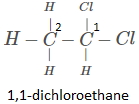
$IUPAC $ name of $H - \mathop {\mathop {\mathop {\mathop C\limits^| }\limits^H }\limits_| }\limits_H - \mathop {\mathop {\mathop {\mathop C\limits^| }\limits^{Cl} }\limits_| }\limits_H - Cl$ is
  • A
    $1, 2-$ dichloroethane
  • B
    $2, 2-$ dichloroethane
  • $1, 1-$ dichloroethane
  • D
    Dichloroethane

Answer

Correct option: C.
$1, 1-$ dichloroethane
c
The numbering of carbon chain is done from the carbon which is having two chlorine atoms.

The parent alkane containing two carbon atoms is called as ethane and hence the IUPAC name of this compound is $1,1$-Dichloroethane.

Need a full question paper?

Generate a complete, print-ready paper with questions like this in minutes — across 16+ boards, with answer keys.

Start Generating Free

Similar questions

Oxygen molecule is paramagnetic because
$N_2(g) + 3H_ 2(g)  \rightleftharpoons 2NH_3(g); K_1$

$ NH_3(g)  \rightleftharpoons \frac{1}{2}\,{N_2}\left( g \right) + \frac{3}{2}{H_2}\left( g \right);\,{K_2}$

$\frac{1}{2}\,{N_2}\left( g \right) + \frac{3}{2}{H_2}\left( g \right)  \rightleftharpoons NH_3(g); K_3$

$2NH_3(g)  \rightleftharpoons N_2(g) + 3H_2(g); K_4$

If $K_1 = K_2^x = K_3^y = K_4^z$ then correct values of $x, y$ and $z$ are respectively

Which of the following is a chiral ?
$CH _{3} CH _{2} CH = CH _{2} \frac{ B _{2} H _{6}}{ H _{2} O , H _{2} O _{2}, OH ^{-}} Z$ What is $Z?$
Which of the following is an amphoteric acid
What is $DDT$ among the following?
Total possible stereo isomer from given compound will be

$\begin{array}{*{20}{c}}
  {C{H_3} - CH = CH - CH - CH - C{H_3}} \\ 
  {{\mkern 1mu} {\mkern 1mu} {\mkern 1mu} \,\,\,\,\,\,\,\,\,\,\,\,\,\,\,\,\,\,\,\,\,\,\,\,\,\,\,{\mkern 1mu} {\mkern 1mu} |{\mkern 1mu} {\mkern 1mu} {\mkern 1mu} {\mkern 1mu} {\mkern 1mu} {\mkern 1mu} {\mkern 1mu} {\mkern 1mu} {\mkern 1mu} {\mkern 1mu} \,\,\,\,\,\,\,\,\,\,\,{\mkern 1mu} {\mkern 1mu} |{\mkern 1mu} {\mkern 1mu} {\mkern 1mu} {\mkern 1mu} {\mkern 1mu} {\mkern 1mu} {\mkern 1mu} {\mkern 1mu} } \\ 
  {\,\,\,\,\,\,\,\,\,\,\,\,\,\,\,\,\,\,\,\,\,\,\,\,\,\,\,\,\,\,\,OH{\mkern 1mu} {\mkern 1mu} {\mkern 1mu} {\mkern 1mu} \,\,\,\,{\mkern 1mu} {\mkern 1mu} \,\,\,{\mkern 1mu} {\mkern 1mu} OH\,\,} 
\end{array}\,$
Which of the following set of species have planar structures?
Given the molecular formula of the hexa coordinated complexes (a) $CoC{l_3}.6N{H_3}$ (b)$CoC{l_3}.5N{H_3}$ (c)$CoC{l_3}.4N{H_3}$. If the number of co-ordinated $N{H_3}$ molecules in $A, B $ and $C$  respectively are $6, 5$  and $ 4, $ the primary valency in $ (a), (b)$ and $(c) $ are:
The solubility product for a salt of the type $AB$ is $4 \times 10^{-8}$. What is the molarity of its standard solution?