MCQ
$Joule-second$ is the unit of
  • A
    Work
  • B
    Momentum
  • C
    Pressure
  • Angular momentum

Answer

Correct option: D.
Angular momentum
d
(d) $\tau = \frac{{dL}}{{dt}}$

$⇒$ $dL = \tau \times dt$$ = r \times F \times dt$

i.e. the unit of angular momentum is joule-second.

Need a full question paper?

Generate a complete, print-ready paper with questions like this in minutes — across 16+ boards, with answer keys.
Start Generating Free

Similar questions

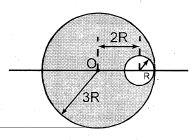
In the figure shown find out the distance of centre of mass of a system of a uniform circular plate of radius $3R$ from $O$ in which a hole of radius $R$ is cut whose centre is at $2R$ distance from centre of large circular plate
An engineer claims to have made an engine delivering $10 kW$ power with fuel consumption of $1\,g\,{s^{ - 1}}$. The calorific value of fuel is $2k cal/g$. His claim
The power of a pump, which can pump $500 \,kg$ of water to height $100 \,m$ in $10 \,s$ is .......... $kW$
Two wires $A$ and $B$ of same length, same area of cross-section having the same Young's modulus are heated to the same range of temperature. If the coefficient of linear expansion of $A$ is $3/2$ times of that of wire $B$. The ratio of the forces produced in two wires will be
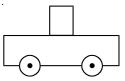
$A$ uniform cylinder rests on a cart as shown. The coefficient of static friction between the cylinder and the cart is $0.5$. If the cylinder is $4\, cm$ in diameter and $10\, cm$ in height, which of the following is the minimum acceleration of the cart needed to cause the cylinder to tip over ? ....... $m/s^2$.
Which is correct relation
Which of the following statements is incorrect regarding the polar satellite.
A cube of wood supporting $200\,gm$ mass just floats in water. When the mass is removed, the cube rises by $2\, cm$. ............ $cm$ is the side of cube .
At $NTP$ water boils at $100°C.$ Deep down the mine, water will boil at a temperature
A wooden block of mass $M$ resting on a rough horizontal surface is pulled with a force $F$ at an angle $\phi $ with the horizontal. If $\mu $ is the coefficient of kinetic friction between the block and the surface, then acceleration of the block is