Question
Justify the following statement in terms of ecosystem dynamics. “Nature tends to increase the gross primary productivity, while man tends to increase the net primary productivity”.

Answer

Gross primary productivity of an ecosystem is the rate of production of organic matter during photosynthesis. A considerable amount of GPP is utilised by plants in respiration. Gross primary productivity minus respiration losses (R), is the net primary productivity (NPP). Net primary productivity is the available biomass for the consumption to heterotrophs (herbivores and decomposers).
  • Nature tends to increase the gross primary productivity so that it can utilise much of the solar energy and convert it into food.
  • Man tends to increase the net primary productivity so that sufficient food is provided to the growing human population.

Need a full question paper?

Generate a complete, print-ready paper with questions like this in minutes — across 16+ boards, with answer keys.
Start Generating Free

Similar questions

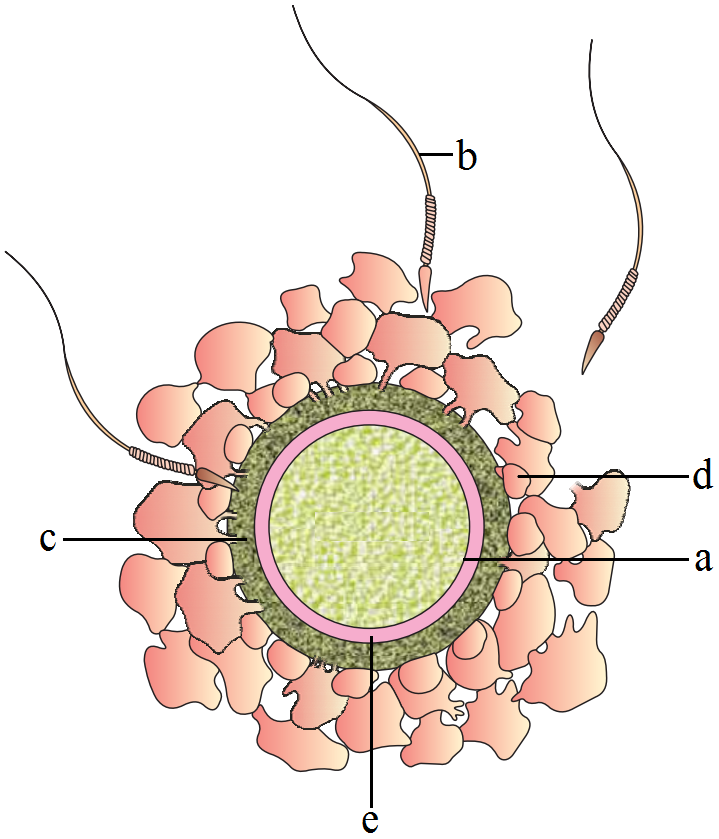
Study the illustration given and answer the questions that follow:

Name and state the function of ‘c’.

“Maintenance of personal and public hygiene is necessary for prevention and control of many infectious diseases”. Justify the statement giving suitable examples.
Work out a monohybrid cross upto F, generation, between two pea plants and two Antirrhinum plants, both having contrasting traits with respect to colour of flower. Comment on the patterns of inheritance in the crosses carried above.
How does the transmission of each of the following diseases take place?
  1. Amoebiasis.
  2. Malaria.
  3. Ascariasis.
  4. Pneumonia.
Define an operon. giving an example, explain an Inducible operon.
State the law of independent assortment.
(i) Define contact inhibition.
(ii) Explain the difference between benign tumors
and malignant tumors.
(iii) Write any one cause of cancer.
Explain the process of divergent evolution in detail. Also, write down the driving force behind it.
Draw the structure of HIV virus of AIDS and give its transmission, symptoms and treatment.
OR
Draw a labeled picture of HIV. Describe its structure.
In a biology class, teacher was telling the students that the structures/components and their functions in a watch can be compared with various levels of organisation we find in nature. Radhika was surprised and asked teacher to explain it. Teacher got impressed with Radhika's interest and explained that there is a systematic arrangement of smaller and simpler components into larger one in a hierarchy or pyramid having different levels where each level is formed of components of lower level and itself becomes part of higher level for achieving a common goal.
(i) What are the four levels of biological organisation found in nature?
(ii) What is the basic unit of ecological organisation?
(iii) Define community.
(iv) What values are shown by Radhika?