MCQ
${K_\alpha }$characteristic $X- $ ray refers to the transition
  • $n = 2$ to $n = 1$
  • B
    $n = 3$ to $n = 2$
  • C
    $n = 3$ to $n = 1$
  • D
    $n = 4$ to $n = 2$

Answer

Correct option: A.
$n = 2$ to $n = 1$
a
$K _{ a }$ characteristic X-ray refers to the transition from $n =2$ to $n =1$.

Need a full question paper?

Generate a complete, print-ready paper with questions like this in minutes — across 16+ boards, with answer keys.
Start Generating Free

Similar questions

Water rises to height $'h'$ in capillary tube. If the length of capillary tube above the surface of water is made less than $'h'$, then
A force of $-F$$\hat k$ acts on $O$, the origin of the coordinate system. The torque about the point $(1, -1)$ is
The energy supply being cut-off, an electric heater element cools down to the temperature of its surroundings, but it will not cool further because
When ${10^6}$small drops coalesce to make a new larger drop then the drop
The potential (in volts ) of a charge distribution is given by

$V(z)\, = \,30 - 5{z^2}for\,\left| z \right| \le 1\,m$

$V(z)\, = \,35 - 10\,\left| z \right|for\,\left| z \right| \ge 1\,m$

$V(z)$  does not depend on $x$  and  $y.$  If this potential is generated by a constant charge per unit volume $\rho _0$ (in units of $\varepsilon _0$ ) which is spread over a certain region, then choose the correct statement
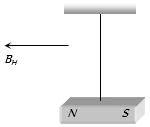
A magnet is suspended horizontally in the earth's magnetic field. When it is displaced and then released it oscillates in a horizontal plane with a period $T$. If a place of wood of the same moment of inertia (about the axis of rotation) as the magnet is attached to the magnet what would the new period of oscillation of the system become
In a Young's double slit experiment, an angular width of the fringe is $0.35^{\circ}$ on a screen placed at $2\,m$ away for particular wavelength of $450\,nm$. The angular width of the fringe, when whole system is immersed in a medium of refractive index $7 / 5$, is $\frac{1}{\alpha}$. The value of $\alpha$ is ..............
A thermometer graduated according to a linear scale reads a value $x_0$ when in contact with boiling water, and $x_0/3$ when in contact with ice. What is the temperature of an object in ${}^oC$, if this thermometer in the contact with the object reads $x_0/2$ ?
The charge given to any conductor resides on its outer surface, because
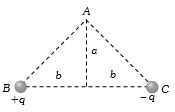
As shown in the figure, charges $ + q$ and $ - q$ are placed at the vertices $B$ and $C$ of an isosceles triangle. The potential at the vertex $A$ is