Question
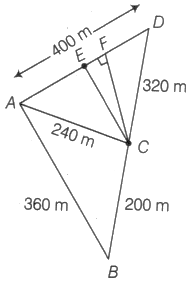
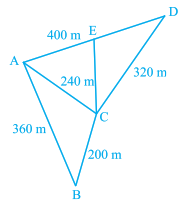
Kamla has a triangular field with sides $240 \ m, 200 \ m, 360 \ m$, where she grew wheat. In another triangular field with sides $240 \ m, 320 \ m, 400 \ m$ adjacent to the previous field, she wanted to grow potatoes and onions.
She divided the field in two parts by joining the mid-point of the longest side to the opposite vertex and grew potatoes in one part and onions in the other part. How much area (in hectares) has been used for wheat, potatoes and onions? [$1$ hectare $= 1000 m^2,$ $\sqrt{2} = 1.41]$
Answer

Let $ABC$ be the field, where wheat is grown. Also, let $ACD$ be the field which has been divided into two parts by joining $C$ to the mid-point $E$ of $AD$. For the area of $\triangle ABC$, we have
$a = 200m, b = 240 m, c = 360m$

Therefore, s = $\frac{200+240+360}{2} = 400 m$
So, area of growing wheat = $\sqrt{s(s-a)(s-b)(s-c)}$
= $\sqrt{400(400-200)(400-240)(400-360)}$
= 1.6 $\times$ $\sqrt{2}$ hec $= 1.6 \times 1.41$ [ $\because 1.6$ hec $= 16000 m^2$]
$= 2.26$ hec(approx.)
Now, we calculate the area of $\triangle ACD.$
Here, s = $\frac{240+320+400}{2} = 480 m$
So, area of $\triangle ACD$
= $\sqrt{480(480-240)(480-320)(480-400)}$
= $\sqrt{480 \times 240 \times 160 \times 80}$= 38400 $m_2$
$= 3.84$ hec [$\because$ 1 $m_2$ = $\frac{1}{10000}$hec]
Now, let $C F \perp AD$. Then,
$\operatorname{ar}(\triangle A E C)=\frac{1}{2} \times A E \times C F=\frac{1}{2} \times E D \times C F[\because A E=E D$, as $E$ is mid-point of $A D]$
$=\operatorname{ar}(\triangle EDC )[\because CF$ is also a height of $\because E D C$ corresponding to base $ED]$
$\therefore$ Area for growing potatoes $=$ Area for growing onions
$=(3.84 \div 2)=1.92 hec$
Hence, area has been used for growing wheat, potatoes and onion are $2.26 hec , 1.92 hec$ and $19.2$ hec , respectively.

Need a full question paper?

Generate a complete, print-ready paper with questions like this in minutes — across 16+ boards, with answer keys.

Start Generating Free

Similar questions

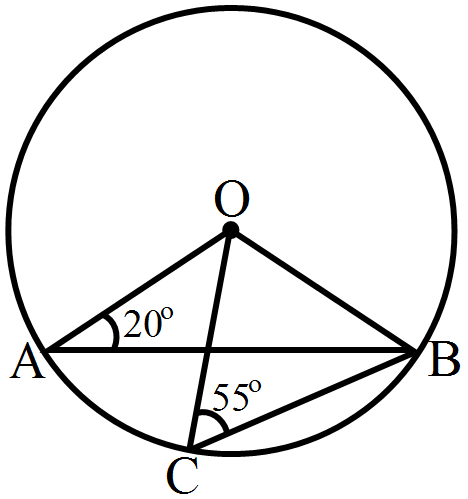
In the given figure, $O$ is the centre of a circle in which $\angle\text{OAB}=20^\circ$and $\angle\text{OCB}=55^\circ.$ Find
$i. \angle\text{BOC}$
$ii. \angle\text{AOC}$
Three coins are tossed simultaneously $100$ times with the following frequencies of different outcomes:
Outcome
No head
One head
Two head
Three head
Frequency
$14$
$38$
$36$
$12$
If the three coins are tossed simultaneously again, compute the probability of:
$1.$ heads coming up.
$2.$ heads coming up.
$3.$ At least one Head coming up.
$4.$ Getting more Tails than Heads.
$5.$ Getting more heads than tails.
A field is in the shape of a trapezium having parallel sides $90\ m$ and $30 \ m$ . These sides meet the third side at right angles. The length of the fourth side is $100\ m$ . If it costs $₹ 5$ to plough $1 m^2$ of the field, find the total cost of ploughing the field.
What length of tarpaulin $3 m$ wide will be required to make conical tent of height $8 m$ and base radius $6 m?$
Assume that the extra length of material that will be required for stitching margins and wastage in cutting is approximately $20 \ cm . ($Use $\pi=3.14$ )
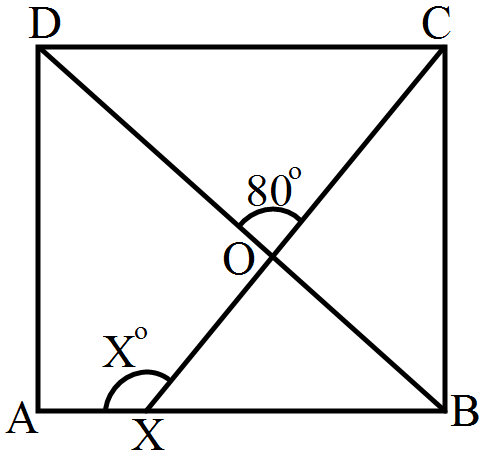
In the adjoining figure, $ABCD$ is a square. $A$ line segment $CX$ cuts $AB$ at $X$ and the diagonal $BD$ at $O$ such that $\angle\text{COD}=80^{\circ}$ and $\angle\text{OXA}=\text{x}^{\circ}.$ Find the value of x.
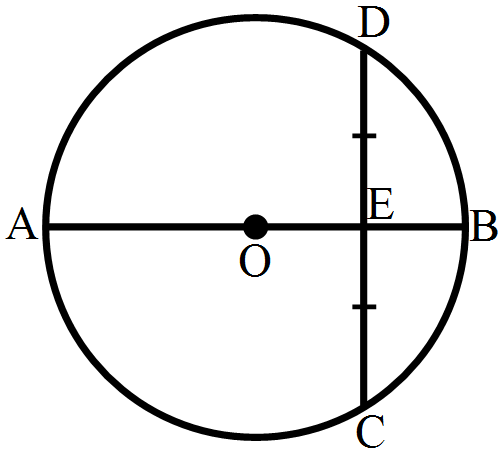
In the given figure, a circle with centre $O$ is given in which a diameter $A B$ bisects the chord $C D$ at a point $E$ such that $C E=E D=8 cm$ and $E B=4 cm$. Find the radius of the circle.
Two circles with centres $O$ and $O'$ intersect at two points $A$ and $B$. $A$ line $PQ$ is drawn parallel to $OO'$ through $A$ or $B$, intersecting the circles at $P$ and $Q$. Prove that $PQ = 2OO'$.
Find the values of $a$ and $b$ if $\frac{7+3 \sqrt{5}}{3+\sqrt{5}}-\frac{7-3 \sqrt{5}}{3-\sqrt{5}}=a+b \sqrt{5}$.
Divide $p(x) by g(x)$, where $p(x) = x + 3x^2 – 1$ and $g(x) = 1 + x$
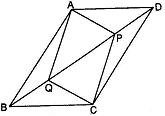
In parallelogram $A B C D$, two points $P$ and $Q$ are taken on diagonal $B D$ such that $D P=B Q$.

Show that
i. $\triangle APD \cong \triangle C Q B$
ii. $A P=C Q$
iii. $\triangle A Q B \cong \triangle C P D$
iv. $A Q=C P$
v. $APCQ$ is a parallelogram.