MCQ
$KI$ when heated with conc. ${H_2}S{O_4}$ gives
- A$HI$
- ✓${I_2}$
- C$HI{O_3}$
- D$KI{O_3}$
${{H}_{2}}S{{O}_{4}}+2HI\,\to \ 2{{H}_{2}}O+\underset{\text{Violet vapour}}{\mathop{{{I}_{2}}+S{{O}_{2}}\uparrow }}\,$
Generate a complete, print-ready paper with questions like this in minutes — across 16+ boards, with answer keys.
Upon treatment with dilute alkaline $KMnO _4, P$ as well as $Q$ could produce one or more than one from $S , T$ and $U$.$Image$
$1.$ Compounds formed form $P$ and $Q$ are, respectively
$(A)$ Optically active $S$ and optically active pair $(T, U)$
$(B)$ Optically inactive $S$ and optically inactive pair $(T, U)$
$(C)$ Optically active pair $(T, U)$ and optically active $S$
$(D)$ Optically inactive pair $(T, U)$ and optically inactive $S$
$2.$ In the following reaction sequences $V$ and $W$ are respectively :$Image$
mcq $Image$
Give the answer question $1$ and $2.$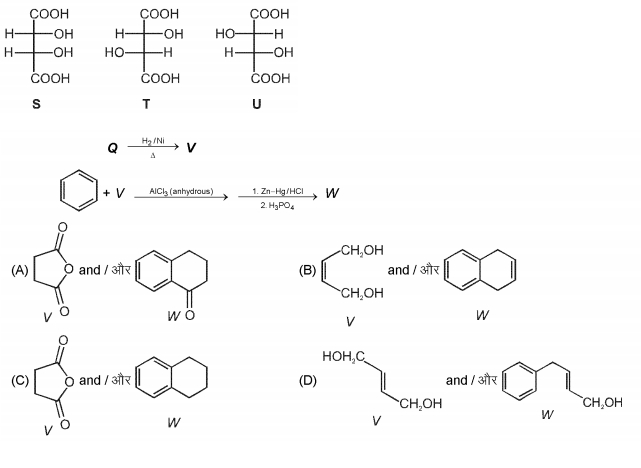
|
List $-I$ (Element) |
List $-II$ (Electronic Configuration) | ||
| $A.$ | $N$ | $I.$ | $[\mathrm{Ar}] 3 \mathrm{~d}^{10} 4 \mathrm{~s}^2 4 \mathrm{p}^5$ |
| $B.$ | $S$ | $II.$ | $[\mathrm{Ne}] 3 \mathrm{~s}^2 3 \mathrm{p}^4$ |
| $C.$ | $Br$ | $III.$ | $[\mathrm{He}] 2 \mathrm{~s}^2 2 \mathrm{p}^3$ |
| $D.$ | $Kr$ | $IV.$ | $[\mathrm{Ar}] 3 \mathrm{~d}^{10} 4 \mathrm{~s}^2 4 \mathrm{p}^6$ |
Choose the correct answer from the options given below: