MCQ
$Kilowatt - hour$ is a unit of
  • A
    Electrical charge
  • Energy
  • C
    Power
  • D
    Force

Answer

Correct option: B.
Energy
b
(b)

Need a full question paper?

Generate a complete, print-ready paper with questions like this in minutes — across 16+ boards, with answer keys.
Start Generating Free

Similar questions

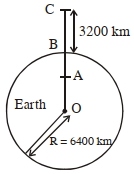
In the reported figure of earth, the value of acceleration due to gravity is same at point $A$ and $C$ but it is smaller than that of its value at point $B$ (surface of the earth). The value of OA $: AB$ will be $x : y .$ The value of $x$ is $\ldots \ldots \ldots$
A particle of mass $M=0.2 kg$ is initially at rest in the $x y$-plane at a point $( x =-l, y =-h)$, where $l=10 m$ and $h=1 m$. The particle is accelerated at time $t =0$ with a constant acceleration $a =10 m / s ^2$ along the positive $x$-direction. Its angular momentum and torque with respect to the origin, in SI units, are represented by $\vec{L}$ and $\vec{\tau}$, respectively. $\hat{i}, \hat{j}$ and $\hat{k}$ are unit vectors along the positive $x , y$ and $z$-directions, respectively. If $\hat{k}=\hat{i} \times \hat{j}$ then which of the following statement($s$) is(are) correct?

$(A)$ The particle arrives at the point $(x=l, y=-h)$ at time $t =2 s$.

$(B)$ $\vec{\tau}=2 \hat{ k }$ when the particle passes through the point $(x=l, y=-h)$

$(C)$ $\overrightarrow{ L }=4 \hat{ k }$ when the particle passes through the point $(x=l, y=-h)$

$(D)$ $\vec{\tau}=\hat{ k }$ when the particle passes through the point $(x=0, y=-h)$

According to Poiseuille's law, the pressure drop per unit length required (overcome viscous forces is $\Delta P =\frac{8 \eta v }{ r ^2}$, where $r$ is the radius of cross section, $v$ is the fluid velocity and $\eta$ is the coefficient of viscosity. A capillary tube of radius a is dipped in a liquid of density $\rho$, surface tension $T$ and coefficient of viscosity $\eta$. The liquid starts rising in it so that its height $h ( t )$ is a function of time t. The resulting rate of change of the momentum of liquid column in the capillary (taking vertically up to be positive direction and the contact angle to be close to $\left.0^{\circ}\right)$ is $-\pi a ^2 \rho gh + F$. Then $F$ is $[ g$ is the acceleration due to gravity):
Which of the following quantities can be written in SI units in kg2 m2 A-2 S-3?
A person can jump higher on the lunar surface than on the earth's surface because:
Center of mass of a system of three particles of masses $1, 2, 3\, kg$ is at the point $(1\, m, 2\, m, 3\, m)$ and center of mass of another group of two particles of masses $2 \,kg$ and $3\, kg$ is at point $(-1 \,m, 3\, m, -2\, m)$ . Where a $5\, kg$ particle should be placed, so that center of mass of the system of all these six particles shifts to center of mass of the first system?
A block is lying on an inclined plane which makes $60^°$ with the horizontal. If coefficient of friction between block and plane is $0.25$ and $g = 10\,m/{s^2}$, then acceleration of the block when it moves along the plane will be ........ $m/s^2$
The mass of a spaceship is $1000\ kg$. It is to be launched from the earth's surface out into free space. The value of $g$ and $R$( radius of earth) are $10\ m/s^2 $ and $6400\ km$ respectively. The required energy for this work will be
A projectile is thrown with some initial velocity at an angle $\alpha$ to the horizontal. Its velocity when it is at the highest point is $(2 / 5)^{1 / 2}$ times the velocity when it is at height half of the maximum height. Find the angle of projection $\alpha$ with the horizontal.
The time period of a satellite, revolving above earth's surface at a height equal to $R$ will be (Given $g =\pi^2 m / s ^2, R =$ radius of earth)