MCQ
Kirchhoff's second law in any closed circuit represents:
- ✓law of conservation of energy
- Blaw of conservation of charge
- Claw of conservation of current
- Dlaw of conservation of momentum
Generate a complete, print-ready paper with questions like this in minutes — across 16+ boards, with answer keys.
In a transformer 220 ac voltage is increased to 2200 volts. If the number of turns in the secondary are 2000, then the number of turns in the primary will be
|
(a) 200 |
(b) 100 |
(c) 50 |
(d) 20 |
The potential difference between points A and B of adjoining figure is

(a) 
|
(b) 
|
(c) |
(d) 2 V |
An e.m.f. of 5 volt is produced by a self inductance, when the current changes at a steady rate from 3 A to 2 A in 1 millisecond. The value of self inductance is
|
(a) Zero |
(b) 5 H |
(c) 5000 H |
(d) 5 mH |
The diagram shows the path of four a-particles of the same energy being scattered by the nucleus of an atom simultaneously. Which of these are/is not physically possible
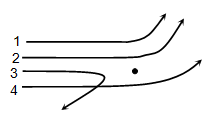
|
(a) 3 and 4 |
(b) 2 and 3 |
(c) 1 and 4 |
(d) 4 only |
Two circuits have coefficient of mutual induction of 0.09 henry. Average e.m.f. induced in the secondary by a change of current from 0 to 20 ampere in 0.006 second in the primary will be
|
(a) 120 V |
(b) 80 V |
(c) 200 V |
(d) 300 V |
Two identical bar magnets are placed on above the other such that they are mutually perpendicular and bisect each other. The time period of this combination in a horizontal magnetic field is T. The time period of each magnet in the same field is
|
(a) |
(b) |
(c) |
(d) |
What is the difference between soft and hard X-rays
|
(a) Velocity |
(b) Intensity |
(c) Frequency |
(d) Polarization |


