MCQ
Kirchhoff’s second law (voltage law) is based on ______ 
  • A
    conservation of charge
  • B
    conservation of mass
  • conservation of energy
  • D
    conservation of momentum

Answer

Correct option: C.
conservation of energy
Kirchhoff’s second law (voltage law) is based on the conservation of energy.

Need a full question paper?

Generate a complete, print-ready paper with questions like this in minutes — across 16+ boards, with answer keys.
Start Generating Free

Similar questions

A bar magnet $10 cm$ long has cross-sectional area $2 cm ^2$ and magnetic dipole moment of 10 A.-m². The magnetization of its material, assumed to be uniform, is
Which of the following statements is correct for diamagnetic materials?
From a metallic surface photoelectric emission is observed for frequencies $v_1$ and $v_2\left(v_1>v_2\right)$ of the incident light. The maximum values of the kinetic energy of the photoelectrons emitted in the two cases are in the ratio $1: x$. Hence the threshold frequency of the metallic surface is
Two simple harmonic waves of the same amplitude and frequency, but $90^{\circ}$ out of phase, pass through the same region in a medium. The resultant wave has
A thermodynamic process of uncontrolled change satisfying the equation $Q=W=0$, is $[ Q =$ heat supplied, $W=$ work done $]$
Electric Intensity due to a charged sphere at a point outside the sphere dectea.ses with
The mutual inductance $(M)$ of the two coils is $3 H$. The self inductances of the coils are $4 H$ and $9 H$ respectively. The coefficient of coupling between the coils is
A proton and an $\alpha-$particle (with their masses in the ratio $1: 4$ and charges in the ratio of $1 : 2$ are accelerated from rest through a potential difference $V$. If a uniform magnetic field $(B)$ is set up perpendicular to their velocities, the ratio of the radii $r_p: r_\alpha$ of the circular paths described by them will be
A particle executing SHM of amplitude $5 cm$ has an acceleration of $27 cm / s ^2$ when it is $3 cm$ from the mean position. Its maximum velocity is
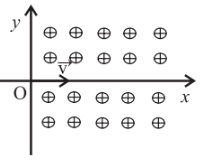
A proton enters a perpendicular uniform magnetic field B at origin along the positive x axis with a velocity v as shown in the figure. Then it will follow the following path. [The magnetic field is directed into the paper].

Image