MCQ
Kirchoff's junction law is equivalent to $......$.
  • A
    Conservation of energy.
  • Conservation of charge.
  • C
    Conservation of electric potential.
  • D
    Conservation of electric flux.

Answer

Correct option: B.
Conservation of charge.

Kirchhoff's junction rule is an application of the principle of conservation of electric charge: current is flow of charge per time, and if current is constant, that which flows into a point in a circuit must equal that which flows out of it.

Need a full question paper?

Generate a complete, print-ready paper with questions like this in minutes — across 16+ boards, with answer keys.
Start Generating Free

Similar questions

The focal length of the objective lens of a compound microscope is
A current loop consists of two identical semicircular parts each of radius $R,$ one lying in the $x-y$ plane and the other in $x-z$ plane. If the current in the loop is $i.$ The resultant magnetic field due to the two semicircular parts at their common centre is
The energy gap in case of which of the following is less than $3\ eV$?
A long straight wire carrying current of $30\,A$ is placed in an external uniform magnetic field of induction $4 \times 10^{-4}$ $T$. The magnetic field is acting parallel to the direction of current. The magnitude of the resultant magnetic induction in tesla at a point $2.0\, cm$ away from the wire is
Two coherent monochromatic light beams of intensities $ I$ and $4I$ are superposed. The maximum and minimum possible intensities in the resulting beam are
The time period of a particle in simple harmonic motion is equal to the time between consecutive appearances of the particle at a particular point in its motion. This point is:
An electric bulb rated for 500 watts at 100 volts is used in a circuit having a 200-volt supply. The resistance R that must be put in series with the bulb, so that the bulb draws 500 W is
A coil having n turns and resistance $R\, \Omega$ is connected with a galvanometer of resistance $4\,R\Omega $. This combination is moved in time $t$ seconds from a magnetic field $W_1$ weber to $W_2$ weber. The induced current in the circuit is
In a Thomson set-up for the determination of e/m, electrons accelerated by 2.5 kV enter the region of crossed electric and magnetic fields of strengths $3.6 \times 10^4 \mathrm{Vm}^{-1}$ and $1.2 \times 10^{-3} \mathrm{~T}$ respectively and go through undeflected. The measured value of e/m of the electron is equal to
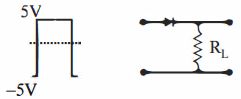
If in a $p -n$ junction diode, a square input signal of $10\ V$ is applied as shown