Question
Kyra has a rectangular painting canvas having a total area of $24\ ft^2$ which includes a border of $0.5\ ft.$ on the left right and a border of $0.75\ ft.$ on the bottom, top inside it.
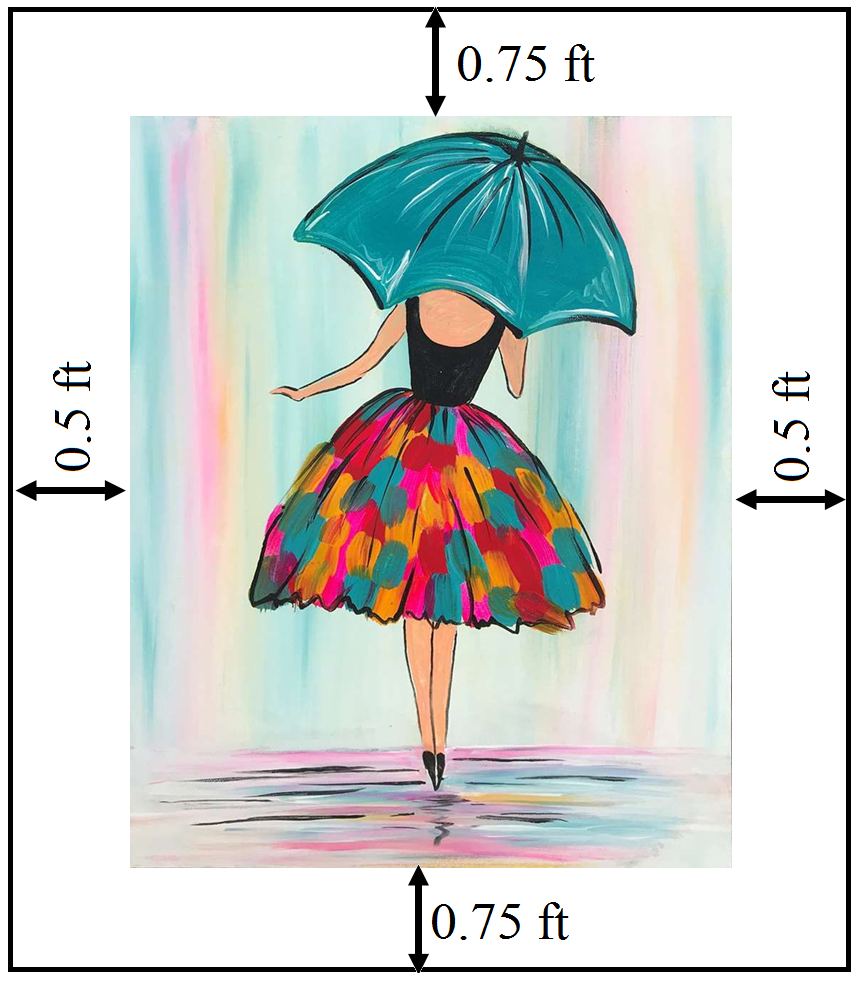
Based on the above information, answer the following questions.
  1. If Kyra wants to paint in the maximum area, then she needs to maximize.
  1. Area of outer rectangle.
  2. Area of inner rectangle.
  3. Area of top border.
  4. None of these.
  1. If $x$ is the length of the outer rectangle, then area of inner rectangle in terms of $x$ is.
  1. $(\text{x}+3)\Big(\frac{24}{\text{x}}-2\Big)$
  2. $(\text{x}-1)\Big(\frac{24}{\text{x}}+1.5\Big)$
  3. $(\text{x}-1)\Big(\frac{24}{\text{x}}-1.5\Big)$
  4. $(\text{x}-1)\Big(\frac{24}{\text{x}}\Big)$
  1. Find the range of $x.$
  1. $(1, \infty)$
  2. $(1, 16)$
  3. $(-\infty, 16)$
  4. $(-1, 16)$
  1. If area of inner rectangle is maximum, then $x$ is equal to.
  1. $2\ ft.$
  2. $3\ ft.$
  3. $4\ ft.$
  4. $5\ ft.$
  1. If area of inner rectangle is maximum, then length and breadth of this rectangle are respectively.
  1. $3\ ft, 4.5\ ft.$
  2. $4.5\ ft, 5\ ft.$
  3. $1\ ft, 2\ ft.$
  4. $2\ ft, 4\ ft.$

Answer

  1. $(b)$ Area of inner rectangle
In order to paint in the maximum area, Kyra needs to maximize the area of inner rectangle.
  1. $(c) (\text{x}-1)\Big(\frac{24}{\text{x}}-1.5\Big)$
Let $x$ be the length and $y$ be the breadth of outer rectangle.
$\therefore$ Length of inner rectangle $= x - 1$
and breadth of inner rectangle $= y - 1.5$
$\therefore A(x) = (x - 1)(y - 1.5) [\therefore xy = 24 ($given$)$
$=\big(\text{x}-1\big)\bigg(\frac{24}{\text{x}}-1.5\bigg)$
  1. $(b)\ (1, 16)$
Dimensions of rectangle $($outer/inner$)$ should be positive.
$\therefore\text{x}-1>0\text{ and }\frac{24}{\text{x}}-1.5>0$
$\therefore\text{x}>1\text{ and }{\text{x}}<16$
$\therefore$ Range of $x$ is $(1, 16)$
  1. $(c)\ 4\ ft$
We have $\text{A}'\text{(x)}=(\text{x}-1)\bigg(\frac{24}{\text{x}}-1.5\bigg)$
$\Rightarrow\text{A}'(\text{x)}=(\text{x}-1)\Big(\frac{-24}{\text{x}^2}\Big)+\bigg(\frac{24}{\text{x}}-1.5\bigg)$
$=\frac{24}{\text{x}^2}-1.5\ \text{and}\ \text{A}''(\text{x})=\frac{-48}{\text{x}^3}$
For $A(x)$ to be maximum or minimum, $A'(x) = 0$
$\Rightarrow-1.5+\frac{24}{\text{x}^2}=0$
$\Rightarrow\text{x}^2=16$
$\Rightarrow\text{x}=\pm4$
$\therefore\text{x}=4 $[Since, length can't be negative$]$
Also, $\text{A}''(4)=\frac{-48}{4^3}<0$
Thus, at $x = 4,$ area is maximum.
  1. $(a)\ 3\ ft, 4.5\ ft.$
If area of inner rectangle is maximum, then Length of inner rectangle $= x - 1 = 4 - 1 = 3\ ft$.
And breadth of inner rectangle =\text{y}-1.5=\frac{24}{\text{x}}-1.5
=\frac{24}{4}-1.5=6-1.5=4.5\ \text{ft}

Need a full question paper?

Generate a complete, print-ready paper with questions like this in minutes — across 16+ boards, with answer keys.

Start Generating Free

Similar questions

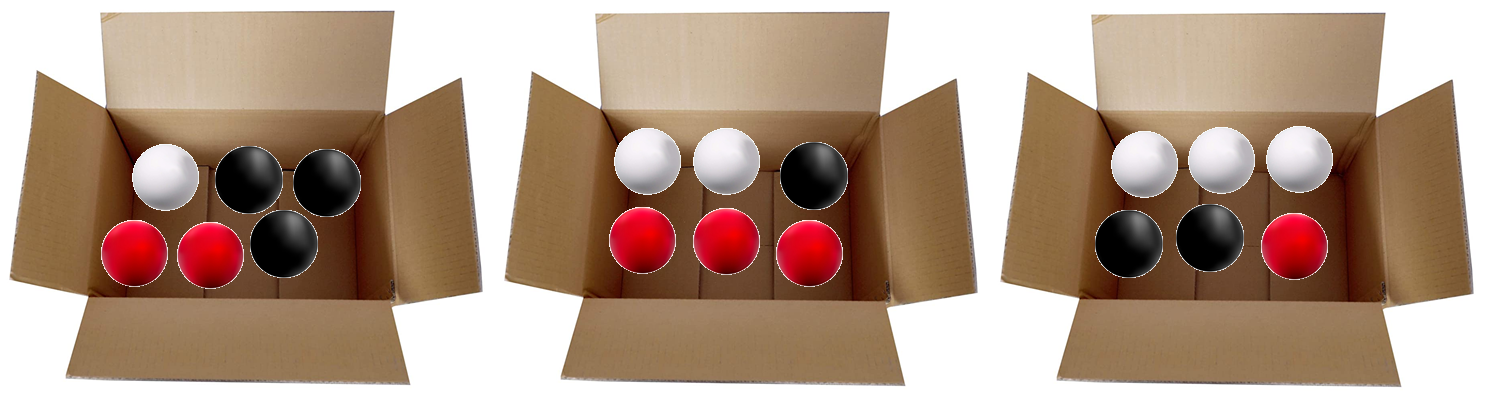
Box $I$ contains $1$ white, $3$ black and $2$ red balls. Box $II$ contains $2$ white, $1$ black and $3$ red balls. Box $III$ contains $3$ white, $2$ black and $1$ red balls. One box is chosen at random and two balls are drawn with replacement.

If $E_1, E_2, E_3$ be the events that the balls drawn from box $I,$ box $II$ and box $III$ respectively and $E$ be the event that balls drawn are one white and one red, then answer the following questions.
  1. Probability of occurrence of event $E$ given that the balls drawn are from box $I,$ is:
  1. $\frac{1}{9}$
  2. $\frac{2}{6}$
  3. $\frac{3}{5}$
  4. $\frac{1}{7}$
  1. Probability of occurrence of event $E,$ given that the balls drawn are from box $II,$ is:
  1. $\frac{1}{3}$
  2. $\frac{1}{4}$
  3. $\frac{3}{4}$
  4. $\frac{3}{5}$
  1. Probability of occurrence of event $E,$ given that balls drawn are from box $III,$ is:
  1. $\frac{1}{12}$
  2. $\frac{3}{11}$
  3. $\frac{1}{6}$
  4. $\frac{4}{11}$
  1. The value of $\displaystyle{\sum^3_{\text{i}=1}}\text{P(E}|\text{E}_\text{i})$ is equal to.
  1. $\frac{5}{18}$
  2. $\frac{1}{2}$
  3. $\frac{1}{18}$
  4. $\frac{11}{18}$
  1. The probability that the balls drawn are from box $II,$ given that event $E$ has already occurred, is:
  1. $\frac{1}{11}$
  2. $\frac{6}{11}$
  3. $\frac{5}{11}$
  4. None of these
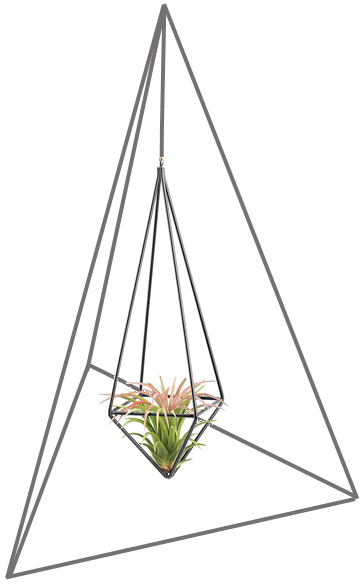
Ginni purchased an air plant holder which is in the shape of a tetrahedron.
Let A, B, C, and Dare the coordinates of the air plant holder where $\text{A}\equiv(1,1,1),\text{B}\equiv(2,1,3),\text{C}\equiv(3,2,2)$ and $\text{D}\equiv(3,3,4).$

Based on the above information, answer the following questions.
  1. Find the position vector of $\overline{\text{AB}}.$
  1. $-\hat{\text{i}}-2\hat{\text{k}}$
  2. $2\hat{\text{i}}+\hat{\text{k}}$
  3. $\hat{\text{i}}+2\hat{\text{k}}$
  4. $-2\hat{\text{i}}-\hat{\text{k}}$
  1. Find the position vector of $\overline{\text{AC}}.$
  1. $2\hat{\text{i}}-\hat{\text{j}}-\hat{\text{k}}$
  2. $2\hat{\text{i}}+\hat{\text{j}}+\hat{\text{k}}$
  3. $-2\hat{\text{i}}-\hat{\text{j}}+\hat{\text{k}}$
  4. $\hat{\text{i}}+2\hat{\text{j}}+\hat{\text{k}}$
  1. Find the position vector of $\overline{\text{AD}}.$
  1. $2\hat{\text{i}}-2\hat{\text{j}}-3\hat{\text{k}}$
  2. $\hat{\text{i}}+\hat{\text{j}}-3\hat{\text{k}}$
  3. $3\hat{\text{i}}+2\hat{\text{j}}+2\hat{\text{k}}$
  4. $2\hat{\text{i}}+2\hat{\text{j}}+3\hat{\text{k}}$
  1. Area of $\triangle\text{ABC}=$
  1. $\frac{\sqrt{11}}{2}\text{sq}.\text{units}$
  2. $\frac{\sqrt{14}}{2}\text{sq}.\text{units}$
  3. $\frac{\sqrt{13}}{2}\text{sq}.\text{units}$
  4. $\frac{\sqrt{17}}{2}\text{sq}.\text{units}$
  1. Find the unit vector along $\overline{\text{AD}}.$
  1. $\frac{1}{\sqrt{17}}(2\hat{\text{i}}+2\hat{\text{j}}+3\hat{\text{k}})$
  2. $\frac{1}{\sqrt{17}}(3\hat{\text{i}}+3\hat{\text{j}}+2\hat{\text{k}})$
  3. $\frac{1}{\sqrt{11}}(2\hat{\text{i}}+2\hat{\text{j}}+3\hat{\text{k}})$
  4. $(2\hat{\text{i}}+2\hat{\text{j}}+3\hat{\text{k}})$
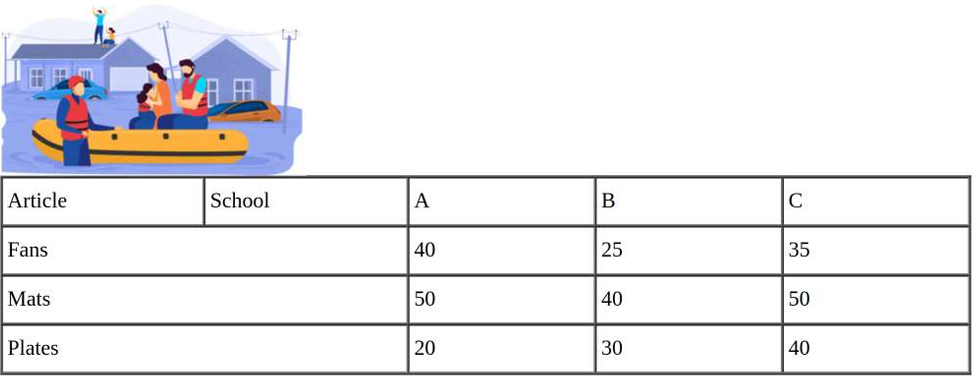
Three schools A, B and C organized a mela for collecting funds for helping the rehabilitation of flood victims. They sold handmade fans, mats, and plates from recycled material at a cost of ₹ 25 , ₹ 100 and ₹ 50 each. The number of articles sold by school A, B, C are given below.

Image

(i) Represent the sale of handmade fans, mats and plates by three schools A, B and C and the sale prices (in ₹) of given products per unit, in matrix form.

(ii) Find the funds collected by school A, B and C by selling the given articles.

(iii) If they increase the cost price of each unit by $20 \%$, then write the matrix representing new price.

OR

Find the total funds collected for the required purpose after $20 \%$ hike in price.

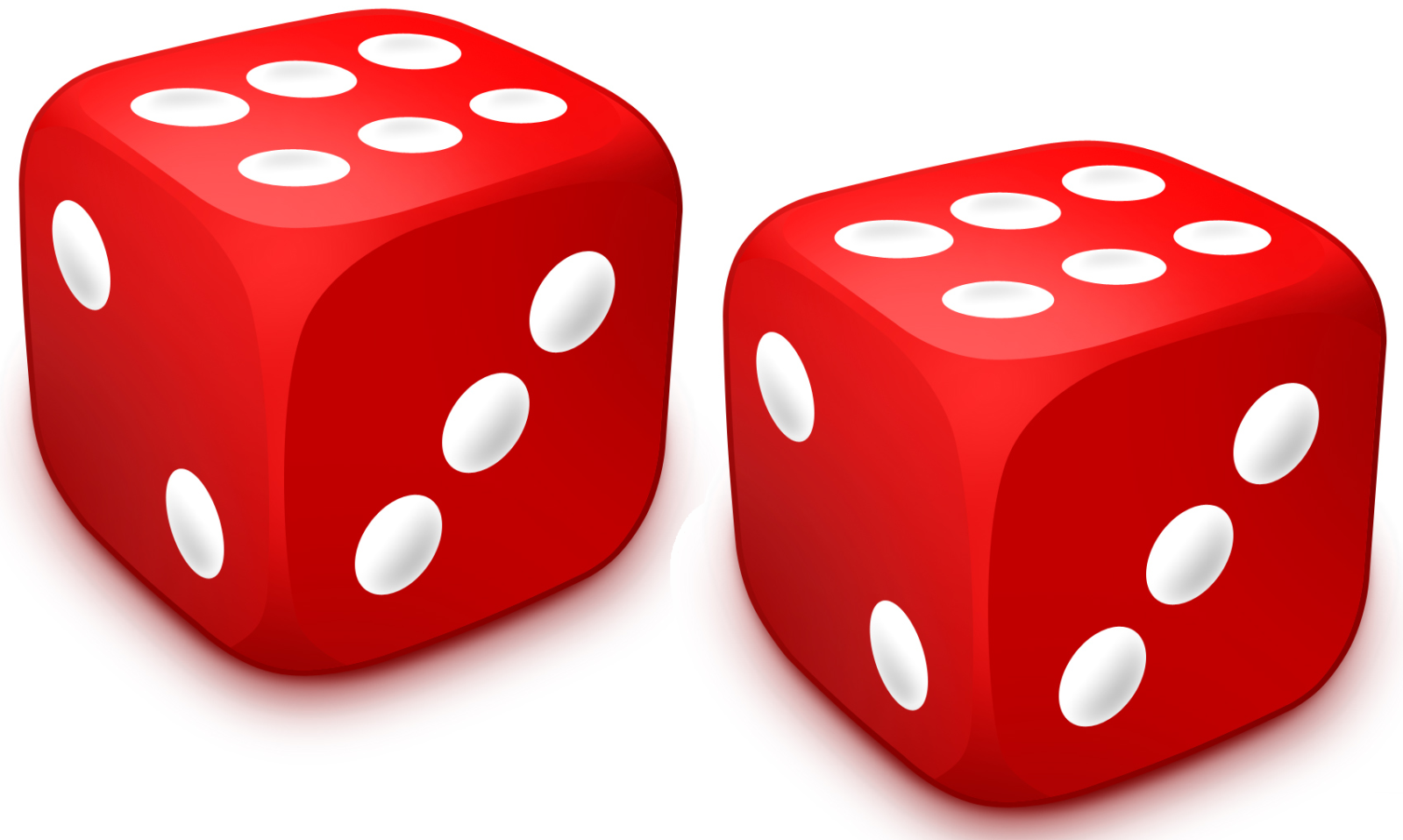
Varun and Jsha decided to play with dice to keep themselves busy at home as their schools are closed due to coronavirus pandemic. Varun throw a dice repeatedly until a six is obtained. He denote the number of throws required by X.
Based on the above information, answer the following questions.
  1. The probability that X = 2 equals.
  1. $\frac{1}{6}$
  2. $\frac{5}{6^2}$
  3. $\frac{5}{3^6}$
  4. $\frac{1}{6^3}$
  1. The probability that X = 4 equals.
  1. $\frac{1}{6^4}$
  2. $\frac{1}{6^6}$
  3. $\frac{5^3}{6^4}$
  4. $\frac{5}{6^4}$
  1. The probability that $\text{X}\geq2$ equals.
  1. $\frac{25}{216}$
  2. $\frac{1}{36}$
  3. $\frac{5}{6}$
  4. $\frac{25}{36}$
  1. The value of $\text{P}(\text{X}\geq6)$ is:
  1. $\frac{5^5}{6^5}$
  2. $1-\frac{5^3}{6^5}$
  3. $\frac{5^3\times61}{6^5}$
  4. $\frac{5^3}{6^4}$
  1. The probability that X > 3 equals.
  1. $\frac{36}{25}$
  2. $\frac{5^2}{6^2}$
  3. $\frac{5}{6}$
  4. $\frac{5^3}{6^3}$
A student is preparing for the competitive examinations LIC AAO, SSC CGL and Bank P.O. The probabilities that the student is selected independently in competitive examination of LIC AAO, SSC CGL and Bank P.O. are a, band c respectively. Of these examinations, students has 50% chance of selection in at least one, 40% chance of selection in at least two and 30% chance of selection in exactly two examinations.

Based on the above information, answer the following questions.
  1. The value of a+ b + e - ab - be - ca + abe is:
  1. 0.3
  2. 0.5
  3. 0.7
  4. 0.6
  1. The value of ab + be + ae - 2abe is:
  1. 0.5
  2. 0.3
  3. 0.4
  4. 0.6
  1. The value of abe is:
  1. 0.1
  2. 0.5
  3. 0.7
  4. 0.3
  1. The value of ab + be + ae is:
  1. 0.1
  2. 0.6
  3. 0.5
  4. 0.3
  1. The value of a + b + e is:
  1. 1
  2. 1.5
  3. 1.6
  4. 1.4
In a family there are four children. All of them have to work in their family business to earn their livelihood at the age of 18. Based on the above information, answer the following questions.
  1. Probability that all children are girls, if it is given that elder child is a boy, is:
  1. $\frac{3}{8}$
  2. $\frac{1}{8}$
  3. $\frac{5}{8}$
  4. None of these.
  1. Probability that all children are boys, if two elder children are boys, is:
  1. $\frac{1}{4}$
  2. $\frac{3}{4}$
  3. $\frac{1}{2}$
  4. None of these.
  1. Find the probability that two middle children are boys, if it is given that eldest child is a girl.
  1. $0$
  2. $\frac{3}{4}$
  3. $\frac{1}{4}$
  4. None of these.
  1. Find the probability that all children are boys, if it is given that at most one of the children is a girl.
  1. $0$
  2. $\frac{1}{5}$
  3. $\frac{2}{5}$
  4. $\frac{4}{5}$
  1. Find the probability that all children are boys, if it is given that at least three of the children are boys.
  1. $\frac{1}{5}$
  2. $\frac{2}{5}$
  3. $\frac{3}{5}$
  4. $\frac{4}{5}$
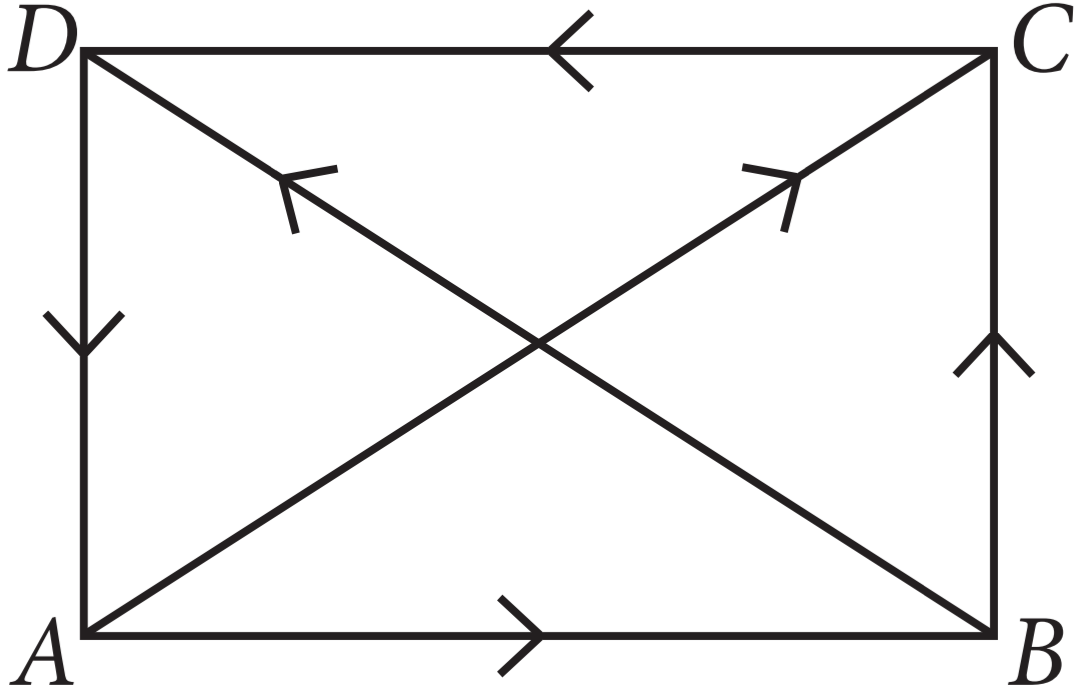
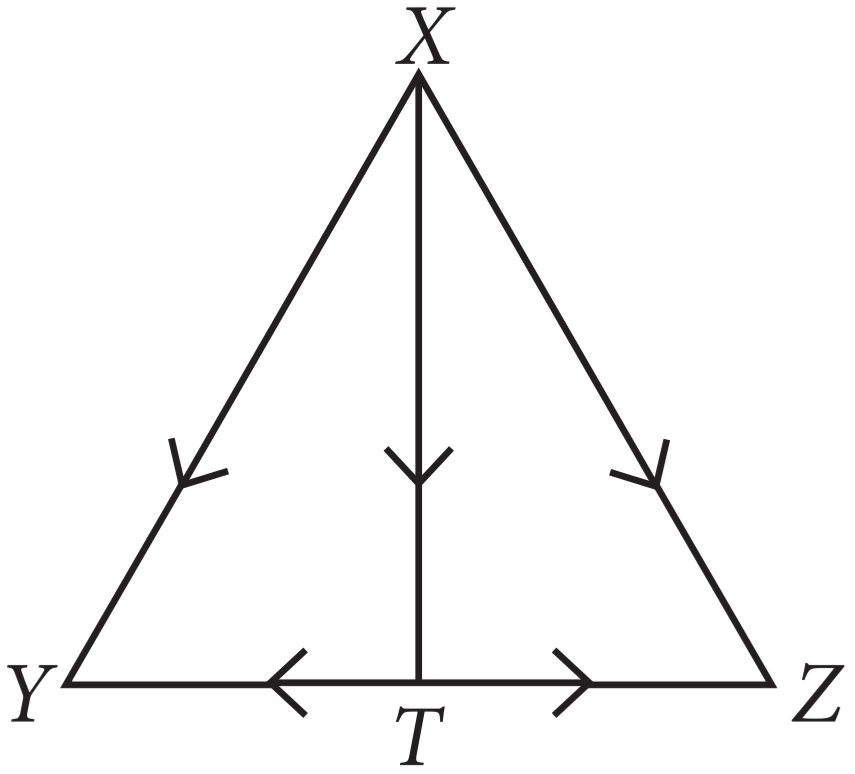
If two vectors are represented by the two sides of a triangle taken in order, then their sum is represented by the third side of the triangle taken in opposite order and this is known as triangle law of vector addition. Based on the above information, answer the following questions.
  1. If $\vec{\text{p}},\vec{\text{q}},\vec{\text{r}}$ are the vectors represented by the sides of a triangle taken in order, then $\vec{\text{q}},+\vec{\text{r}}=$
  1. $\vec{\text{p}}$
  2. $2\vec{\text{p}}$
  3. $-\vec{\text{p}}$
  4. None of these
  1. If ABCD is a parallelogram and AC and BD are its diagonals, then $\overline{\text{AC}}+\overline{\text{BD}}=$
  1. $2\overline{\text{DA}}$
  2. $2\overline{\text{AB}}$
  3. $2\overline{\text{BC}}$
  4. $2\overline{\text{BD}}$
  1. If ABCD is a parallelogram, where $\overline{\text{AB}}=2\vec{\text{a}}$ and $\overline{\text{BC}}=2\vec{\text{b}},$ then $\overline{\text{AC}}-\overline{\text{BD}}=$
  1. $3\vec{\text{a}}$
  2. $4\vec{\text{a}}$
  3. $2\vec{\text{b}}$
  4. $4\vec{\text{b}}$
  1. If ABCD is a quadrilateral whose diagonals are $\overline{\text{AC}}$ and $\overline{\text{BD}},$ then $\overline{\text{BA}}+\overline{\text{DC}}=$
  1. $\overline{\text{AC}}+\overline{\text{DB}}$
  2.  $\overline{\text{AC}}+\overline{\text{BD}}$
  3. $\overline{\text{BC}}+\overline{\text{AD}}$
  4. $\overline{\text{BD}}+\overline{\text{CA}}$
  1. If T is the mid point of side YZ of $\triangle\text{XYZ},$ then $\overline{\text{XY}}+\overline{\text{XZ}}=$
  1. $2\overline{\text{YT}}$
  2. $2\overline{\text{XT}}$
  3. $2\overline{\text{TZ}}$
  4. None of these
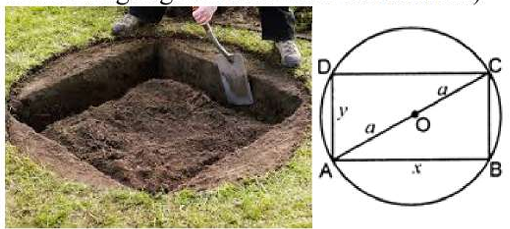
A gardener wants to construct a rectangular bed of garden in a circular patch of land. He takes the maximum perimeter of the rectangular region as possible. (Refer to the images given below for calculations) 

Image

(i) Find the perimeter of rectangle in terms of any one side and radius of circle.

(ii) Find critical points to maximize the perimeter of rectangle?

(iii) Check for maximum or minimum value of perimeter at critical point.

OR

If a rectangle of the maximum perimeter which can be inscribed in a circle of radius $10 \mathrm{~cm}$ is square, then the perimeter of region.

Three schools A, B and C organized a mela for collecting funds for helping the rehabilitation of flood victims. They sold hand made fans, mats and plates from recycled material at a cost of ₹ 25, ₹ 100 and ₹ 50 each. The number of articles sold by school A, B, C are given below.
Article
School
A
B
C
Fans
40
25
35
Mats
50
40
50
Plates
20
30
40
Based on above information, answer the following questions.
  1. If P be a 3 × 3 matrix represent the sale of handmade fans, mats and plates by three schools A, B and C, then
  1. $\begin{matrix}& \ \ \ \ \ \ \ \ \ \ \text{Fans}&\text{Mats}&\text{Plates}\end{matrix}\\\begin{matrix}\ \ \ \ \ \ \ \ \ \ \text{A}\\\text{P}\ =\text{B}\\\ \ \ \ \ \ \ \ \ \ \text{C}\end{matrix}\begin{bmatrix} \ \ 40 \ \ \ & 50 & \ \ \ \ \ 25\\25 & 40 & \ \ \ \ \ 30\\35& \ 50& \ \ \ \ \ 40\end{bmatrix}$
  2. $\begin{matrix}& \ \ \ \ \ \ \ \ \ \ \text{Fans}&\text{Mats}&\text{Plates}\end{matrix}\\\begin{matrix}\ \ \ \ \ \ \ \ \ \ \text{A}\\\text{P}\ =\text{B}\\\ \ \ \ \ \ \ \ \ \ \text{C}\end{matrix}\begin{bmatrix} \ \ 25 \ \ \ & 40 & \ \ \ \ \ 20\\35 & 40 & \ \ \ \ \ 30\\40& \ 50& \ \ \ \ \ 20\end{bmatrix}$
  3. $\begin{matrix}& \ \ \ \ \ \ \ \ \ \ \text{Fans}&\text{Mats}&\text{Plates}\end{matrix}\\\begin{matrix}\ \ \ \ \ \ \ \ \ \ \text{A}\\\text{P}\ =\text{B}\\\ \ \ \ \ \ \ \ \ \ \text{C}\end{matrix}\begin{bmatrix} \ \ 40 \ \ \ & 25 & \ \ \ \ \ 35\\50 & 40 & \ \ \ \ \ 50\\20& \ 30& \ \ \ \ \ 40\end{bmatrix}$
  4. $\begin{matrix}& \ \ \ \ \ \ \ \ \ \ \text{Fans}&\text{Mats}&\text{Plates}\end{matrix}\\\begin{matrix}\ \ \ \ \ \ \ \ \ \ \text{A}\\\text{P}\ =\text{B}\\\ \ \ \ \ \ \ \ \ \ \text{C}\end{matrix}\begin{bmatrix} \ \ 25 \ \ \ & 35 & \ \ \ \ \ 40\\40 & 40 & \ \ \ \ \ 50\\20& \ 30& \ \ \ \ \ 20\end{bmatrix}$
  1. If Q be a 3 x 1 matrix represent the sale prices (in ₹) of given products per unit, then
  1. $\text{Q}=\begin{bmatrix}25\\50\\100\end{bmatrix}\begin{matrix}\text{Fans}\\\text{Mats}\\\text{Plates}\end{matrix}$
  2. $\begin{matrix}\ \ \ \ \ \ \text{Fans}&\text{Mats}&\text{Plates}\end{matrix}\\\text{Q}=\begin{matrix}[25\ \ \ &50&\ \ \ 100]\end{matrix}\\$
  3. $\begin{matrix}\ \ \ \ \ \ \text{Fans}&\text{Mats}&\text{Plates}\end{matrix}\\\text{Q}=\begin{matrix}[25\ \ \ &100&\ \ \ 50]\end{matrix}\\$
  4. $\text{Q}=\begin{bmatrix}25\\100\\50\end{bmatrix}\begin{matrix}\text{Fans}\\\text{Mats}\\\text{Plates}\end{matrix}$
  1. The funds collected by school A by selling the given articles is:
  1. ₹ 7000
  2. ₹ 6125
  3. ₹ 7875
  4. ₹ 8000
  1. The funds collected by school B by selling the given articles is:
  1. ₹ 5125
  2. ₹ 6125
  3. ₹ 7125
  4. ₹ 8125
  1. The total funds collected for the required purpose is:
  1. ₹ 20000
  2. ₹ 21000
  3. ₹ 30000
  4. ₹ 35000
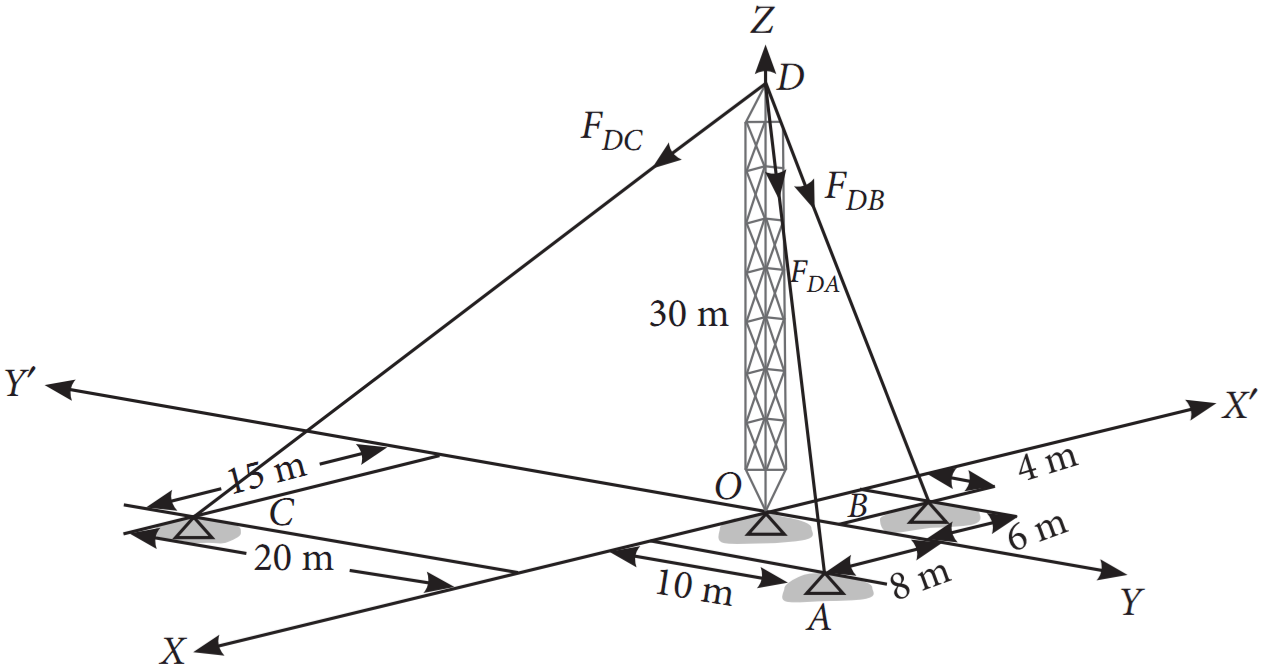
Consider the following diagram, where the forces in the cable are given. Based on the above information, answer the following questions.
  1. The equation of line along the cable AD is:
  1. $\frac{\text{x}}{5}=\frac{\text{y}}{4}=\frac{\text{z}-30}{15}$
  2. $\frac{\text{x}}{4}=\frac{\text{y}}{5}=\frac{\text{z}-30}{15}$
  3. $\frac{\text{x}}{5}=\frac{\text{y}}{4}=\frac{30-\text{z}}{15}$
  4. $\frac{\text{x}}{4}=\frac{\text{y}}{5}=\frac{30-\text{z}}{15}$
  1. The length of cable DC is:
  1. $4\sqrt{61}\text{m}$
  2. $5\sqrt{61}\text{m}$
  3. $6\sqrt{61}\text{m}$
  4. $7\sqrt{61}\text{m}$
  1. The vector DB is:
  1. $-6\hat{\text{i}}+4\hat{\text{j}}-30\hat{\text{k}}$
  2. $6\hat{\text{i}}-4\hat{\text{j}}+30\hat{\text{k}}$
  3. $6\hat{\text{i}}+4\hat{\text{j}}+30\hat{\text{k}}$
  4. None of these
  1. The sum of vectors along the cables is:
  1. $17\hat{\text{i}}+6\hat{\text{j}}+90\hat{\text{k}}$
  2. $17\hat{\text{i}}-6\hat{\text{j}}-90\hat{\text{k}}$
  3. $17\hat{\text{i}}+6\hat{\text{j}}-90\hat{\text{k}}$
  4. None of these
  1. The sum of distances of points A, B and C from the origin, i.e., OA + OB + OC is:
  1. $\sqrt{164}+\sqrt{52}+\sqrt{625}$
  2. $\sqrt{52}+\sqrt{625}+\sqrt{48}$
  3. $\sqrt{164}+\sqrt{625}+\sqrt{49}$
  4. None of these