MCQ
$L, C$ and $R$ represent physical quantities inductance, capacitance and resistance. The combination which has the dimensions of frequency is 
  • $\frac{1}{{RC}}\,\,and\,\,\frac{R}{L}$
  • B
    $\frac{1}{{\sqrt {RC} }}\,\,and\,\,\sqrt {\frac{R}{L}} \,$
  • C
    $\sqrt {LC} $
  • D
    $\frac{C}{L}\,$

Answer

Correct option: A.
$\frac{1}{{RC}}\,\,and\,\,\frac{R}{L}$
a
For RC circuits, time constant is,

$\tau=R C$ has unit of time,

so, $\frac{1}{R C}$ has a unit of frequency,

similary for LC oscillations, $\tau=\sqrt{L C}$

for RL circuit, $\tau=\frac{L}{R}$

so,

$\frac{1}{R C}, \frac{R}{L}$ and $\frac{1}{\sqrt{L C}}$ has units of frequency.

Need a full question paper?

Generate a complete, print-ready paper with questions like this in minutes — across 16+ boards, with answer keys.

Start Generating Free

Similar questions

In a fission reaction ${}_{92}^{236}U \to {}^{117}X + {}^{117}Y + n + n$ , the binding energy per nucleon of $X$ and $Y$ is $8.5\,MeV$ whereas of $^{236}U$ is $7.6\,MeV$ . The total energy liberated will be about
A circular coil having $N$ $turns$ is made from a wire of length $L$ $meter$. If a current $I$ $ampere$ is passed through it and is placed in a magnetic field of $B$ $Tesla$, the maximum torque on it is
A refrigerator is to maintain eatables kept inside at $9^{\circ} C .$ If room temperature is $36^{\circ} C$ calculate the coefficient of performance.
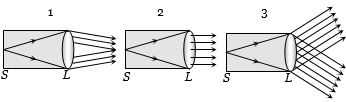
The slit of a collimator is illuminated by a source as shown in the adjoining figures. The distance between the slit $S$ and the collimating lens $L$ is equal to the focal length of the lens. The correct direction of the emergent beam will be as shown in figure
The maximum wavelength that a sample of hydrogen atoms can absorb is
A rubber cord catapult has cross-sectional area $25\,m{m^2}$ and initial length of rubber cord is $10\,cm.$ It is stretched to $5\,cm.$ and then released to project a missile of mass $5gm.$ Taking ${Y_{rubber}} = 5 \times {10^8}N/{m^2}$ velocity of projected missile is ......... $ms^{-1}$
Which of the following figure shows the correct equipotential surfaces of a system of two positive charges?
Three point charges $q, q$ and $-2 q$ are placed at the corners of an equilateral triangle of side '$L$'. Calculate work done by extemal force in moving all the charges far apart without acceleration
If $97.52$ is divided by $2.54$, the correct result in terms of significant figures is
The shortest wavelength in the Lyman series of hydrogen spectrum is $912 Å$ orresponding to a photon energy of $13.6 eV.$ The shortest wavelength in the Balmer series is about.....$\mathop A\limits^o $