MCQ
Lactic acid on oxidation by alkaline potassium permanganate gives
  • A
    Tartaric acid
  • Pyruvic acid
  • C
    Cinnamic acid
  • D
    Propionic acid

Answer

Correct option: B.
Pyruvic acid
b
(b)$C{H_3} - \mathop {CHOH - }\limits_{{\text{Lactic}}\,{\text{acid}}} COOH + [O]\xrightarrow{{KMn{O_4}}}$   $C{H_3}\mathop { - CO - COOH}\limits_{{\text{Pyruvic}}\,{\text{acid}}}  + {H_2}O$

Need a full question paper?

Generate a complete, print-ready paper with questions like this in minutes — across 16+ boards, with answer keys.

Start Generating Free

Similar questions

The product $(c)$ in the following sequence of reactions has . . . . . . . .$\pi$ bonds.
Cellulose is a straight chain polysaccharide composed of only
The noble gases have closed-shell electronic configuration and are monoatomic gases under normal conditions. The low boiling points of the lighter noble gases are due to weak dispersion forces between the atoms and the absence of other interatomic interactions.

The direct reaction of xenon with fluorine leads to a series of compounds with oxidation numbers $+2,+4$ and $+6$ . XeF $4$ reacts violently with water to give $\mathrm{XeO}_3$. The compounds of xenon exhibit rich stereochemistry and their geometries can be deduced considering the total number of electron pairs in the valence shell.

$1.$ Argon is used in arc welding because of its

$(A)$ low reactivity with metal 

$(B)$ ability to lower the melting point of metal

$(C)$ flammability 

$(D)$ high calorific value

$2.$  The structure of $\mathrm{XeO}_3$ is

$(A)$ linear  $(B)$ planar  $(C)$ pyramidal  $(D)$ $T$-shaped

$3.$  $\mathrm{XeF}_4$ and $\mathrm{XeF}_6$ are expected to be

$(A)$ oxidizing  $(B)$ reducing  $(C)$ unreactive  $(D)$ strongly basic

Give the answer question $1,2$ and $3.$

For a reaction, activation energy $\mathrm{E}_{\mathrm{a}}=0$ and the rate constant at $200\; \mathrm{K}$ is $1.6 \times 10^{6} \;\mathrm{s}^{-1} .$ The rate constant at $400\; \mathrm{K}$ will be glven that gas constant]

$\mathrm{R}=8.314\; \mathrm{JK}^{-1} \mathrm{mol}^{-1}$

If $60\%$ of a first order reaction was completed in $60$ minutes, $50\%$ of the same reaction would be completed in approximately ........... $\min.$

$(\log \,4 = 0.60,\, \log \,5 = 0.69)$
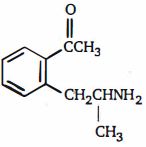
The amino ketone shown below undergoes a spontaneous cyclization on  standing. What is the major product of this intramolecular reaction ?
Sum of $\pi$-bonds present in peroxodisulphuric acid and pyrosulphuric acid is
The standard e.m.f. of a call, involving one electron change is found to be $0.591\,V $ at $25\,^o C$. The equilibrium constant of the reaction is

($F = 96,500\;C\;mo{l^{ - 1}}; \,\, R = 8.314\;J{K^{ - 1}}mo{l^{ - 1}})$

The rate of a reaction $A$ doubles on increasing the temperature from $300$ to $310\, K$. By how much, the temperature of reaction $B$ should be increased from $300\, K$ so that rate doubles if activation energy of the reaction $B$ is twice to that of reaction $A$. ......... $K$
If the rate of the reaction is equal to the rate constant, the order of the reaction is