MCQ
Lanthanide for which $+ II$ and $ + III $ oxidation states are common is
  • $La$
  • B
    $Nd$
  • C
    $Ce$
  • D
    $Eu$

Answer

Correct option: A.
$La$
a
It’s Obvious.
 

Need a full question paper?

Generate a complete, print-ready paper with questions like this in minutes — across 16+ boards, with answer keys.

Start Generating Free

Similar questions

Which of the following metal oxide is not amphoteric
$Pt(s)|Fe^{+2}(10^{-2}\ M, aq),\ $ $ Fe^{+3}(10^{-3}\ M, aq) || MnO_4^-(10^{-3}\ M, aq),\ $$Mn^{+2} (10^{-2}\ M, aq)$

$| Pt(s)$ At $298\ K$, $E^o_{cell}$ for cell is $- 2.31\ V$ , what will be the $E_{cell}$ at $pH = 1$ ? ........... $\mathrm{Volt}$

Which of the following oxidizes ${H_2}O$ to oxygen
One mole of gas absorbs $200\,J$ of heat at constant volume then its temperature rises from $298\,K$ to $308\,K$. Change in internal energy will be....$J$
Which of the following does not give alcohol on reduction
Consider the following complex ions  $ \mathrm{P}=\left[\mathrm{FeF}_6\right]^{3-} $  ,  $ \mathrm{Q}=\left[\mathrm{V}\left(\mathrm{H}_2 \mathrm{O}\right)_6\right]^{2+} $  ,  $ \mathrm{R}=\left[\mathrm{Fe}\left(\mathrm{H}_2 \mathrm{O}\right)_6\right]^{2+}$  The correct order of the complex ions, according to their spin only magnetic moment values (in $B.M.$) is :
Who is called the father of chemistry
Which of following is not product of given reaction ?

$[IMAGE]\,\,\xrightarrow{{{C_2}{H_5}OH/\Delta }}$

Given below are two statements :

Statement $I :$ The limiting molar conductivity of $\mathrm{KCl}$ (strong electrolyte) is higher compared to that of $\mathrm{CH}_{3} \mathrm{COOH}$ (weak electrolyte).

Statement $II :$ Molar conductivity decreases with decrease in concentration of electrolyte.

In the light of the above statements, choose the most appropriate answer from the options given below:

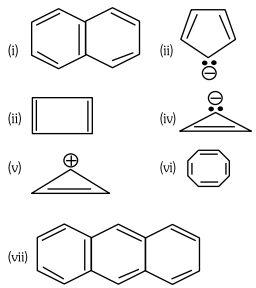
Consider the following compounds/species: 

The number of compounds/species which obey Huckel's rule is $..........$