MCQ
Lapis lazuli is
  • A
    Ferrous sulphate
  • B
    Copper sulphate
  • Sodium alumino silicate
  • D
    Zinc sulphate

Answer

Correct option: C.
Sodium alumino silicate
c
(c) Lapis Lazuli is a rock composed mainly of the following mineral, lazurite, hauynite sodalite, nosean, calcite, pyrite, lapis lazuli is actually sulphur containing, sodium aluminium silicate having chemical composition $3N{a_2}O.3A{l_2}.6Si{O_2}.2N{a_2}S$.

Need a full question paper?

Generate a complete, print-ready paper with questions like this in minutes — across 16+ boards, with answer keys.
Start Generating Free

Similar questions

An electron in a hydrogen atom in its ground state absorbs $2$ times as much energy as the minimum required for it to escape from the atom. The kinetic energy of the emitted electron is ............ $\mathrm{eV}$
On analysis, a saturated hydrocarbon is found to contain $83.70 $ percent carbon and $16.30\%$ hydrogen. The empirical formula will be (at. wt. of $C=12,$ at. wt. of $H = 1$)
$9.0\, gm$  of ${H_2}O$ is vaporised at ${100\,^o}C$ and  $1 \,atm$  pressure. If the latent heat of vaporisation of water is $x\,J/gm$, then $\Delta S$ is given by
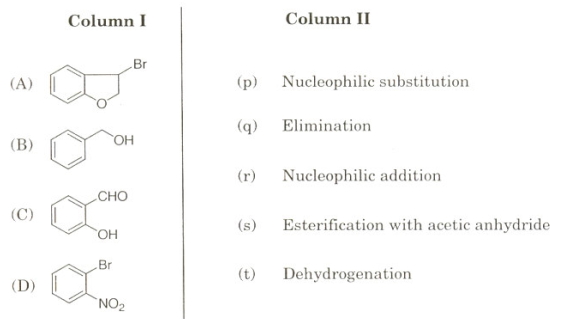
Match each of the compounds given in Column $I$ with the reaction$(s)$, that they can undergo, given in Column $II$.
Given below are two statements:

Statement $I$ : The boiling point of three isomeric pentanes follows the order

n-pentane $>$ isopentane $>$ neopentane

Statement $II$ : When branching increases, the molecule attains a shape of sphere. This results in smaller surface area for contact, due to which the intermolecular forces between the spherical molecules are weak, thereby lowering the boiling point.

In the light of the above statements, choose the most appropriate answer from the options given below:

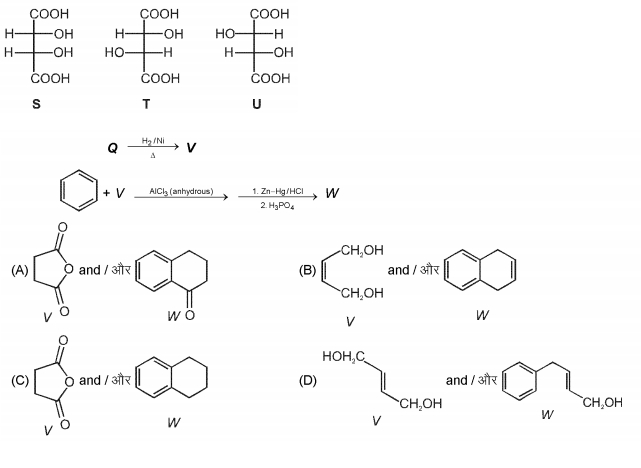
$P$ and $Q$ are isomers of dicarboxylic acid $C _4 H _4 O _4$. Both decolorize $Br _2 / H _2 O$. On heating, $P$ forms the cyclic anhydride.

Upon treatment with dilute alkaline $KMnO _4, P$ as well as $Q$ could produce one or more than one from $S , T$ and $U$.$Image$

$1.$ Compounds formed form $P$ and $Q$ are, respectively

$(A)$ Optically active $S$ and optically active pair $(T, U)$

$(B)$ Optically inactive $S$ and optically inactive pair $(T, U)$

$(C)$ Optically active pair $(T, U)$ and optically active $S$

$(D)$ Optically inactive pair $(T, U)$ and optically inactive $S$

$2.$ In the following reaction sequences $V$ and $W$ are respectively :$Image$

mcq $Image$

Give the answer question $1$ and $2.$
Dehydrohalogenation of an alkyl halide is a/an
The maximum valency of an element with atomic number $7$ is
Amongst $LiCl, RbCl,$ $BeC{l_2}$ and $MgC{l_2}$ the compounds with the greatest and the least ionic character, respectively, are
$\text{H}-\text{O}-\text{H}$ bond angle in water is: