MCQ
Laser beams are used to measure long distances because
  • A
    They are monochromatic
  • B
    They are highly polarised
  • C
    They are coherent
  • They have high degree of parallelism

Answer

Correct option: D.
They have high degree of parallelism
d
(d) Laser beams are perfectly parallel. So that they are very narrow and can travel a long distance without spreading. This is the feature of laser while they are monochromatic and coherent these are characteristics only.

Need a full question paper?

Generate a complete, print-ready paper with questions like this in minutes — across 16+ boards, with answer keys.
Start Generating Free

Similar questions

A Body moves $6\, m$ north. $8 \,m$ east and $10\;m$ vertically upwards, what is its resultant displacement from initial position
For an isometric process
An unpolarised beam of intensity $2 a^{2}$ passes through a thin polaroid. Assuming zero absorption in the polaroid, the intensity of emergent plane polarised light is
Two lenses of power $ 6D$ and $-2D$ are combined to form a single lens. The focal length of this lens will be
The charge density in a nucleus varies with distance from the centre of the nucleus according to the curve in Fig.
Five particles of mass = $2\ kg$ are attached to the rim of a circular disc of radius $0.1\ m$ and negligible mass. Moment of inertia of the system about the axis passing through the centre of the disc and perpendicular to its plane is ........ $kg\,m^2$
A nucleus of mass $M + \Delta m$ is at rest and decays into two  daughter nuclei of equal mass $\frac{M}{2}$ each. Speed of light is $c.$ The binding energy per nucleon for the parent nucleus is $E_1$ and that for the daughter nuclei is $E_2$ . Then
A hospital uses an ultrasonic scanner to locate tumours in a tissue. The operating frequency of the scanner is $4.2 MHz$. The speed of sound in a tissue is $1.7 \,km-s^{-1}$. The wavelength of sound in the tissue is close to
Which of the following statements is true for an $N$ -type semiconductor
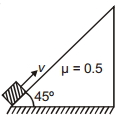
A block of mass $1 \,kg$ is projected from the lowest point up along the inclined plane. If $g=10 \,ms ^{-2}$, the retardation experienced by the block is ............. $ms ^ {-2}$