MCQ
$\left[ Co \left( C _{2} O _{4}\right)_{3}\right]^{3-}$ is a :
  • Low spin complex
  • B
    Paramagnetic
  • C
    High spin
  • D
    $sp ^{3} d ^{2}$ hybridized

Answer

Correct option: A.
Low spin complex
a
In coordination complex $\left[ Co \left( C _{2} O _{4}\right)_{3}\right]^{3-}, Co ^{3+}$ acts as a central metal ion.

$Co ^{3+}$ shows $d ^{2} sp ^{3}$ hybridization hence all the electrons are paired and diamagnetic in nature. Thus, it is a low spin complex.

Need a full question paper?

Generate a complete, print-ready paper with questions like this in minutes — across 16+ boards, with answer keys.

Start Generating Free

Similar questions

The pair of compounds in which both the compounds give positive test with Tollen's reagent is
The enthalpy of combustion of propane, graphite and dihydrogen at $298\,K$ are: $-2220.0\,kJ\,mol ^{-1}$, $393.5\,kJ mol ^{-1}$ and $-285.8\,kJ\,mol ^{-1}$ respectively. The magnitude enthalpy of formation of propane $\left( C _{3} H _{8}\right)$ is......... $kJ\,mol\,{ }^{-1}$. (Nearest integer)
The crystal lattice of ice is mostly formed by
$75\%$ of a first order reaction was completed in $ 32$ minutes when was $50\% $ of the reaction completed ........... $\min.$
An organic compound $'A'$ on reaction with $PCC$ (Phyridiniumchlorochromate) gives a compound $'B'$. Which on further reaction with $I_2$ and $NaOH$ forms tri-iodomethane Identify the compound $'A'$.
The relative reactivity of $1\,^oH, 2\,^oH$ and $3\,^oH$ in bromination reaction has been found to be $1 : 82 : 1600$ respectively. In the reaction

$\begin{array}{*{20}{c}}
  {C{H_3}\,\,\,\,\,\,\,\,\,\,\,\,\,\,\,\,\,\,\,\,\,\,\,\,\,\,\,\,\,\,\,\,\,\,\,\,\,\,\,\,\,\,\,} \\ 
  {|\,\,\,\,\,\,\,\,\,\,\,\,\,\,\,\,\,\,\,\,\,\,\,\,\,\,\,\,\,\,\,\,\,\,\,\,\,\,\,\,\,\,\,\,\,\,\,\,\,} \\ 
  {C{H_3} - CH - C{H_3}(excess) + B{r_2}\xrightarrow{{hv}}} 
\end{array}$ $\mathop {\begin{array}{*{20}{c}}
  {\,\,\,\,\,C{H_3}} \\ 
  | \\ 
  {C{H_3} - C - C{H_3}} \\ 
  | \\ 
  {\,\,Br} 
\end{array}}\limits_{(A)} $   +   $\mathop {\begin{array}{*{20}{c}}
  {C{H_3}\,\,\,\,\,\,\,\,\,\,} \\ 
  {\,\,|\,\,\,\,\,\,\,\,\,\,\,\,\,\,\,\,\,\,\,} \\ 
  {C{H_3} - CH - C{H_2} - Br} 
\end{array}}\limits_{(B)} $ 

the percentage yields of the products $(A)$ and $(B)$ are expected to be

Correct order of basic strength is:
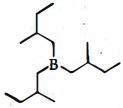
Which of the following compound would yield trialkylborane shown below when  treated with $BH_3/THF$?
The total number of monohalogenated organic products in the following (including stereoisomers) reaction is.........

$\begin{array}{*{20}{c}} A \\ {{\text{(simplest optically active alkene)}}} \end{array}\,\xrightarrow[{(ii)\,{X_2}/\Delta }]{{(i)\,{H_2}/Ni/\Delta }}$

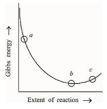
Consider the graph of $G i b b s$ free energy $G$ vs Extent of reaction. The number of statement/s from the following which are true with respect to points $(a), (b)$ and $(c)$ is $.................$

$A.$Reaction is spontaneous at $(a)$ and $(b)$

$B.$Reaction is at equilibrium at point $(b)$ and nonspontaneous at point $(c)$

$C.$Reaction is spontaneous at $(a)$ and nonspontaneous at $(c)$

$D.$Reaction is non-spontaneous at $(a)$ and $(b)$