Question
$\left[ Cr \left( NH _3\right)_6\right]^{3+}$ is paramagnetic while [Ni(CN)4]2- is diamagnetic. Explain why?

Answer

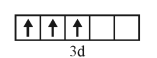
In [Cr(NH3)6]3+, Cr is in +3 oxidation state whose electronic configuration is 3d3, which has three unpaired electrons.
Image
These unpaired electrons remain present even after the hybridization (d2sp3) because only vacant d-orbitals are used in hybridization, hence [Cr(NH3)6]3+ is paramagnetic but in $\left[ Ni ( CN )_4\right]^{2-}, Ni$ is in $Ni ^{2+}$ state whose configuration is 3d8. Due to strong ligand CN-, its unpaired electrons becomes paired at the time of hybridization, hence it is diamagnetic.

Need a full question paper?

Generate a complete, print-ready paper with questions like this in minutes — across 16+ boards, with answer keys.
Start Generating Free

Similar questions

Answer the following questions:
Illustrate the following reactions:
  1. Hoffmann bromamide degradation reaction.
  2. Coupling reaction.
Discuss the reactivity of aldehydes and ketones towards the nucleophilic addition reaction.
Based on solute-solvent interactions, arrange the following in order of increasing solubility in n-octane and explain. Cyclohexane, KCl, CH3OH, CH3CN.
Write complete reaction for the bromination of phenol in aqueous and non aqueous medium.
State Raoult’s law for a solution containing non-volatile solute. What type of deviation from Raoult’s law is shown by a solution of chloroform and acetone and why?
Explain physical properties of transition elements.
Arrange the compound in increasing order of their property as indicated :
Benzoic acid 4-Nitrobenzoic acid, 3,4-Dinitro benzoic acid, 4-Methoxy benozic acid (Acid strength)
(i) Complete the following reaction :
$CH _2= CH - CH _2- Br \xrightarrow[\text { Peroxide }]{ HBr }$
(ii) How form n-propyl bromide from isopropyl bromide?
Answer the following:
(a) For a certain reaction large fraction of molecules has energy more than the threshold energy, yet the rate of reaction is very slow. Why?
(b) State a condition under which a bimolecular reaction is kinetically first-order reaction.