MCQ
$\left| {\,\begin{array}{*{20}{c}}{{{\log }_3}512}&{{{\log }_4}3}\\{{{\log }_3}8}&{{{\log }_4}9}\end{array}\,} \right| \times \left| {\,\begin{array}{*{20}{c}}{{{\log }_2}3}&{{{\log }_8}3}\\{{{\log }_3}4}&{{{\log }_3}4}\end{array}\,} \right|=$
  • A
    $7$
  • $10$
  • C
    $13$
  • D
    $17$

Answer

Correct option: B.
$10$
b
(b) $\left| {\,\begin{array}{*{20}{c}}{{{\log }_2}512}&{{{\log }_8}3}\\{{{\log }_3}8}&{{{\log }_3}9}\end{array}\,} \right|$  $×$  $\left| {\,\begin{array}{*{20}{c}}{{{\log }_2}3}&{{{\log }_8}3}\\{{{\log }_3}4}&{{{\log }_3}4}\end{array}\,} \right|$

$ = \left( {\frac{{\log 512}}{{\log 3}} \times \frac{{\log 9}}{{\log 4}} - \frac{{\log 3}}{{\log 4}} \times \frac{{\log 8}}{{\log 3}}} \right)$

$×$ $\left( {\frac{{\log 3}}{{\log 2}} \times \frac{{\log 4}}{{\log 3}} - \frac{{\log 3}}{{\log 8}} \times \frac{{\log 4}}{{\log 3}}} \right)$

$= \left( {\frac{{\log {2^9}}}{{\log 3}} \times \frac{{\log {3^2}}}{{\log {2^2}}} - \frac{{\log {2^3}}}{{\log {2^2}}}} \right)$ $×$ $\left( {\frac{{\log {2^2}}}{{\log 2}} - \frac{{\log {2^2}}}{{\log {2^3}}}} \right)$

$= \left( {\frac{{9 \times 2}}{2} - \frac{3}{2}} \right)\,\left( {2 - \frac{2}{3}} \right) = \frac{{15}}{2} \times \frac{4}{3} = 10$.

Need a full question paper?

Generate a complete, print-ready paper with questions like this in minutes — across 16+ boards, with answer keys.

Start Generating Free

Similar questions

Let $f(x) = \left\{ {\begin{array}{*{20}{c}}{0,}&{x < 0}\\{{x^2},}&{x \ge 0}\end{array}} \right.$ , then for all values of $x$
If A is a 3 × 3 matrix and det(3A) = k(detA), then k =
  1. 9
  2. 6
  3. 1
  4. 27
Statement $1$ : If $A$ and $B$ be two sets having $p$ and $q$ elements respectively, where $q > p$. Then the total number of functions from set $A$ to set $B$ is $q^P$.
Statement $2$ : The total number of selections of $p$ different objects out of $q$ objects is ${}^q{C_p}$.
Find the principal values of: $\tan ^{-1}(\sqrt{3})$
The area bounded by y = xand y = 1 - x2 is:
  1. $\frac{\sqrt{8}}{3}$
  2. $\frac{16}{3}$
  3. $\frac{32}{3}$
  4. $\frac{17}{3}$
The number of binary operation that can be defined on a set of 2 elements is:
  1. 8
  2. 4
  3. 16
  4. 64
If G is the set of all matrices of the form $\begin{bmatrix}\text{x}&\text{x}\\\text{x}&\text{x}\end{bmatrix}$, where $\text{x}\in\text{R}-\{0\}$, then the identity element with respect to the multiplication of matrices as binary operation, is:
  1. $\begin{bmatrix}1&1\\1&1\end{bmatrix}$
  2. $\begin{bmatrix}-\frac{1}2&-\frac{1}2\\-\frac{1}2&-\frac{1}2\end{bmatrix}$
  3. $\begin{bmatrix}\frac{1}2&\frac{1}2\\\frac{1}2&\frac{1}2\end{bmatrix}$
  4. $\begin{bmatrix}-1&-1\\-1&-1\end{bmatrix}$
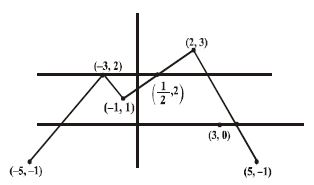
The graph of $y = f(x)$ is shown then number of solutions of the equation $f(f(x)) =2$ is
Choose the correct answer from the given four options.
$\text{X}$
$1$
$2$
$3$
$4$
$\text{P}(\text{X})$
$\frac{1}{10}$
$\frac{1}{5}$
$\frac{3}{10}$
$\frac{2}{5}$
For the following probability distribution E(X2) is equal to:
The equation of the normal to the curve 3x2 - y2 = 8 which is parallel to x + 3y = 8 is:
  1. x + 3y = 8
  2. x + 3y + 8 = 0
  3. x + 3y ± 8 = 0
  4. x + 3y = 0