MCQ
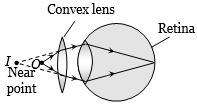
Lens used to remove long sightedness (hypermetropia) is
- AConcave lens
- BPlano-concave lens
- CConvexo-concave lens
- ✓Convex lens
Generate a complete, print-ready paper with questions like this in minutes — across 16+ boards, with answer keys.
Use the model described above to answer the following three questions for a particle moving in the line $x=0$ to $x=a$. Take $h=6.6 \times 10^{-34} \mathrm{~J} \mathrm{~s}$ and $e=1.6 \times 10^{-19} \mathrm{C}$.
$1.$ The allowed energy for the particle for a particular value of $n$ is proportional to
$(A)$ $a^{-2}$ $(B)$ $a^{-3 / 2}$ $(C)$ $a^{-1}$ $(D)$ $a^2$
$2.$ If the mass of the particle is $m=1.0 \times 10^{-30} \mathrm{~kg}$ and $a=6.6 \mathrm{~nm}$, the energy of the particle in its ground state is closest to
$(A)$ $0.8 \ \mathrm{meV}$ $(B)$ $8 \ \mathrm{meV}$ $(C)$ $80 \ \mathrm{meV}$ $(D)$ $800 \ \mathrm{meV}$
$3.$ The speed of the particle, that can take discrete values, is proportional to
$(A)$ $n^{-3 / 2}$ $(B)$ $n^{-1}$ $(C)$ $n^{1 / 2}$ $(D)$ $n$
Give the answer question $1, 2$ and $3.$