MCQ
Lenz's law is a direct consequence of:
  • A
    The law of conservation of momentum.
  • B
    The law of conservation of charge.
  • The law of conservation of energy.
  • D
    The law of conservation of emf.

Answer

Correct option: C.
The law of conservation of energy.

Lenz's law states that the current induced in a circuit due to a change or a motion in a magnetic field is so directed as to oppose the change in flux.
We know that induced EMF produces a current that opposes the change in flux, because a change in flux means a change in energy.Energy can enter or leave, but not instantaneously. So, Lenz' law is a consequence of the law of conservation of energy.

Need a full question paper?

Generate a complete, print-ready paper with questions like this in minutes — across 16+ boards, with answer keys.

Start Generating Free

Similar questions

The induced $emf$ can be produced in a coil by

$A.$ moving the coil with uniform speed inside magnetic field

$B.$ moving the coil with non-uniform speed inside uniform magnetic field

$C.$ rotating the coil inside the uniform magnetic field

$D.$ changing the area of the coil inside the uniform magnetic field

Choose the correct answer from the options given below:
The magnetic field of the earth can be modelled by that of a point dipole placed at the centre of the earth. The dipole axis makes an angle of $11.3^\circ $ with the axis of the earth. At Mumbai, declination is nearly zero. Then,
$4 eV$ is the energy of the incident photon and the work function in $2eV.$ What is the stopping potential ............. $V$ 
An a-particle of 5 MeV energy strikes with a nucleus of uranium at stationary at an scattering angle of $180^{\circ}$. The nearest distance upto which a-particle reaches the nucleus will be of the order of
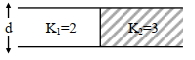
A capacitor of $10 \mu \mathrm{F}$ capacitance whose plates are separated by $10 \mathrm{~mm}$ through air and each plate has area $4 \mathrm{~cm}^2$ is now filled equally with two dielectric media of $\mathrm{K}_1=2, \mathrm{~K}_2=3$ respectively as shown in figure. If new force between the plates is $8 \mathrm{~N}$. The supply voltage is . . . .. . .V.
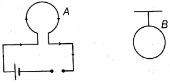
A system $S$ consists of two coils $A$ and $B$. The coil $A$ carries a steady current $I .$ While the coil $B$ is suspended nearby as shown in figure. Now, if the system is heated, so as to raise the temperature of two coils steadily, then
A current source sends a current $\text{I}-\text{i}_0\cos(\omega\text{t}).$ when connected across an unknown load, it gives a voltage output of $\text{v}=\text{v}_0\sin[\omega\text{t}+(\frac{\pi}{4})]$across that load. then the voltage across the current source may be brought in phase with the current through it by.
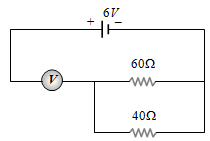
The measurement of voltmeter in the following circuit is
A ray is incident at an angle of incidence i on one surface of a small angle prism (with angle of prism $A$) and emerges normally from the opposite surface. If the refractive index of the material of the prism Is $\mu,$ then the angle of incidence is nearly equal to
Two short magnets having magnetic moments in the ratio 27 : 8, when placed on opposite sides of a deflection magnetometer, produce no deflection. If the distance of the weaker magnet is 0.12 m from the centre of deflection magnetometer, the distance of the stronger magnet from the centre is