Question
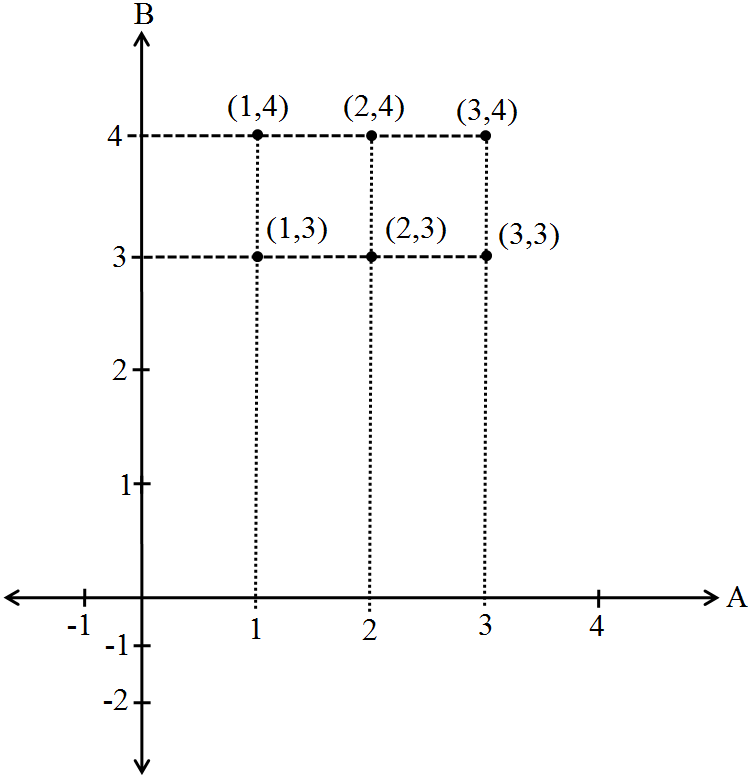
Let A = {1, 2, 3} and B = {3, 4}. Find A × B and show it graphically.

Answer

We have, A = {1, 2, 3} and B = {3, 4} $\therefore$ A × B = {1, 2, 3} × {3, 4} = {(1, 3), (1, 4), (2, 3), (2, 4), (3, 3), (3, 4)} To represent A × B graphically, follow the given steps: Draw two mutually perpendicular lines-one horizontal and one vertical. On the horizontal line, represent the elements of set A and on the vertical line, represent the elements of set B. Draw vertical dotted lines through points representing elements of set A on the horizontal line and horizontal lines through points representing elements of set B on the vertical line. The points of intersection of these lines will represent A × B graphically.

Need a full question paper?

Generate a complete, print-ready paper with questions like this in minutes — across 16+ boards, with answer keys.
Start Generating Free

Similar questions

Show that the expansion $\Big(\text{x}^2+\frac{1}{\text{x}}\Big)^{12}$ does not contain any term involving $x^{-1}.$
Prove that:
$3\sin\frac{\pi}{6}\sec\frac{\pi}{3}-4\sin\frac{5\pi}{6}\cot\frac{\pi}{4}=1$
Check the validity of the following statement.
q : 131 is a multiple of 3 or 11.
A variable line passes through a fixed point $P.$ The algebraic sum of the perpendiculars drawn from the points $(2, 0), (0, 2)$ and $(1, 1)$ on the line is zero. Find the coordinates of the point $P.$
$[$Hint: Let the slope of the line be m. Then the equation of the line passing through the fixed point $P (x_1, y_1)$ is $y - y_1 = m (x - x_1)$. Taking the algebraic sum of perpendicular distances equal to zero$,$ we get $y - 1 = m (x - 1).$ Thus $(x_1, y_1)\  is\  (1, 1).]$
Find the coordinates of the foci, the vertices, the length of major axis, the minor axis, the eccentricity and the length of the latus rectum of the ellipse.
$\frac{{{x^2}}}{{100}} + \frac{{{y^2}}}{{400}} = 1$
Find the coordinates of the foci and the vertices, the eccentricity, the length of the latus rectum of the hyperbolas: $\frac{x^{2}}{9}-\frac{y^{2}}{16}=1$
If $\frac{1}{\text{a}},\ \frac{1}{\text{b}},\ \frac{1}{\text{c}}$ are in A.P., Prove that:
$\frac{\text{b}+\text{c}}{\text{a}},\ \frac{\text{c}+\text{a}}{\text{b}},\ \frac{\text{a}+\text{b}}{\text{c}}$ are in A.P.
The 10th and 18th terms of an A.P. are 41 and 73 respectively. Find 26th term.
$\frac{\cos10^\circ+\sin10^\circ}{\cos10^\circ-\sin10^\circ}$ is equal to:
Prove that:
$\tan\frac{11\pi}{3}-2\sin\frac{4\pi}{6}-\frac{3}{4}\text{cosec}^2\frac{\pi}{4}+4\cos^2\frac{17\pi}{6}=\frac{3-4\sqrt{3}}{2}$