MCQ
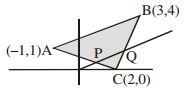
Let $A (-1,1), B (3,4)$ and $C (2,0)$ be given three points. $A$ line $y = mx , m > 0$, intersects lines $AC$ and $BC$ at point $P$ and $Q$ respectively. Let $A _{1}$ and $A _{2}$ be the areas of $\Delta ABC$ and $\Delta PQC$ respectively, such that $A _{1}=3 A _{2}$, then the value of $m$ is equal to:
  • A
    $\frac{4}{15}$
  • $1$
  • C
    $2$
  • D
    $3$

Answer

Correct option: B.
$1$
b
$P \equiv\left( x _{1}, mx _{1}\right)$

$Q \equiv\left( x _{2}, mx _{2}\right)$

$A _{1}=\frac{1}{2}\left|\begin{array}{ccc}3 & 4 & 1 \\ 2 & 0 & 1 \\ -1 & 1 & 1\end{array}\right|=\frac{13}{2}$

$A _{2}=\frac{1}{2}\left|\begin{array}{ccc} x _{1} & mx _{1} & 1 \\ x _{2} & mx _{2} & 1 \\ 2 & 0 & 1\end{array}\right|$

$A _{2}=\frac{1}{2}\left|2\left( mx _{1}- mx _{2}\right)\right|= m \left| x _{1}- x _{2}\right|$

$A _{1}=3 A _{2} \Rightarrow \frac{13}{2}=3 m \left| x _{1}- x _{2}\right|$

$AC : x +3 y =2$

$BC : y =4 x -8$

$P : x +3 y =2$ and $y = mx \Rightarrow x _{1}=\frac{2}{1+3 m }$

$Q : y =4 x -8$ and $y = mx \Rightarrow x _{2}=\frac{8}{4- m }$

$\left| x _{1}- x _{2}\right|=\left|\frac{2}{1+3 m }-\frac{8}{4- m }\right|$

$=\left|\frac{-26 m }{(1+3 m )(4- m )}\right|=\frac{26 m }{(3 m +1)| m -4|}$

$=\frac{26 m }{(3 m +1)(4- m )}$

$\left| x _{1}- x _{2}\right|=\frac{13}{6 m }$

$\Rightarrow \frac{26 m }{(3 m +1)(4- m )}=\frac{13}{6 m }$

$\Rightarrow \quad 12 m ^{2}=-(3 m +1)( m -4)$

$\Rightarrow \quad 12 m ^{2}=-\left(3 m ^{2}-11 m -4\right)$

$\Rightarrow \quad 15 m ^{2}-11 m -4=0$

$\Rightarrow \quad 15 m ^{2}-15 m +4 m -4=0$

$\Rightarrow \quad(15 m +4)( m -1)=0$

$\Rightarrow m =1$
Need a full question paper?

Generate a complete, print-ready paper with questions like this in minutes — across 16+ boards, with answer keys.

Start Generating Free

Similar questions

Let $\alpha=\sum_{k=0}^n\left(\frac{\left({ }^n C_k\right)^2}{k+1}\right)$ and $\beta=\sum_{k=0}^{n-1}\left(\frac{{ }^n C_k{ }^n C_{k+1}}{k+2}\right)$. If $5 \alpha=6 \beta$, then $n$ equals
The domain of the function $\sqrt {\log ({x^2} - 6x + 6)} $ is
A line passes through $(2, 2)$ and is perpendicular to the line $3x + y = 3.$ Its $y$ intercept is:
In a geometric progression consisting of positive terms, each term equals the sum of the next two terms. Then the common ratio of its progression is equals
Columns $1,2$ and $3$ contain conics, equations of tangents to the conics and points of contact, respectively.

$column 1$ $column 2$ $column 3$
$(I)$ $x^2+y^2=a^2$ $(i)$ $m y=m^2 x+a$ $(P)$ $\left(\frac{a}{m^2}, \frac{2 a}{m}\right)$
$(II)$ $x^2+a^2 y^2=a^2$ $(ii)$ $y=m x+a \sqrt{m^2+1}$ $(Q)$ $\quad\left(\frac{-m a}{\sqrt{m^2+1}}, \frac{a}{\sqrt{m^2+1}}\right)$
$(III)$ $y^2=4 a x$ $(iii)$ $y=m x+\sqrt{a^2 m^2-1}$ $(R)$ $\quad\left(\frac{-a^2 m}{\sqrt{a^2 m^2+1}}, \frac{1}{\sqrt{a^2 m^2+1}}\right)$
$(IV)$ $x^2-a^2 y^2=a^2$ $(iv)$ $y=m x+\sqrt{a^2 m^2+1}$ $(S)$ $\quad\left(\frac{-a^2 m}{\sqrt{a^2 m^2-1}}, \frac{-1}{\sqrt{a^2 m^2-1}}\right)$

($1$) The tangent to a suitable conic (Column $1$) at $\left(\sqrt{3}, \frac{1}{2}\right)$ is found to be $\sqrt{3} x+2 y=4$, then which of the following options is the only CORRECT combination?

$[A] (II) (iii) (R)$    $[B] (IV) (iv) (S)$    $[C] (IV) (iii) (S)$    $[D] (II) (iv) (R)$

($2$) If a tangent to a suitable conic (Column $1$) is found to be $y=x+8$ and its point of contact is $(8,16$ ), then which of the following options is the only CORRECT combination?

$[A] (III) (i) (P)$   $[B] (III) (ii) (Q)$   $[C] (II) (iv) (R)$   $[D] (I) (ii) (Q)$

($3$)  For $a=\sqrt{2}$, if a tangent is drawn to a suitable conic (Column $1$ ) at the point of contact $(-1,1)$, then which of the following options is the only CORRECT combination for obtaining its equation?

$[A] (II) (ii) (Q)$   $[B] (III) (i) (P)$    $[\mathrm{C}]$ $(I) (1) (P)$    $[D] (I) (ii) (Q)$

The propositions $(p \Rightarrow \sim p)\ Λ\ \sim p \Rightarrow p)$ is.
If $3$ is a root of ${x^2} + kx - 24 = 0,$ it is also a root of
The locus of the midpoints of the chord of the circle, $x^{2}+y^{2}=25$ which is tangent to the hyperbola $, \frac{ x ^{2}}{9}-\frac{ y ^{2}}{16}=1$ is
Let A and B be finite sets containing m and n elements respectively. The number of relations that can be defined from A to B is
The point $P(10,\;7)$ lies outside the circle ${x^2} + {y^2} - 4x - 2y - 20 = 0$. The greatest distance of $P$ from the circle is