MCQ
Let $A$ and $B$ be two events associated with an experiment such that $P(A \cap B)=P(A) P(B)$.
Assertion (A) : $P(A \mid B)=P(A)$ and $P(B \mid A)=$ $P(B)$
Reason (R): $P(A \cup B)=P(A)+P(B)$.
  • A
    Both (A) and (R) are true and (R) is the correct explanation of (A).
  • B
    Both (A) and (R) are true but (R) is not the correct explanation of (A).
  • (A) is true but (R) is false.
  • D
    (A) is false but (R) is true.

Answer

Correct option: C.
(A) is true but (R) is false.
(c) : Since, $P(A \cap B)=P(A) P(B)$, therefore, $A$ and $B$ are independent events.
$
\therefore \quad P(A \mid B)=\frac{P(A \cap B)}{P(B)}=\frac{P(A) P(B)}{P(B)}=P(A)
$
Similarly, $P(B \mid A)=P(B)$.
Thus, assertion is true.
However, Reason is not correct for independent events. For example, when a dice is rolled once, then the events $A$ : 'an even number' shows up and $B$ : 'a multiple of 3 ' show up are independent as
$
\begin{aligned}
P(A) P(B)=\frac{3}{6} \times \frac{2}{6}=\frac{1}{6} & =P(A \cap B) \\
& (\because A=\{2,4,6\} \text { and } B=\{3,6\})
\end{aligned}
$
But $P(A \cup B)=P(\{2,3,4,6\})$
$
=\frac{4}{6} \neq P(A)+P(B) \quad\left(\because P(A)+P(B)=\frac{3}{6}+\frac{2}{6}=\frac{5}{6} \neq \frac{4}{6}\right)
$

Need a full question paper?

Generate a complete, print-ready paper with questions like this in minutes — across 16+ boards, with answer keys.

Start Generating Free

Similar questions

Assertion $(A)$ : The vectors :
\[\vec{a}=6 \hat{i}+2 \hat{j}-8 \hat{k}, \vec{b}=10 \hat{i}-2 \hat{j}-6 \hat{k}, \vec{c}=4 \hat{i}-4 \hat{j}+2 \hat{k}\]
represent the sides of a right angled triangle.
Reason $(R)$ : Three non-zero vectors of which none of two are collinear forms a triangle if their resultant is zero vector or sum of any two vectors is equal to the third.
Directions: In the following questions, a statement of assertion (A) is followed by a statement of reason (R). Mark the correct choice as:
Assertion: $\cot\big[\frac{\pi}{2}-2\cot^{-1}3\big]=7.$
Reason: $\sin^{-1}\big(\frac{4}{5}\big)+2\tan^{-1}\big(\frac{1}{3}\big)=\frac{\pi}{2}.$ 
  1. Both A and R are true and R is the correct explanation of A.
  2. Both A and R are true but R is not the correct explanation of A.
  3. A is true but R is false.
  4. A is false but R is true.
  5. Both A and R are false. 
Directions: In the following questions, a statement of assertion (A) is followed by a statement of reason (R). Mark the correct choice as:
Assertion: The range of the function $\frac{\text{x}^{2}}{1+\text{x}^{2}}$ is (0, 1).
Reason: If $\text{f}(\text{x})\leq\text{g}(\text{x})$ then the range of $\frac{\text{f}(\text{x})}{\text{g}(\text{x})},\text{g}(\text{x})\neq0$ is (0, 1).
  1. Both A and R are true and R is the correct explanation of A. 
  2. Both A and R are true but R is not the correct explanation of A.
  3. A is true but R is false.
  4. A is false but R is true.
  5. Both A and R are fals.
Directions: In the following questions, a statement of assertion (A) is followed by a statement of reason (R). Mark the correct choice as:
Assertion: For a matrix $\begin{bmatrix}2&-1\\-3&4\end{bmatrix},$ A. adj $\text{A}=\begin{bmatrix}4&0\\0&4\end{bmatrix}.$
Reason: For a square matrix A, $\text{A}(\text{adj}\text{A})=(\text{adj}\text{A})\text{A}=\mid\text{A}\mid.$
  1. Both A and R are true and R is the correct explanation of A.
  2. Both A and R are true but R is not the correct explanation of A.
  3. A is true but R is false.
  4. A is false but R is true.
  5. Both A and R are false.
Directions: In the following questions, the Assertions (A) and Reason(s) (R) have been put forward. Read both the statements carefully and choose the correct alternative from the following

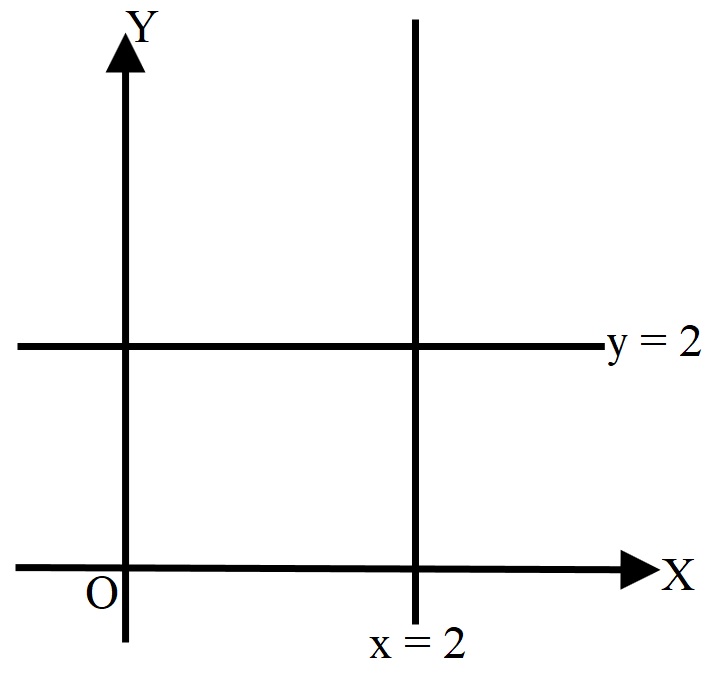
Assertion (A): The graph of $\text{x}\leq2$ and $\text{y}\geq2$ will be situated in the first and second quadrants.

Reason (R):

  1. Both A and R are true and R is the correct explanation of A
  2. Both A and R are true but R is NOT the correct explanation of A
  3. A is true but R is false.
  4. A is false but R is true.
Assertion (A) : The absolute maximum and minimum values of $f(x)=x^2 \sqrt{1+x}$ in $\left[-1, \frac{1}{2}\right]$ are $\frac{\sqrt{6}}{8}$ and 0 respectively.
Reason (R) : Let $f$ be a differentiable function on $I$ and $x_0$ be any interior point of $I$. If $f$ attains its absolute maximum or minimum value at $x_0$, then $f^{\prime}\left(x_0\right)=0$.
Directions: In the following questions, the Assertions (A) and Reason(s) (R) have been put forward. Read both the statements carefully and choose the correct alternative from the following:
Assertion: Maximum value of z = 11x + 7y, subjectto constraints $2\text{x}+\text{y}\leq6,\text{x}\leq2,\text{x}\geq0,\text{y}\geq0$ will be obtained at (0, 6).
Reason: In a bounded feasible region, it always exist a maximum and minimum value.
  1. A is true, R is true: R is a correct explanation for A.
  2. A is true,R is true; R is not a correct explanation for A.
  3. A is true: R is false.
  4. A is false: R is true.
Directions: In the following questions, the Assertions (A) and Reason(s) (R) have been put forward. Read both the statements carefully and choose the correct alternative from the following:
Assertion: If $\vec{\text{a}}=2\hat{\text{i}}+3\hat{\text{j}}-\hat{\text{k}},\vec{\text{a}}=-\hat{\text{i}}+3\hat{\text{j}}-4\hat{\text{k}}$ then projection of on .
Reason: Projection of $\vec{\text{a}}$ on $\vec{\text{b}}=\frac{3}{\sqrt{26}}$
  1. Assertion and Reason both are correct statements and Reason is the correct explanation of Assertion.
  2. Assertion and Reason both are correct statements but Reason is not the correct explanation of Assertion.
  3. Assertion is correct statement but Reason is wrong statement.
  4. Assertion is wrong statement but Reason is correct statement.
Directions: In these questions, a statement of Assertion is followed by a statement of Reason is given.Choose the correct answer out of the following choices:
Assertion: The adjacent sides of a parallelogramarealong $\overline{\text{a}}=\hat{\text{i}}+2\hat{\text{j}}$ and $\overline{\text{b}}=2\hat{\text{i}}+\hat{\text{j}}$ The angle between the diagonals is $150^\circ$.
Reason: Two vectors are perpendicular to each other if their dot product is zero.
  1. Assertion and Reason both are correct statements and Reason is the correct explanation of Assertion.
  2. Assertion and Reason both are correct statements but Reason is not the correct explanation of Assertion.
  3. Assertion is correct statement but Reason is wrong statement.
  4. Assertion is wrong statement but Reason is correct statement.
Assertion (A) : The point $A(1,0,7)$ is the mirror image of the point $B(1,6,3)$ in the line $\frac{x}{1}=\frac{y-1}{2}=\frac{z-2}{3}$.
Reason (R) : The line : $\frac{x}{1}=\frac{y-1}{2}=\frac{z-2}{3}$ bisects the line segment joining $A(1,0,7)$ and $B(1,6,3)$.