MCQ
Let $\overrightarrow{\mathrm{a}}$ and $\overrightarrow{\mathrm{b}}$ be two vectors such that $|2 \vec{a}+3 \vec{b}|=|3 \vec{a}+\vec{b}|$ and the angle between $\vec{a}$ and $\vec{b}$ is $60^{\circ}$. If $\frac{1}{8} \vec{a}$ is a unit vector, then $|\vec{b}|$ is equal to :
  • A
    $4$
  • B
    $6$
  • $5$
  • D
    $8$

Answer

Correct option: C.
$5$
c
$|3 \vec{a}+\vec{b}|^{2}=|2 \vec{a}+3 \vec{b}|^{2}$

$(3 \vec{a}+\vec{b}) \cdot(3 \vec{a}+\vec{b})=(2 \vec{a}+3 \vec{b}) \cdot(2 \vec{a}+3 \vec{b})$

$9 \vec{a} \cdot \vec{a}+6 \vec{a} \cdot \vec{b}+\vec{b} \cdot \vec{b}=4 \vec{a} \cdot \vec{a}+12 \vec{a} \cdot \vec{b}+9 \cdot \vec{b} \cdot \vec{b}$

$5|\vec{a}|^{2}-6 \vec{a} \cdot \vec{b}=8|\vec{b}|^{2}$

$5(8)^{2}-6.8 .|\vec{b}| \cos 60^{\circ}=8|\vec{b}|^{2}$ $[\frac{1}{8}|\vec{a}|=1\Rightarrow|\vec{a}|=8]$

$40-3|\overrightarrow{\mathrm{b}}|=|\overrightarrow{\mathrm{b}}|^{2}$

$\Rightarrow|\overrightarrow{\mathrm{b}}|^{2}+3|\overrightarrow{\mathrm{b}}|-40=0$

$|\overrightarrow{\mathrm{b}}|=-8, \quad|\overrightarrow{\mathrm{b}}|=5$

$\quad$(rejected)
Need a full question paper?

Generate a complete, print-ready paper with questions like this in minutes — across 16+ boards, with answer keys.

Start Generating Free

Similar questions

 Let $ f: R \rightarrow R \text { and } g: R \rightarrow R \text { be respectively given by } f(x)=|x|+1 \text { and } g(x)=x^2+1 \text {. Define } h: R \rightarrow R \text { by }$

$h(x)=\left\{\begin{array}{lll}\max & \{f(x), g(x)\} & \text { if } x \leq 0, \\ \min & \{f(x), g(x)\} & \text { if } x > 0 .\end{array}\right.$ The number of points at which $h(x)$ is not differentiable is

If $A = \left[ {\begin{array}{*{20}{c}}
1&{\sin \,\theta }&1\\
{ - \,\sin \,\theta }&1&{\sin \,\theta }\\
{ - 1}&{ - \,\sin \,\theta }&1
\end{array}} \right];$ then for all $\theta \, \in \,\left( {\frac{{3\pi }}{4},\frac{{5\pi }}{4}} \right),$ det $(A)$ lies in the interval
The value of the definite integral $\int\limits_0^{\frac{1}{{\sqrt 2 }}} {\frac{{{x^2}dx}}{{\sqrt {1 - {x^2}} \,(1 + \sqrt {1 - {x^2}} )}}} $ is
The value of $\sum\limits_{n = 1}^\infty  {\left( {{{\tan }^{ - 1}}\left( {\frac{n}{{n + 2}}} \right)\, - \,{{\tan }^{ - 1}}\left( {\frac{{n - 1}}{{n + 1}}} \right)} \right)} $ is equal to-
Which of the following expressions are meaningful
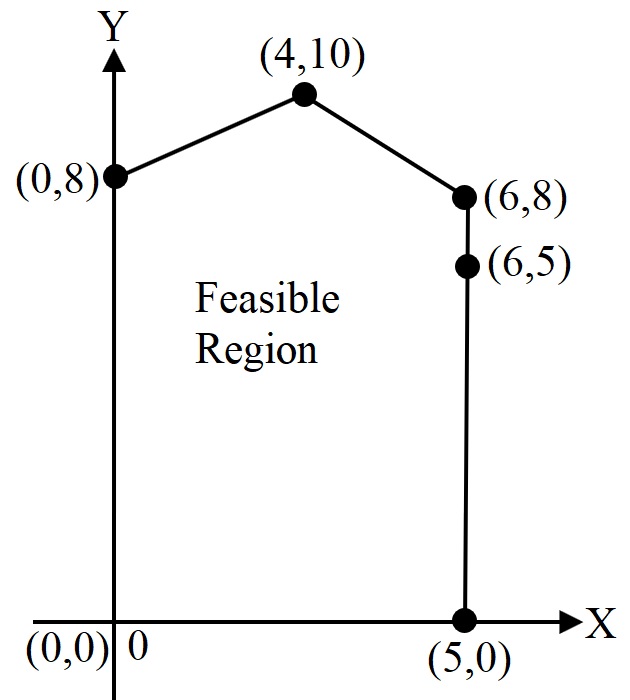
The feasible region for a LPP is shown shaded in the figure. Let Z = 3x - 4y be the objective function. Minimum of Z occurs at.

  1. (0, 0)
  2. (0, 8)
  3. (5, 0)
  4. (4, 10)
Let the curve $y = y ( x )$ be the solution of the differential equation, $\frac{ dy }{ dx }=2( x +1) .$ If the numerical value of area bounded by the curve $y = y ( x )$ and $x-$ axis is $\frac{4 \sqrt{8}}{3},$ then the value of $y (1)$ is equal to
Let $\alpha$ be the area of the larger region bounded by the curve $y ^2=8 x$ and the lines $y = x$ and $x =2$, which lies in the first quadrant. Then the value of $3 \alpha$ is equal to $..............$.
Let $a_1=1, a_2, a_3, a_4, \ldots$. be consecutive natural numbers. Then $\tan ^{-1}\left(\frac{1}{1+ a _1 a _2}\right)+\tan ^{-1}\left(\frac{1}{1+ a _2 a _3}\right)$ $+\ldots . .+\tan ^{-1}\left(\frac{1}{1+ a _{2021} a _{2022}}\right)$ is equal to
Let $f:[0,1] \rightarrow[0,1]$ be the function defined by $f(x)=\frac{x^5}{3}-x^2+\frac{5}{9} x+\frac{17}{36}$. Consider the square region $S=[0,1] \times[0,1]$. Let $G=\{(x, y) \in S: y>f(x)\}$ be called the green region and $R=\{(x, y) \in S$ : $\mathrm{y}<\mathrm{f}(\mathrm{x})\}$ be called the red region. Let $\mathrm{L}_{\mathrm{h}}=\{(\mathrm{x}, \mathrm{h}) \in \mathrm{S}: \mathrm{x} \in[0,1]\}$ be the horizontal line drawn at a height $\mathrm{h} \in[0,1]$. Then which of the following statements is(are) ture?

($A$) There exists an $\mathrm{h} \in\left[\frac{1}{4}, \frac{2}{3}\right]$ such that the area of the green region above the line $\mathrm{L}_{\mathrm{h}}$ equals the area of the green region below the line $\mathrm{L}_{\mathrm{h}}$

($B$) There exists an $\mathrm{h} \in\left[\frac{1}{4}, \frac{2}{3}\right]$ such that the area of the red region above the line $\mathrm{L}_{\mathrm{h}}$ equals the area of the red region below the line $\mathrm{L}_h$

($C$) There exists an $\mathrm{h} \in\left[\frac{1}{4}, \frac{2}{3}\right]$ such that the area of the green region above the line $\mathrm{L}_{\mathrm{h}}$ equals the area of the red region below the line $L_h$

($D$) There exists an $\mathrm{h} \in\left[\frac{1}{4}, \frac{2}{3}\right]$ such that the area of the red region above the line $\mathrm{L}_{\mathrm{h}}$ equals the area of the green region below the line $\mathrm{L}_{\mathrm{h}}$