MCQ
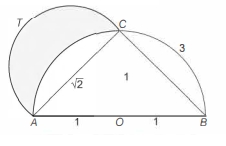
Let $A B$ be a line segment of length $2$ . Construct a semicircle $S$ with $A B$ as diameter. Let $C$ be the mid-point of the $\operatorname{arc} A B$. Construct another semicircle $T$ external to the $\triangle A B C$ with chord $A C$ as diameter. The area of the region inside the semi-circle $T$ but outside $S$ is
  • A
    $\frac{\pi}{2}$
  • $\frac{1}{2}$
  • C
    $\frac{\pi}{\sqrt{2}}$
  • D
    $\frac{1}{\sqrt{2}}$

Answer

Correct option: B.
$\frac{1}{2}$
b
(b)

Given,

$A B$ is diameter of circle $S$ and $C$ is the mid-point of arc length of $A B$.

$A C$ is diameter of circle $T$

$A B=2$

$O A=O B=O C=1$

Area of shaded region

$=$ Area of semi-circle $T+$ Area of

$\triangle O A C-$ Area of quadrant of circle $S$

$=\frac{\pi}{2}\left(\frac{\sqrt{2}}{2}\right)^2+\frac{1}{2} \times 1 \times 1-\frac{\pi}{4} \times(1)^2$

$=\frac{\pi}{4}+\frac{1}{2}-\frac{\pi}{4}=\frac{1}{2}$

Need a full question paper?

Generate a complete, print-ready paper with questions like this in minutes — across 16+ boards, with answer keys.

Start Generating Free

Similar questions

If the coefficients of ${T_r},\,{T_{r + 1}},\,{T_{r + 2}}$ terms of ${(1 + x)^{14}}$ are in $A.P.$, then $r =$
If the lengths of the sides of a triangle are decided by the three throws of a single fair die, then the probability that the triangle is of maximum area given that it is an isosceles triangle, is
Let $C$ be the centre of the circle $x^{2}+y^{2}-x+2 y=$ $\frac{11}{4}$ and $P$ be a point on the circle. A line passes through the point $C$, makes an angle of $\frac{\pi}{4}$ with the line $C P$ and intersects the circle at the points $Q$ and $R$. Then the area of the triangle $P Q R$ (in unit ${ }^{2}$ ) is.
In the expansion of ${(1 + x + {x^3} + {x^4})^{10}},$ the coefficient of ${x^4}$ is
Choose the correct answer. Let $S_n$ denote the sum of the cubes of the first n natural numbers and $s_n$​​​​​​​ denote the sum of the first n natural numbers. Then $\sum\limits^\text{n}_{\text{r}=1}\frac{\text{S}_\text{r}}{\text{S}_\text{r}}$ equals to:
The eccentricity of the hyperbola $\frac{{\sqrt {1999} }}{3}({x^2} - {y^2}) = 1$ is
Let $A(2, 3)$, $B(4, 5)$ and let $C$ = $(x, y)$ be a point such that $(x -2)(x -4) + (y -3)(y -5) = 0$. If area of .$\Delta ABC = \sqrt 2 $ sq. unit, then maximum number of positions of $C$ in the $xy$ plane is 
A point $\mathrm{z}$ moves in the complex plane such that $\arg \left(\frac{\mathrm{z}-2}{\mathrm{z}+2}\right)=\frac{\pi}{4}$, then the minimum value of $|z-9 \sqrt{2}-2 i|^{2}$ is equal to ..... .
${ }^{(2 n+1)} C_0-{ }^{(2 n+1)} C_1+{ }^{(2 n+1)} C_2-\ldots . . .^{2 n+1} C_{2 n}=$
The co-ordinates of the foot of perpendicular from the point $(2, 3)$ on the line $x + y - 11 = 0$are