- A$\frac{\pi}{6}$
- B$\frac{\pi}{4}$
- C$\frac{\pi}{3}$
- ✓$\frac{\pi}{2}$
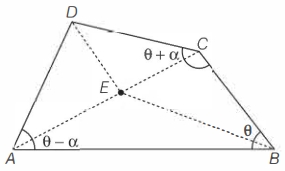
Since, $\angle D A B, \angle A B C$ and $\angle B C D$ are in $AP \therefore$ Let $\angle D A B=\theta-\alpha, \angle A B C=\theta$ and $\angle B C D=\theta+\alpha$
$\therefore$ Median of $\angle D A B, \angle A B C$ and $\angle B C D=\theta$
From point $E$ all the vertices are at equal distance.
$\therefore A B C D$ is cyclic.
and $\angle A D C=2 \pi-(\theta-\alpha+\theta+\theta+\alpha)$
$\quad=2 \pi-3 \theta$
and $\angle A D C+\angle A B C=\pi$
$\Rightarrow 2 \pi-3 \theta+\theta=\pi$
$\therefore \quad \theta=\frac{\pi}{2}$
Generate a complete, print-ready paper with questions like this in minutes — across 16+ boards, with answer keys.
$\lim _{t \rightarrow x} \frac{f(x) \sin t-f(t) \sin x}{t-x}=\sin ^2 x \text { for all } x \in(0, \pi)$
If $f \left(\frac{\pi}{6}\right)=-\frac{\pi}{12}$, then which of the following statement(s) is (are) TRUE?
$(A)$ $f \left(\frac{\pi}{4}\right)=\frac{\pi}{4 \sqrt{2}}$
$(B)$ $f(x)<\frac{x^4}{6}-x^2$ for all $x \in(0, \pi)$
$(C)$ There exists $\alpha \in(0, \pi)$ such that $f ^{\prime}(\alpha)=0$
$(D)$ $f ^{\prime \prime}\left(\frac{\pi}{2}\right)+ f \left(\frac{\pi}{2}\right)=0$