MCQ
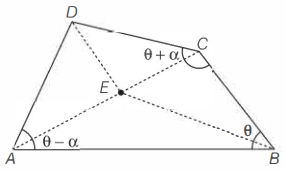
Let $A B C D$ be a quadrilateral such that there exists a point $E$ inside the quadrilateral satisfying $A E=B E=C E=D E$. Suppose $\angle D A B, \angle A B C, \angle B C D$ is an arithmetic progression. Then the median of the set $\{\angle D A B, \angle A B C, \angle B C D\}$ is
  • A
    $\frac{\pi}{6}$
  • B
    $\frac{\pi}{4}$
  • C
    $\frac{\pi}{3}$
  • $\frac{\pi}{2}$

Answer

Correct option: D.
$\frac{\pi}{2}$
d
(d)

Since, $\angle D A B, \angle A B C$ and $\angle B C D$ are in $AP \therefore$ Let $\angle D A B=\theta-\alpha, \angle A B C=\theta$ and $\angle B C D=\theta+\alpha$

$\therefore$ Median of $\angle D A B, \angle A B C$ and $\angle B C D=\theta$

From point $E$ all the vertices are at equal distance.

$\therefore A B C D$ is cyclic.

and $\angle A D C=2 \pi-(\theta-\alpha+\theta+\theta+\alpha)$

$\quad=2 \pi-3 \theta$

and $\angle A D C+\angle A B C=\pi$

$\Rightarrow 2 \pi-3 \theta+\theta=\pi$

$\therefore \quad \theta=\frac{\pi}{2}$

Need a full question paper?

Generate a complete, print-ready paper with questions like this in minutes — across 16+ boards, with answer keys.

Start Generating Free