MCQ
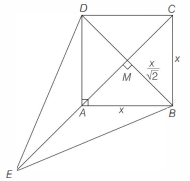
Let $A B C D$ be a square and $E$ be a point outside $A B C D$ such that $E, A, C$ are collinear in that order. Suppose $E B=E D=\sqrt{130}$ and the areas to $\triangle E A B$ and square $A B C D$ are equal. Then, the area of square $A B C D$ is
  • A
    $8$
  • $10$
  • C
    $\sqrt{120}$
  • D
    $\sqrt{125}$

Answer

Correct option: B.
$10$
b
(b)

Given, area of $\triangle E A B=$ area of square $A B C D$

$E B=E D=\sqrt{130}$

Let side of square $=x$

$B M=\frac{x}{\sqrt{2}}=A M$

Area of $\triangle A E B=$ Area of $\triangle B E M$ - area of

$=\frac{1}{2} E M \times B M-\frac{1}{2} A M \times B M$

$=\frac{1}{2} B M(E M-A M)$

$=\frac{1}{2} \frac{x}{\sqrt{2}}\left(\sqrt{\left.130-\frac{x^2}{2}-\frac{x}{\sqrt{2}}\right)}\right.$

$=\frac{1}{2}+\frac{x}{\sqrt{2}}\left(\sqrt{\left.130-\frac{x^2}{2}-\frac{x}{\sqrt{2}}\right)=x^2}\right.$

$=\sqrt{130-\frac{x^2}{2}}=2 \sqrt{2} x+\frac{x}{\sqrt{2}}$

$130-\frac{x^2}{2}=\left(\begin{array}{c}5 x \\ \sqrt{2}\end{array}\right)^2$

$130-\frac{x^2}{2}=\begin{array}{c}25 x^2 \\ 2\end{array}$

$13 x^2=130 \Rightarrow x^2=10$

$\therefore$ Area of square $=10$
Need a full question paper?

Generate a complete, print-ready paper with questions like this in minutes — across 16+ boards, with answer keys.

Start Generating Free

Similar questions

Let $S_{k}=\sum_{r=1}^{k} \tan ^{-1}\left(\frac{6^{r}}{2^{2 r+1}+3^{2 r+1}}\right) .$ Then $\lim _{k \rightarrow \infty} S_{k}$ is equal to
If $\overrightarrow{ a } \cdot \overrightarrow{ b }=1, \overrightarrow{ b } \cdot \overrightarrow{ c }=2$ and $\overrightarrow{ c } \cdot \overrightarrow{ a }=3$, then the value of $[\vec{a} \times(\vec{b} \times \vec{c}), \vec{b} \times(\vec{c} \times \vec{a}), \vec{c} \times(\vec{b} \times \vec{a})]$ is
If $I = \int {\frac{{{{\sin }^2}\,x\, - \,1}}{{2x{{\sin }^2}x + \,\sin 2x}}dx} $ , then. . . . .         $(sinx \neq  0)$ 

(where $c$ is positive constant of integration)

If $x \in [0, 1]$, then the number of solution $(s)$ of the equation $2[cos^{-1}x] + 6[sgn(sinx)] = 3$ is (where $[.]$ denotes greatest integer function and sgn $(x)$ denotes signum function of $x$)-
The line, that is coplanar to the line $\frac{x+3}{-3}=\frac{y-1}{1}=\frac{z-5}{5}$, is
If function $f(x) = \left\{ \begin{array}{l}\frac{{{x^2} - 1}}{{x - 1}},\,\,{\rm{when}}\,\,x \ne 1\\\,\,\,\,\,\,\,\,\,\,\,\,k,\,{\rm{when}}\,\,x = 1\end{array} \right.$ is continuous at $x = 1$, then the value of $k$ will be
If from each of the three boxes containing $3$ white and $1$ black, $2$ white and $2$ black, $1$ white and $3$ black balls, one ball is drawn at random, then the probability that $2$ white and $1$ black ball will be drawn is
A spherical balloon is being inflated at the rate of $35\,cc/min$. The rate of increase in the surface area (in $cm^2/min.$) of the balloon when its diameter is $14\, cm$, is
If $\int \limits_0^\pi \frac{5^{\cos x}\left(1+\cos x \cos 3 x+\cos ^2 x+\cos ^3 x \cos 3 x\right) d x}{1+5^{\cos x}}=\frac{k \pi}{16}$, then $k$ is equal to $...........$.
A point moves in such a way that its distance from $(1,-2)$ is always the twice from $(-3,5)$, the locus of the point is