MCQ
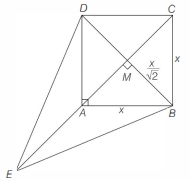
Let $A B C D$ be a square and $E$ be a point outside $A B C D$ such that $E, A, C$ are collinear in that order. Suppose $E B=E D=\sqrt{130}$ and the areas to $\triangle E A B$ and square $A B C D$ are equal. Then, the area of square $A B C D$ is
  • A
    $8$
  • $10$
  • C
    $\sqrt{120}$
  • D
    $\sqrt{125}$

Answer

Correct option: B.
$10$
b
(b)

Given, area of $\triangle E A B=$ area of square $A B C D$

$E B=E D=\sqrt{130}$

Let side of square $=x$

$B M=\frac{x}{\sqrt{2}}=A M$

Area of $\triangle A E B=$ Area of $\triangle B E M$ - area of

$=\frac{1}{2} E M \times B M-\frac{1}{2} A M \times B M$

$=\frac{1}{2} B M(E M-A M)$

$=\frac{1}{2} \frac{x}{\sqrt{2}}\left(\sqrt{\left.130-\frac{x^2}{2}-\frac{x}{\sqrt{2}}\right)}\right.$

$=\frac{1}{2}+\frac{x}{\sqrt{2}}\left(\sqrt{\left.130-\frac{x^2}{2}-\frac{x}{\sqrt{2}}\right)=x^2}\right.$

$=\sqrt{130-\frac{x^2}{2}}=2 \sqrt{2} x+\frac{x}{\sqrt{2}}$

$130-\frac{x^2}{2}=\left(\begin{array}{c}5 x \\ \sqrt{2}\end{array}\right)^2$

$130-\frac{x^2}{2}=\begin{array}{c}25 x^2 \\ 2\end{array}$

$13 x^2=130 \Rightarrow x^2=10$

$\therefore$ Area of square $=10$
Need a full question paper?

Generate a complete, print-ready paper with questions like this in minutes — across 16+ boards, with answer keys.

Start Generating Free

Similar questions

If the complex number $\text{z}=\text{x}+\text{iy}$ satisfies the condition $|\text{z}+1|=1,$ then $z$ lies on:
Seven different lecturers are to deliver lectures in seven periods of a class on a particular day. $A B,$ and $C$ are three of the lecturers.The umber of ways in which a routine for the day can be made such that $A$ delivers his lecture before $B$ and $B$ before $C,$ is:
If the mean deviation about the mean of the numbers $1,2,3, \ldots ., n$, where $n$ is odd, is $\frac{5(n+1)}{n}$, then $n$ is equal to
Angle between the lines $2x - y - 15 = 0$ and $3x + y + 4 = 0$ is .....$^o$
If the line, $2 x-y+3=0$ is at a distance $\frac{1}{\sqrt{5}}$ and $\frac{2}{\sqrt{5}}$ from the lines $4 x-2 y+\alpha=0$ and $6 x-3 y+\beta=0,$ respectively, then the sum of all possible values of $\alpha$ and $\beta$ is
Let a circle $C_1 \equiv  x^2 + y^2 - 4x + 6y + 1 = 0$ and circle $C_2$ is such that it's centre is image of centre of $C_1$ about $x-$axis and radius of $C_2$ is equal to radius of $C_1$, then area of $C_1$ which is not common with $C_2$ is -
If the sum of $n$ terms of a $G.P.$ is $255$ and ${n^{th}}$ terms is $128$ and common ratio is $2$, then first term will be
If $A$ and $B$ are any two sets, then $A \cap (A \cup B)$ is equal to
Range of the function $f (x) =$ $\left[ {\frac{1}{{\ln ({x^2} + e)}}} \right]\,\, + \,\,\frac{1}{{\sqrt {1 + {x^2}} }}\,$  is , where $[*]$ denotes the greatest integer function and $e =$ $\mathop {Limit}\limits_{\alpha  \to 0} {(1 + \alpha )^{1/\alpha }}\,$
The real value of $\alpha$ for which the expression $\frac{1-\text{i}\sin\alpha}{1+2\text{i}\sin\alpha}$ is purely real is: