Question
Let $A$ be a $3\ 3$ matrix of non $-$ negative real elements such that $A \left[\begin{array}{l}1 \\ 1 \\ 1\end{array}\right]=3\left[\begin{array}{l}1 \\ 1 \\ 1\end{array}\right]$. Then the maximum value of det $(A)$ is $...........$

Answer

Let $A=\left[\begin{array}{lll}a_1 & a_2 & a_3 \\ b_1 & b_2 & b_3 \\ c_1 & c_2 & c_3\end{array}\right]$
$A\left[\begin{array}{l}1 \\ 1 \\ 1\end{array}\right]=3\left[\begin{array}{l}1 \\ 1 \\ 1\end{array}\right]$
$ \Rightarrow a_1+a_2+a_3=3$
$\Rightarrow b_1+b_2+b_3=3$
$\Rightarrow c_1+c a_2+c_3=3 $
Now,
$ |A|=\left(a_1 b_2 c_3+a_2 b_3 c_1+a_3 b_1 c_2\right)$
$-\left(a_3 b_2 c_1+a_2 b_1 c_3+a_1 b_3 c_2\right) $
$\therefore$ From above in formation, clearly $| A |_{\max }=27,$
when $a_1=3, b_2=3, c_3=3$

Need a full question paper?

Generate a complete, print-ready paper with questions like this in minutes — across 16+ boards, with answer keys.
Start Generating Free

Similar questions

Let $n$ be a positive integer. Let  $A =\sum_{ k =0}^{ n }(-1)^{ k } n _{ C _{ k }}\left[\left(\frac{1}{2}\right)^{ k }+\left(\frac{3}{4}\right)^{ k }+\left(\frac{7}{8}\right)^{ k }+\left(\frac{15}{16}\right)^{ k }+\left(\frac{31}{32}\right)^{ k }\right]$ . If $63 A =1-\frac{1}{2^{30}},$ then $n$ is equal to ...... .
In a moderately asymmetrical distribution the mode and mean are $7$ and $4$ respectively. The median is
If $f\left( x \right) = \int\limits_x^{{x^2}} {\left( {t - 1} \right)\,dt\,\,,\,\,1 \le x \le 3,} $ then global maximum value of $f(x)$ is
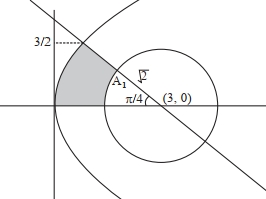
If the area bounded by the curve $2 y^2=3 x$, lines $x+y=3, y=0$ and outside the circle $(x-3)^2+y^2=2$ is $A$, then $4(\pi+4 A )$ is equal to $.........$.
If $\frac{d x}{d y}=\frac{1+x-y^2}{y}, x(1)=1$, then $5 x(2)$ is equal to :
A population  $p(t) $ of $ 1000 $ bacteria introduced into nutrient medium grows according to the relation $p(t) = 1000 + {{1000t} \over {100 + {t^2}}}$. The maximum size of this bacterial population is
The number of $5 -$tuples $(a, b, c, d, e)$ of positive integers such that

$I.$ $a, b, c, d, e$ are the measures of angles of a convex pentagon in degrees

$II$. $a \leq b \leq c \leq d \leq e$

$III.$ $a, b, c, d, e$ are in arithmetic progression is

The value of the integral $\int_{0}^{\pi}|\sin 2 x| dx$ is
$\frac{2^{3}-1^{3}}{1 \times 7}+\frac{4^{3}-3^{3}+2^{3}-1^{3}}{2 \times 11}+$$\frac{6^{3}-5^{3}+4^{3}-3^{3}+2^{3}-1^{3}}{3 \times 15}+\ldots .+$ $\frac{30^{3}-29^{3}+28^{3}-27^{3}+\ldots+2^{3}-1^{3}}{15 \times 63}$is equal to.
If $A$=$\left[ {\begin{array}{*{20}{c}}2&0&0\\0&2&0\\0&0&2\end{array}} \right]$ and $B = \left[ {\begin{array}{*{20}{c}}1&2&3\\0&1&3\\0&0&2\end{array}} \right],$ then $|AB|$ is equal to